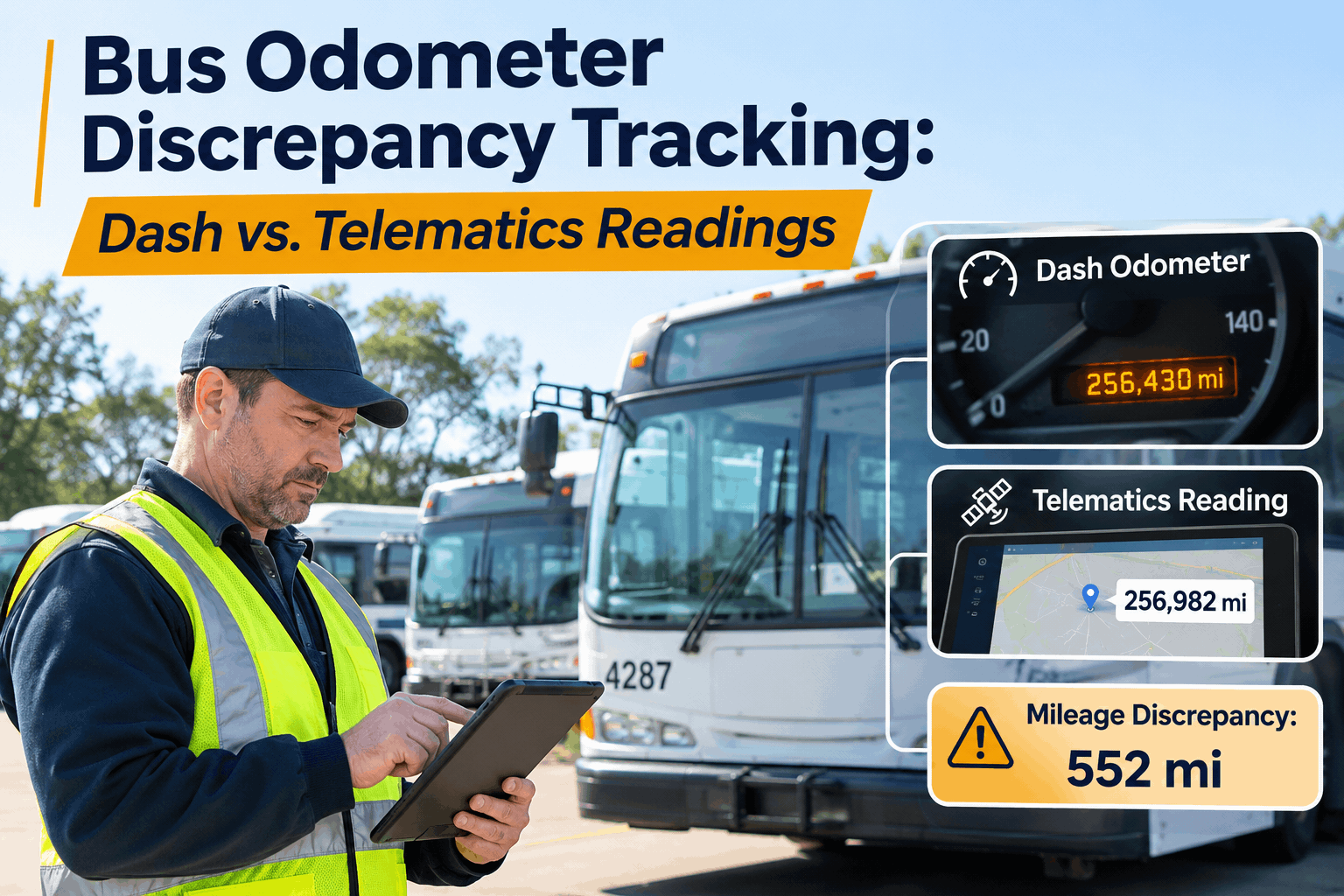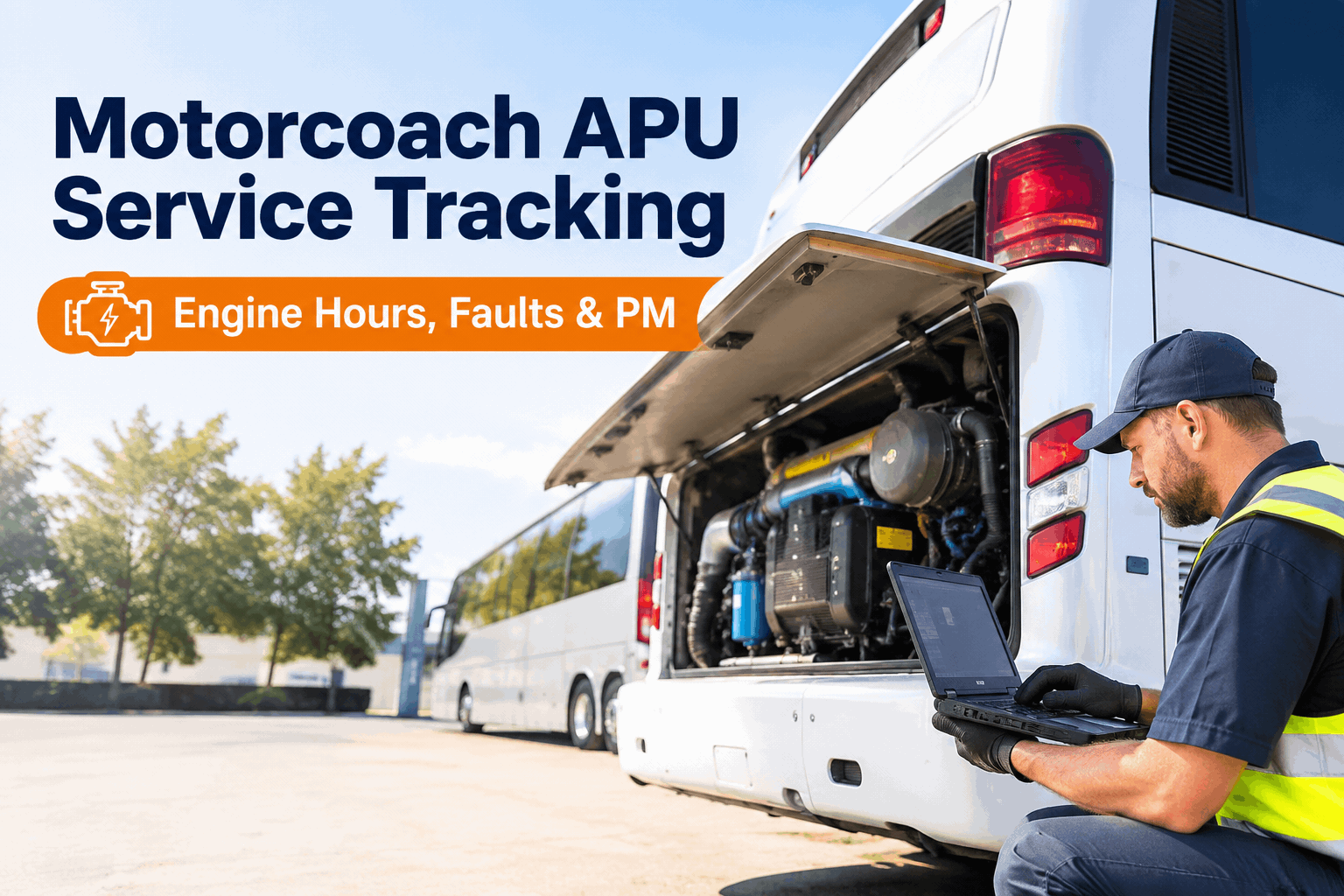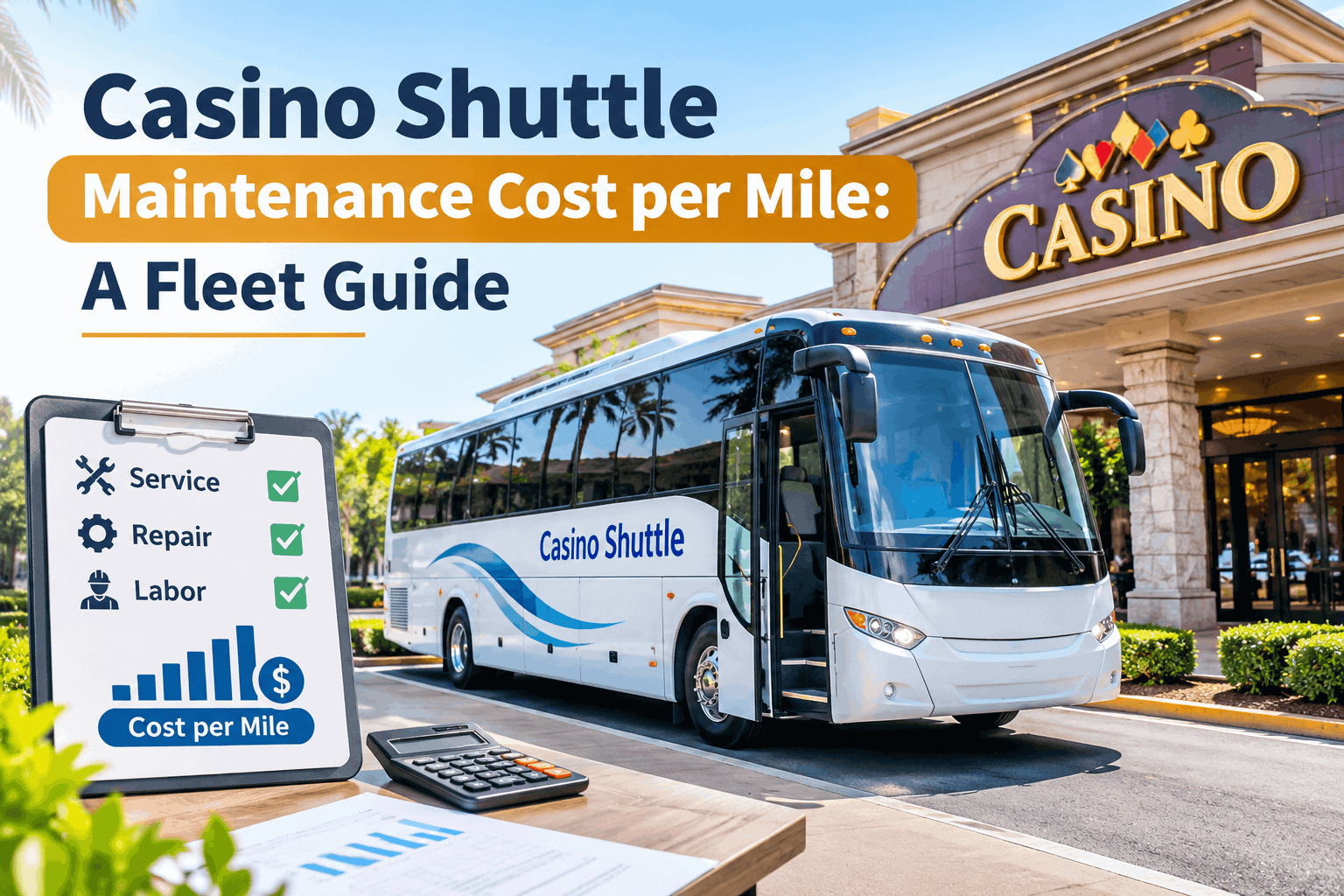
Your casino shuttles never really stop — airport runs, hotel loops and late-night casino circuits, often around the clock. When the GM asks what it actually costs to keep a shuttle on the road, "a lot" is not an answer a budget meeting accepts. Knowing your casino shuttle maintenance cost per mile turns that into a number you can defend. You can see how per-vehicle repair and labor costs roll up into cost per mile in a demo.
Casino Shuttle Maintenance Cost per Mile: A Fleet Guide
High-use casino shuttles rack up miles and repairs around the clock. Here is how to calculate maintenance cost per mile, what belongs in the number, and how to find the vehicle quietly draining your budget.
Why Casino Shuttles Cost More to Maintain per Mile
A casino shuttle is not a once-a-day airport run. It is a near-continuous operation, and that duty cycle shows up directly in the maintenance line. Three things push a casino shuttle's cost per mile above a lighter-use bus.
Around-the-clock hours
Running close to 24/7 means components age in months, not years, and service intervals come up far faster than a nine-to-five fleet.
Stop-and-go loops
Short hotel and terminal loops mean constant braking, idling and door cycles — hard on brakes, doors and the drivetrain, and it adds up per mile.
Downtime is a guest problem
A shuttle out of service strands guests and reflects on the property. The pressure to keep running can defer maintenance — which raises cost per mile later.
High-use cost per mile is not a mystery — it is knowable per vehicle, and once you can see it, you can manage it.
What Belongs in Your Maintenance Cost per Mile
The most common mistake is scoping the top of the fraction too narrowly. A cost per mile built on parts invoices alone understates the real number badly — and makes every vehicle look cheaper than it is. Include all four.
Parts & components
Everything you buy to fix the shuttle — brakes, filters, belts, door and lift parts, tires.
Shop labor
Technician hours at your real burdened labor rate — usually the biggest slice, and the one most often left out.
Outside repairs
Work sent to a vendor — transmission shops, body work, towing. Real money that parts invoices miss.
PM & inspections
Scheduled preventive maintenance and inspection costs — part of keeping the shuttle on the road, so part of the number.
Leave out labor and outside work and your cost per mile is fiction — a number that feels good and hides the real spend. This is the same per-vehicle maintenance picture behind airport and shuttle fleet operations.
Find the Shuttle Draining Your Budget
The real power of cost per mile is comparison. Calculate it per vehicle, line them up, and the outlier announces itself — the shuttle running well above the fleet average is where your budget is quietly going, and where a decision is waiting.
Shuttle 7 is not unlucky — its cost per mile is telling you something: an aging drivetrain, a recurring fault, or a vehicle near the point where replacement beats repair. A common industry rule of thumb is to look hard at a unit once its cost per mile climbs well above the fleet average for its class. You can book a demo to see the outlier flagged automatically, or sign up free and see each shuttle's cost per mile side by side.
Your Casino Shuttle Cost-Tracking Checklist
Run this against how you track shuttle costs today. Each item is a gap that makes your cost per mile wrong or invisible — and each is something a bus-built system turns into a tracked, per-vehicle number you can budget from.
- Every cost tied to a specific shuttleParts, labor and outside repairs tracked per vehicle, not lumped fleet-wide.CRITICAL
- Labor hours captured at a real rateTechnician time counted at your burdened rate — the slice most often missed.CRITICAL
- Mileage current for every vehicleThe denominator — accurate, recent odometer readings per shuttle.TRACK
- Outside repairs folded inVendor and tow costs counted too, so the number is whole — not just in-shop.TRACK
- Cost per mile comparable across the fleetSame method for every shuttle, so the outlier is obvious at a glance.TRACK
- History kept to spot the trendA per-vehicle record so a climbing cost per mile shows up before budget season.TRACK
The two critical items — cost tied to the shuttle and labor captured honestly — are what make the number real; book a demo and we will set cost-per-mile tracking up around your shuttle fleet.
How BusCMMS Builds Cost per Mile From Your Records
Cost per mile is only as good as the records behind it — and capturing those records per vehicle is exactly what a purpose-built bus CMMS does, then does the math for you.
Per-vehicle cost capture
Work orders record parts, labor and outside repairs against the specific shuttle, so every dollar lands on the right vehicle.
Mileage-fed cost per mile
Odometer readings pair with cost totals to produce cost per mile per vehicle — and the same readings trigger PM, so the data does double duty.
Fleet comparison & history
See every shuttle's cost per mile side by side and over time, so the outlier and the climbing trend are both easy to catch.
One place where repair records become a budget you can defend. To set it up around your fleet, book a demo and bring last year's shuttle repair spend.
A Shuttle Fleet Manager's Take
Key Takeaways on Shuttle Cost per Mile
Casino shuttle maintenance cost per mile is a number you can calculate, compare and act on — once the records support it. Four things to carry into budget season.
Scope the numerator fully
Parts, labor, outside repairs and PM — leave one out and the number lies.
Calculate per vehicle
A fleet average hides the outlier; per-shuttle is where decisions live.
24/7 duty shows up here
High-use casino shuttles run up cost per mile faster — expect it, track it.
Watch the trend
A climbing cost per mile is the signal to repair harder, rebuild, or replace.
Put the full cost in the top, accurate miles on the bottom, calculate it per shuttle, and watch it over time — and your casino shuttle maintenance cost per mile stops being a guess and becomes the clearest budget tool you have. The fleet that knows its number is the fleet that controls it.