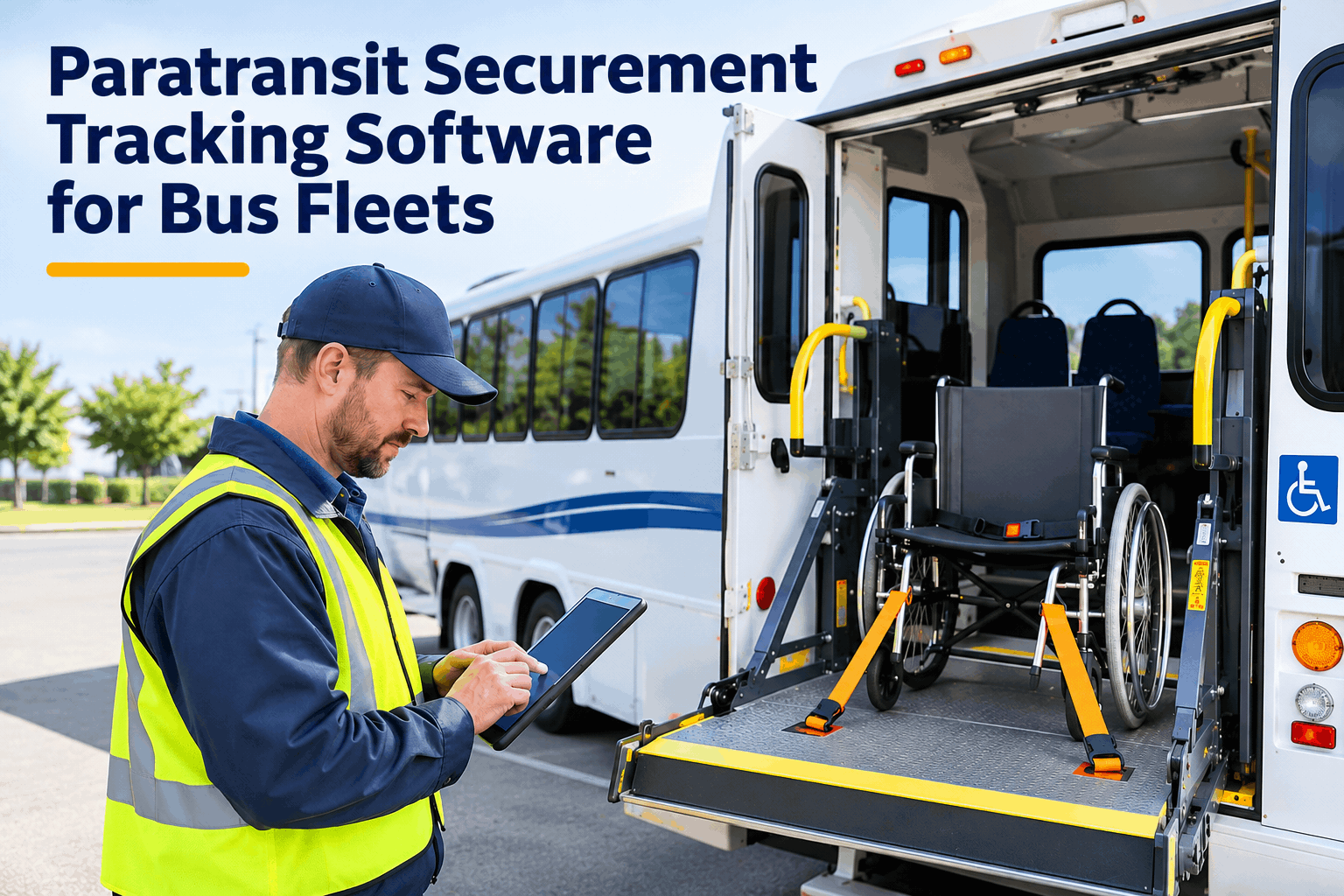
A dozen accessible buses, each carrying four retractors, floor anchors, a lap belt and a shoulder belt — that is dozens of safety-critical wear items across the yard. Which bus has the frayed strap, and when was it last checked? If the answer lives in a driver's memory or a paper binder, you do not really have paratransit securement tracking. You can see how every strap, anchor and retractor gets tracked by bus in a demo.
Track Securement Equipment Across Your Paratransit Fleet
Straps, anchors, retractors and occupant belts are safety-critical wear items — on every accessible bus you run. Here is how to track their condition, defects and replacements by vehicle instead of guessing.
Why Securement Equipment Is So Easy to Lose Track Of
Securement gear is the quiet part of an accessible fleet. Nobody thinks about it until a strap fails or an inspector asks for records — and by then the tracking gap is already a problem. Three things make this equipment slip through the cracks.
Lots of small parts
Four retractors, floor anchors, a lap belt and a shoulder belt per bus, times the whole fleet — dozens of individual wear items with no obvious owner.
Wear hides in plain sight
Webbing frays slowly and a retractor weakens gradually. Without a logged baseline, "looks fine" is the default right up until it is not.
Records live in people's heads
The driver who noticed the worn strap is off today. If the condition was never logged against the bus, that knowledge rode home with them.
Securement is a safety system riders depend on — it deserves the same tracked lifecycle as any other critical component, not a clipboard that disappears.
The Four Securement Components to Track on Every Bus
A securement system is four part groups working together, and each wears differently. Track all four per bus — a perfect strap on a bus with a failing retractor is still an unsafe system.
Tie-down straps & webbing
Track: fraying, cuts, UV fading, contamination.
Replace when: webbing is cut, frayed, burned or chemically contaminated — no field repair.
Floor anchors & track
Track: secure mounting, clean track, undamaged fittings.
Replace when: fittings are bent, cracked, or no longer lock positively into the track.
Retractors
Track: that webbing locks on a sharp pull and retracts cleanly.
Replace when: it will not lock or retract — removed from service, not repaired in the shop.
Occupant lap & shoulder belts
Track: buckle latches and releases, hardware not worn or cracked.
Replace when: the buckle fails to latch, or webbing or hardware shows damage.
Manufacturers are clear that worn securement components get removed and replaced, not patched — so tracking which part on which bus is near end-of-life is the whole game, and it belongs in the same system you use for paratransit and ADA equipment tracking. You can sign up free and record each component's condition against its bus instead of trusting a shared memory.
From New to Replaced: The Lifecycle You Should Be Logging
Every piece of securement gear moves through the same stages. Tracking means knowing which stage each part is in — so a replacement is planned, not discovered the morning a rider needs the bus.
In service
Installed and inspected, condition logged as a baseline against the bus. This is your known-good starting point.
Monitor
Early wear noted — light fraying, a stiff buckle. Flagged on that bus so it is watched, not forgotten until it fails.
Replace
Condition crosses the line — cut webbing, a retractor that will not lock. A replacement work order opens against the bus.
Logged & closed
New part installed, dated, recorded in the bus's history. The clock on the replacement starts, and the trail is complete.
That cycle, tracked per component per bus, is what turns securement from a surprise into a schedule. You can book a demo and watch a worn strap move from flagged to replaced to logged.
Your Fleet Securement Tracking Checklist
Run this against how you track securement today. Each item is a gap that leaves a safety-critical part unaccounted for — and each is something a bus-built system turns from a loose task into a tracked, per-vehicle record.
- Every component tied to a specific busStraps, anchors, retractors and belts logged by vehicle — not fleet-wide guesses.CRITICAL
- Inspections recorded, not just performedA dated condition entry each time — so a baseline exists to compare against later.CRITICAL
- Defects flagged with photosA frayed strap or failed buckle captured visually and tied to the bus and date.LOG IT
- Replacements become work ordersA worn part opens a tracked job so it is actually swapped, not noted and forgotten.LOG IT
- Replacement dates on recordWhen each part went in, so age and service life are visible across the fleet.LOG IT
- History pulls up per bus on demandA continuous securement record ready when an audit or a safety review asks.LOG IT
The two critical items — every component tied to a bus, every inspection recorded — are the foundation everything else sits on; book a demo and we will map your securement equipment into the system.
How BusCMMS Handles Paratransit Securement Tracking
Tracking safety-critical wear items by vehicle is exactly what a purpose-built bus CMMS does — capturing condition, turning defects into repairs, and keeping the record per bus so nothing rides on memory.
Component inspections by bus
Record each securement part's condition against its vehicle, with dated entries and photos — so the status of every strap and belt is known, not assumed.
Defect-to-replacement work orders
A flagged worn part becomes a tracked replacement job, so the swap happens and the fix is documented alongside the defect.
Per-bus securement history
Every inspection, defect and replacement stays with the vehicle — a continuous record ready for a safety review or an ADA equipment audit.
One place to see securement condition across the whole accessible fleet. To set it up around your buses, book a demo and bring your vehicle list.
A Maintenance Supervisor's Take
Key Takeaways on Securement Tracking
Strong paratransit securement tracking is about knowing the condition of every safety-critical part before it fails. Four things to carry back to the shop.
Track by bus, not by fleet
Each component tied to a specific vehicle — that is what makes a record usable.
All four component groups
Straps, anchors, retractors, belts — the system is only as safe as its weakest part.
Replace, don't repair
Worn securement parts get swapped, so tracking which is near end-of-life is key.
Keep the history
A dated per-bus record turns a safety review into a quick pull, not a two-day scramble.
Tie every strap, anchor, retractor and belt to its bus, log each inspection, open a work order when a part is worn, and keep the dated history — and securement stops being the thing nobody tracked and becomes a system you can prove is safe. For riders who depend on it, that is exactly how it should be.