Your school district adds twelve new Type C propane autogas buses to eliminate sub-zero morning no-starts and tailpipe soot, and six months later a technician runs a standard diesel PM sheet—skipping the coalescing fuel-lock filter drain and dielectric coil-boot check until two buses misfire on a morning hill climb. Building a dedicated propane school bus maintenance schedule separates autogas filtration, high-energy ignition, and lock-off solenoid checks from diesel routines on one shop board. You can see how fuel-type-specific PM templates run side by side in a live demo.
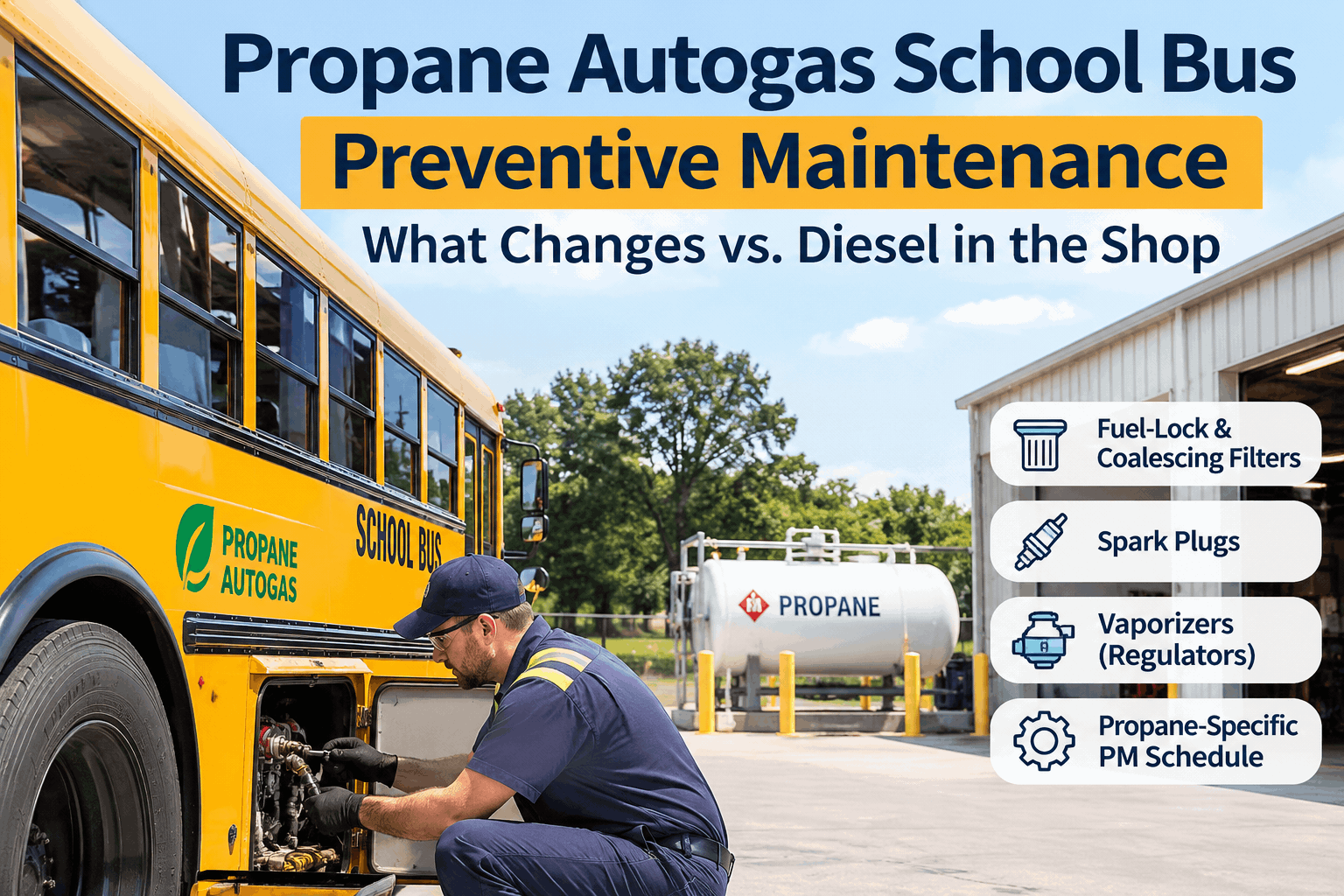
Propane Autogas School Bus Preventive Maintenance: What Changes vs. Diesel in the Shop
No DEF tank, no DPF regens, and instant -40°F starts—but propane school buses introduce coalescing fuel-lock filters, high-voltage ignition boots, and pressure relief valves that diesel checklists miss. Here is what your shop needs to track.
- DPF soot monitoring & stationary regens
- DEF dosing valves, quality sensors & heaters
- Winter block heaters & anti-gel fuel additives
- Coalescing fuel-lock filter & heavy-ends drain
- Iridium spark plugs & dielectric coil-boot checks
- Lock-off solenoid & electronic gas-sniffer sweep
Why Mixed Diesel-and-Propane Fleets Need Separate PM Logic
According to the Propane Education & Research Council (PERC) and U.S. Department of Energy Alternative Fuels Data Center data, more than 22,000 propane school buses operate across over 1,000 U.S. school districts—driven by quieter cabins, zero DPF regeneration downtime, and dependable cold-weather starts without electrical plug-ins.
Yet when a district runs diesel and propane buses off a single generic PM worksheet, technicians either waste time checking off "N/A" next to diesel aftertreatment lines or overlook spark-ignited autogas components (such as the Ford 7.3L V8 / ROUSH CleanTech fuel-rail systems common in Type C yellow buses) until a misfire or fuel-trim code grounds a route.
| Vehicle System | Clean-Diesel School Bus | Propane Autogas School Bus | Shop PM Adjustment |
|---|---|---|---|
| Exhaust Aftertreatment | DPF ash bake, DOC, DEF injector & NOx sensors | Three-way catalytic converter only (zero DPF/DEF) | Remove DPF/DEF lines; monitor O2 sensor fuel trim |
| Fuel Filtration | Primary water separator + secondary fuel filter | Coalescing fuel-lock filter + in-line/tank filters | Drain heavy-ends compressor oil every oil change |
| Ignition Hardware | Compression ignition + glow plugs / grid heater | Coil-on-plug boots, iridium plugs & ignition wires | Inspect boots for carbon tracking every 25k–30k mi |
| Fuel Delivery & Safety | High-pressure common rail & lift pump | Liquid-injection rail or vaporizer + lock-off & PRV | Leak-test fittings with calibrated combustible gas detector |
| Cold-Weather Readiness | Block heaters, anti-gel additives, high CCA load | Starts reliably to -40°F without block heaters | Verify fuel-line heat shields & PRV rain caps |
The Four Propane-Specific PM Checks Diesel Shops Miss Most Often
Almost every preventable road call on a propane school bus comes back to four straightforward items that take minutes to service when built into a mileage-triggered autogas template.
Coalescing Filter & Heavy-Ends Drain
Commercial HD-5 propane carries trace compressor oils ("heavy ends"). If the coalescing fuel-lock bowl isn't drained and replaced on schedule, oily residue coats fuel injectors and pressure sensors.
Iridium Spark Plugs & Dielectric Boots
Propane demands higher secondary ignition voltage than gasoline. Worn electrode gaps or hairline carbon tracks on coil boots cause misfires under grade load that rapidly overheat the catalytic converter.
Lock-Off Solenoid & Electronic Gas Sweep
Every PM must confirm the automatic fuel lock-off solenoid closes cleanly at key-off and sweep tank valves, braided lines, and pressure relief valves (PRVs) with a calibrated combustible gas sniffer.
OEM-Spec Synthetic Oil & Cooling Flow
Propane produces zero soot dilution in crankcase oil, but higher upper-cylinder combustion heat requires OEM-specified API SP / ILSAC GF-6 viscosity oil and full coolant flow through vaporizer circuits.
Separating propane PM logic from diesel checklists inside one CMMS ensures technicians follow the exact steps required for each VIN. You can sign up free to run dedicated propane and diesel PM schedules side by side, or book a demo to see fuel-type-aware work orders.
Propane School Bus Shop Safety & PM Audit Checklist
Verify that your garage bays, parts room, and PM templates cover these five propane-specific essentials.
-
Calibrated Combustible Gas Detector in Every Bay Technicians test tank fittings, lock-off solenoids, and fuel rails electronically on every PM—never with soap solution alone.CRITICAL
-
VIN-Matched Propane PM Checklists Propane buses trigger coalescing filter drains, spark-plug boot checks, and PRV weather-cap inspections automatically.CRITICAL
-
NFPA 58 Floor-Level Gas Sensors & Purge Fans Because propane vapor is heavier than air, low-wall gas monitors and bay ventilation systems are tested and logged on schedule.VERIFY
-
Dedicated Propane Parts Min/Max Stock Coalescing filter elements, Viton O-rings, iridium plugs, and dielectric grease have separate auto-reorder thresholds.VERIFY
-
Fuel-Card MPG & Gallon-Spike Alerts Sudden propane consumption jumps per bus auto-trigger fuel-trim and ignition diagnostics before catalyst damage occurs.VERIFY
School districts managing mixed-fuel fleets on BusCMMS report saving ~$2,800 per bus annually while maintaining 95%+ fleet availability—the same multi-propulsion control built across BusCMMS's pupil transportation maintenance platform.
A Fleet Supervisor's Take
Key Takeaways on Propane School Bus Maintenance
Capturing the full reliability and cost advantage of propane school bus maintenance comes down to four shop habits:
Separate PM templates
Drop DPF/DEF lines and assign autogas-specific checklists by VIN.
Drain heavy ends
Service coalescing fuel-lock filters on schedule to protect injectors.
Protect ignition boots
Inspect spark plugs and dielectric boots every 25k–30k miles.
Log electronic leak sweeps
Verify lock-off solenoids, lines, and PRVs with a calibrated gas detector.
Assign dedicated autogas PM checklists, keep coalescing filter kits stocked, and log electronic leak sweeps on every service—so your propane buses deliver quiet, trouble-free starts year-round. Book a 20-minute demo with our fleet team to see multi-fuel PM automation in action.