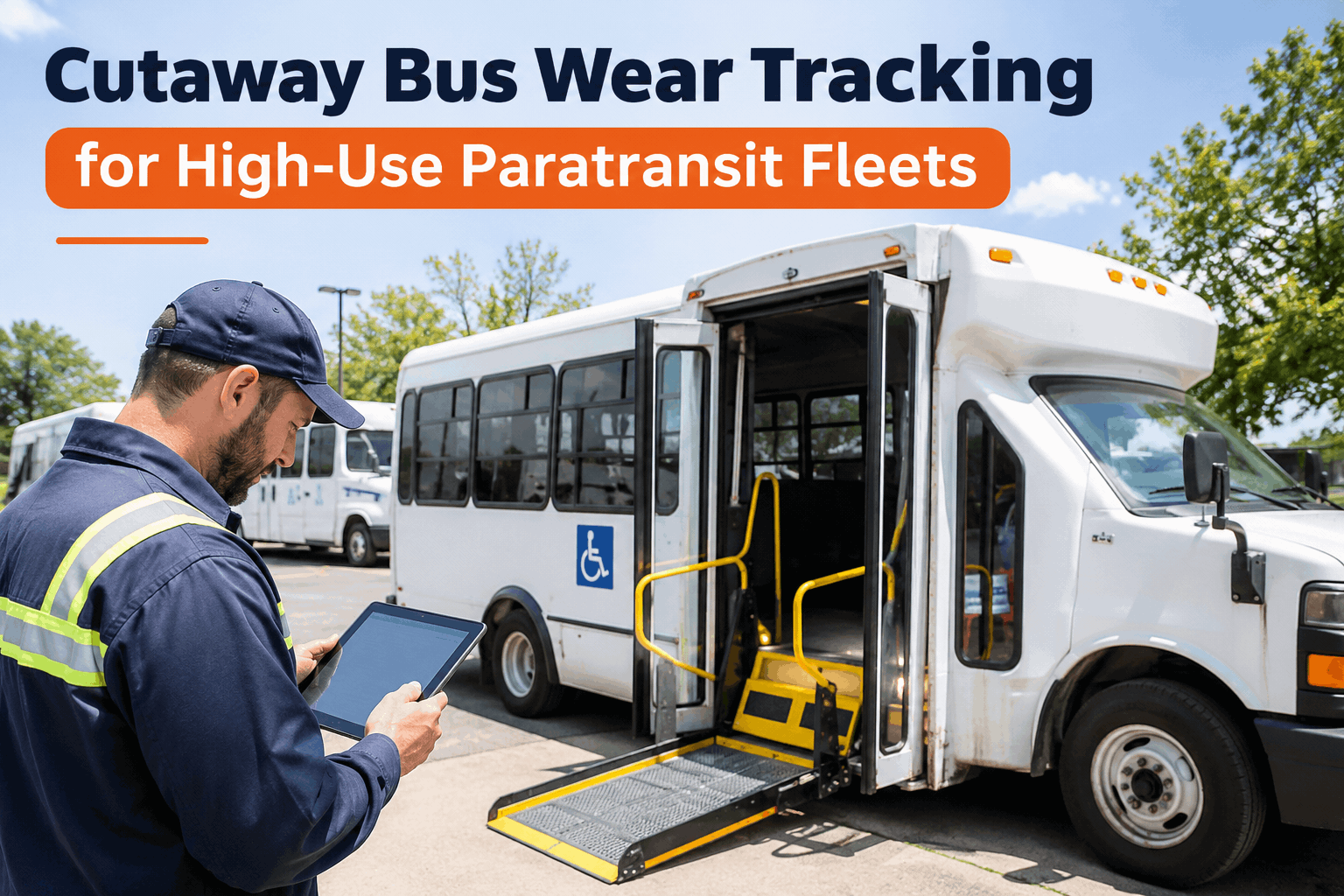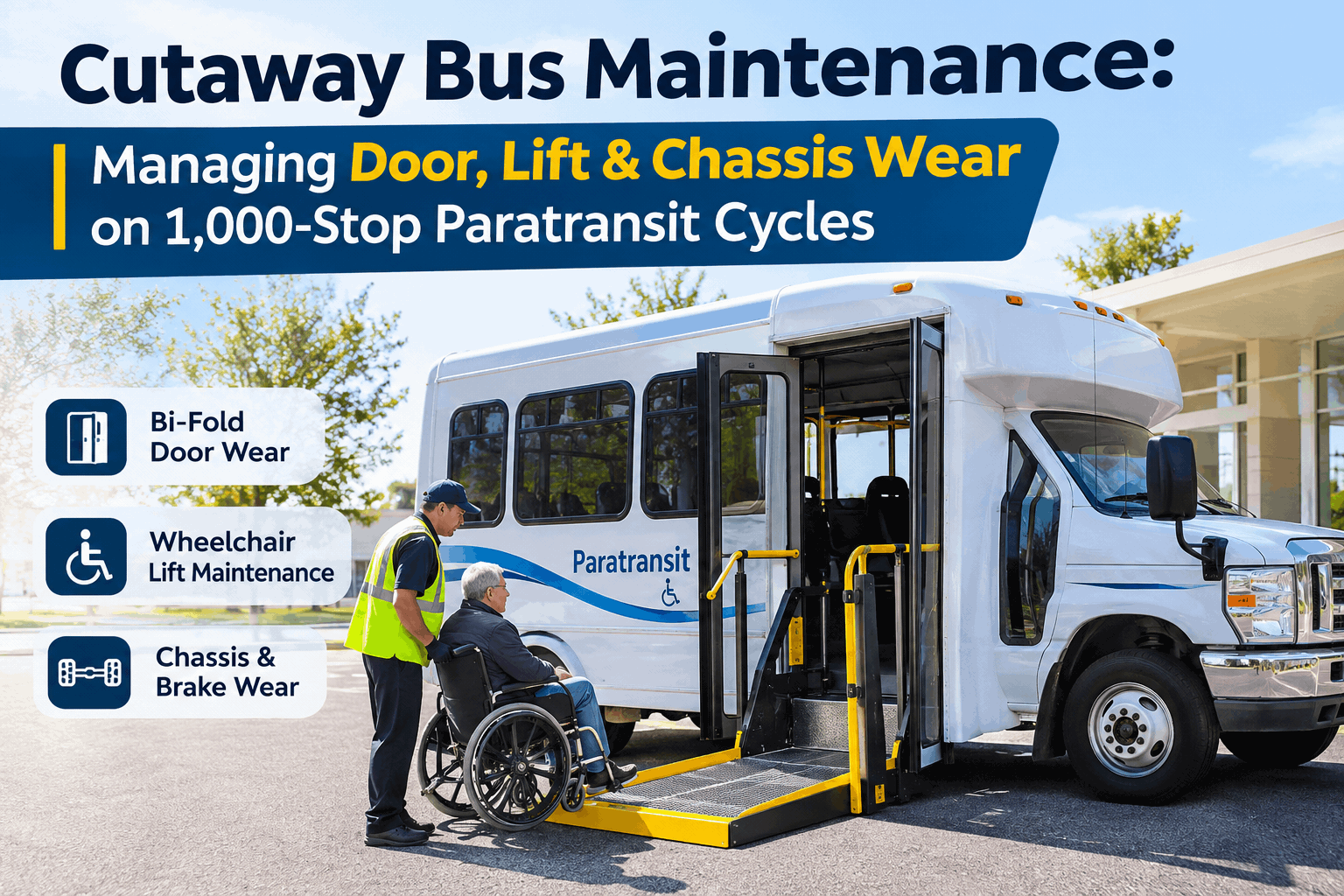
A Ford E-450 cutaway shuttle pulls into a dialysis clinic curb for the thirty-eighth time today, the bi-fold passenger door hesitates halfway open and the hydraulic wheelchair lift refuses to stow—leaving a rider waiting on the platform while four subsequent pickup windows collapse. Purpose-built cutaway bus maintenance treats commercial van chassis carrying heavy fiberglass passenger bodies and high-cycle accessibility hardware differently from standard delivery vans. You can see how duty-cycle PMs track cutaway doors, lifts, and brakes in a live demo.
Cutaway Bus Maintenance: Managing Door, Lift & Chassis Wear on 1,000-Stop Paratransit Cycles
A cutaway shuttle pairs a light-duty truck cab with a heavy passenger body, high-cycle electric/air entry doors and an ADA wheelchair lift. Here is how to structure severe-duty PM intervals that keep cutaway shuttles off the tow hook.
Upper pivot bushings, drive linkages, and sensitive-edge sensors wear out long before 50,000 miles.
Auxiliary battery sag under rear A/C load and dry pivot pins trigger stow/deploy interlock lockouts.
Curb-to-curb braking near full weight rating cuts pad, ball-joint, and transmission fluid life in half.
Why Standard Cargo-Van Schedules Fail Cutaway Buses
Most paratransit, airport, and campus cutaway buses ride on Ford E-350/E-450, Ford Transit, or Chevrolet Express 4500 chassis—yet once an upfitter bolts on a 22- to 28-foot passenger body, dual-compressor rooftop HVAC, and an 800-pound hydraulic lift, the vehicle runs continuously near its Gross Vehicle Weight Rating (GVWR) in stop-and-go neighborhood service.
According to FTA National Transit Database (NTD) demand-response fleet benchmarks, cutaway buses have shorter useful service lives (typically 5 to 7 years or 150,000–200,000 miles) than heavy-duty 40-foot transit coaches while logging far higher door and lift cycles per revenue hour. Following standard 7,500-mile light-truck oil-change intervals allows brake pads, front suspension ball joints, and door motors to fail mid-route.
| Cutaway Subsystem | Standard Light-Truck Interval | Severe-Duty Cutaway Target | Primary Failure Trigger |
|---|---|---|---|
| Brakes & Rotors | Every 7,500–10,000 miles | Measure pad thickness every 3,500–4,000 mi | Constant curb-to-curb stops near max GVWR |
| Passenger Entry Door | Omitted on OEM chassis sheets | Lubricate pivots, check linkage & edge strip every 3,500 mi | 100+ daily open/close cycles & body flex |
| ADA Wheelchair Lift | Omitted on OEM chassis sheets | Daily pre-trip cycle + 90-day ADA hydraulic/interlock PM | Voltage drop, dirty limit switches, dry pins |
| Front Steer & Alignment | Every 15,000 miles | Check ball joints, tie rods & toe every 7,000 mi | Tight cul-de-sac turns & curb impacts |
| Dual-Battery & Rear A/C | Annual seasonal check | Load-test aux batteries & 220A+ alternator quarterly | High idle amp draw from lift + rear HVAC |
Four Shop Practices That Cut Cutaway Road Calls in Half
Because cutaway shuttles operate on tight medical, airport, and campus schedules with thin spare ratios, preventing a door or lift lockout is just as critical as engine reliability.
Add Upfitter Body & Door Items to Daily DVIRs
Standard van pre-trip forms ignore the passenger door actuator, sensitive safety edge, step-well heater, and wheelchair floor tracks. Pre-load body-specific items so drivers flag sluggish doors before they jam shut.
Pair Engine-Hour Triggers With Odometer Miles
Paratransit drivers idle with rear A/C or heat running while escorting riders to the door. Combine 3,500-mile PM triggers with 250-engine-hour alerts so oil and transmission fluid never shear out.
Load-Test Auxiliary Batteries & Alternators
Running a hydraulic wheelchair lift, rooftop A/C condenser, and electric bi-fold door together draws heavy amperage. Weak auxiliary batteries cause 70% of "lift won't deploy" road calls.
Automate 90-Day ADA Lift & Securement Audits
Schedule recurring 90-day lift inspections covering manual backup pumps, threshold warning buzzers, and 4-point wheelchair tie-down retractors to stay audit-ready for FTA and state reviews.
Keeping chassis PMs, upfitter body repairs, and 90-day lift certifications on one vehicle profile stops minor door wear from grounding an entire route. You can sign up free to run cutaway-specific DVIRs and 90-day lift PMs, or book a demo tailored to your cutaway shuttle fleet.
Cutaway Shuttle Severe-Duty Maintenance & ADA Checklist
Audit your current cutaway maintenance workflow against these five checkpoints to eliminate curb lockouts.
-
Daily Pre-Trip Lift & Transmission Interlock Cycle Test Drivers deploy and stow the wheelchair lift and confirm shift-interlock engagement before yard pull-out.CRITICAL
-
Severe-Duty 3,500-Mile Brake & Front Suspension Check Pad thickness, rotor runout, ball joints, and tie-rod ends are inspected twice as often as standard cargo vans.CRITICAL
-
Bi-Fold / Plug Door Pivot Lubrication & Edge Sensor Test Door drive linkages, rollers, and obstruction-reversal strips are serviced on every scheduled A/B inspection.VERIFY
-
Dual-Battery & 220A+ Alternator Load Verification Charging output under simultaneous rear-A/C and lift load is logged to prevent voltage-drop lift stalls.VERIFY
-
90-Day ADA Lift & Securement Webbing Certification Hydraulic hoses, manual backup pumps, and 4-point tie-down retractors are documented per VIN for FTA audits.VERIFY
Paratransit and shuttle operators managing cutaway fleets on BusCMMS report saving ~$2,800 per bus annually and maintaining 95%+ fleet availability—the same uptime framework built into BusCMMS's passenger transit and paratransit solution.
A Paratransit Manager's Take
Key Takeaways on Cutaway Bus Maintenance
Keeping cutaway buses reliable on thousand-stop duty cycles requires treating the chassis and body as one unified asset:
Tighten chassis intervals
Continuous max-GVWR stops wear brakes and front-end joints twice as fast as cargo vans.
Service entry doors on PMs
Lubricate pivots and test sensitive edges before 100 daily cycles cause a jam.
Guard auxiliary voltage
Load-test dual batteries and high-output alternators to stop lift interlock stalls.
Automate 90-day ADA logs
Keep lift certifications and securement checks tied directly to each cutaway VIN.
Move off generic cargo-van checklists, track engine hours alongside miles, and schedule door and lift PMs proactively—so every cutaway shuttle stays route-ready through peak medical and commuter runs. Book a live walkthrough with our transit team to see BusCMMS in action.