Georgia school bus compliance isn't one inspection — it's three overlapping cycles running at once: monthly, annual, and a records deadline most fleets don't think about until it's almost due. Miss the rhythm on any one of them and the gap shows up at the worst possible time. See how Georgia fleets keep every cycle on track in a demo.
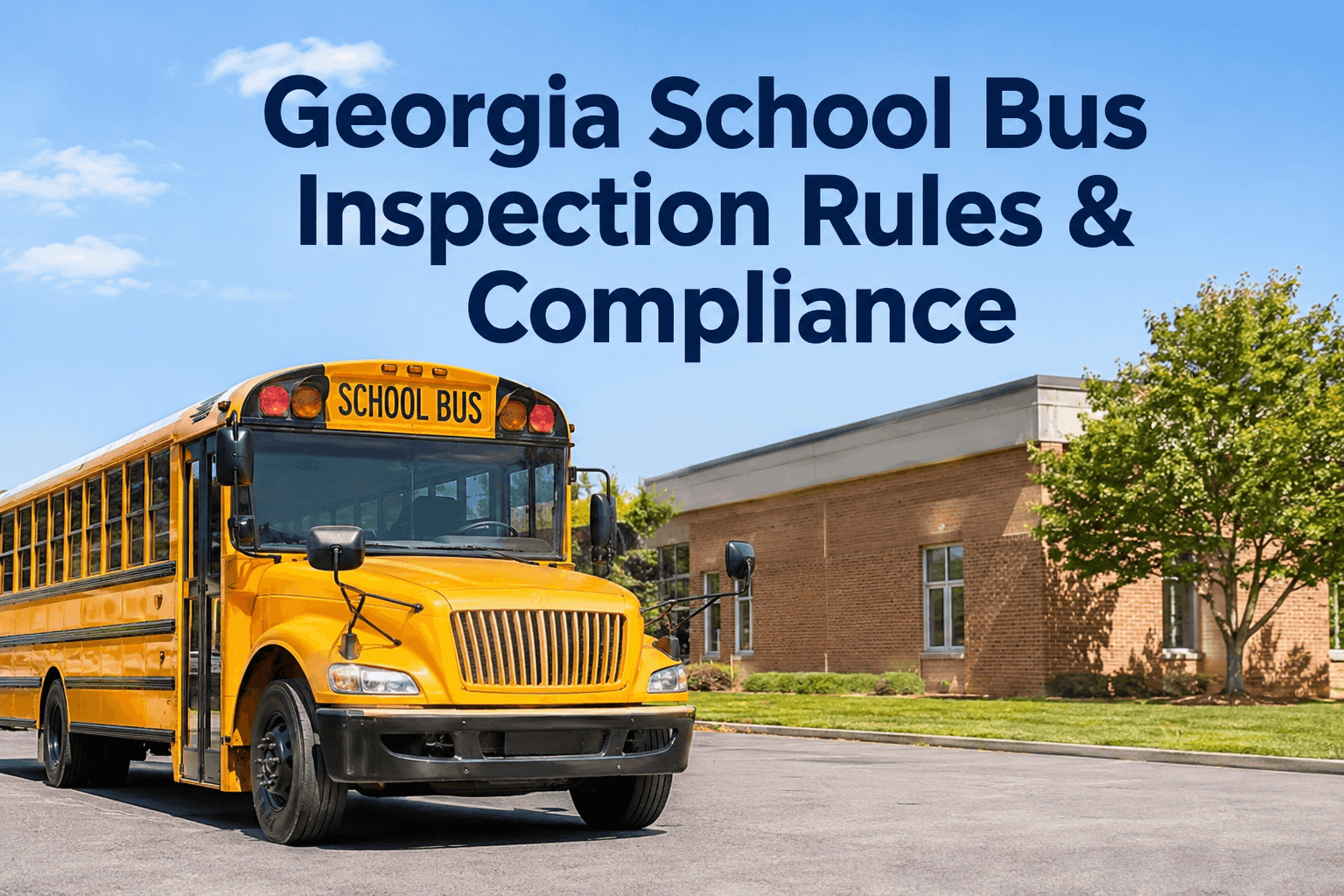
Georgia School Bus Inspection Rules & Compliance
Under Georgia Rule 160-5-3-.03, every school bus is inspected on two separate schedules — monthly by local maintenance personnel and annually by the Department of Motor Vehicle Safety — on top of a records deadline each spring that's easy to lose track of.
Plus an annual DMVS inspection on every bus, and a Department of Education on-site assessment every 5 years.
Three Layers of Inspection Oversight
Rule 160-5-3-.03 stacks three separate review cycles on top of each other, each with a different owner.
Monthly — Local Maintenance Staff
Every school bus is inspected each month by local maintenance or service personnel, with results recorded on Department of Education forms or an approved local equivalent.
Annual — Department of Motor Vehicle Safety
Every bus is inspected annually by the Department of Motor Vehicle Safety, independent of the local system's own monthly checks.
Every 5 Years — DOE On-Site Assessment
The Department of Education reviews each local system's transportation program on-site every five years — or sooner, if requested or if student safety is a concern.
What a Monthly Inspection Requires
- Every school bus in the fleet is inspected, every calendar month, with no exceptions for buses in light use
- Inspections are performed by local maintenance or service personnel, not just drivers
- Results are recorded on Department of Education forms, or a local form the department has approved
- Any defects found feed into the same maintenance records reviewed during the annual DMVS inspection
- New buses with a material or construction defect are reported to the Department of Education in writing by the superintendent
Track every bus's monthly inspection status in one place instead of a separate paper form per vehicle.
The Annual Records Deadline Most Fleets Miss
Separate from the inspection cycles, Rule 160-5-3-.16 requires every local school system to electronically submit a completed Transportation Records and Best Practices Assessment, signed by the superintendent, every year.
Swipe sideways to see all columns.
Expert Review: Paper Forms Per Bus vs. One Fleet-Wide Record
Swipe sideways to see all columns.
Content here is grounded in Georgia Rule 160-5-3-.03 (School Bus Inspections) and Rule 160-5-3-.16 (Bus Transportation Records) as published by the Georgia Department of Education — specific checklist items and local-form approvals vary by school system, so confirm current forms with your district's transportation office. Walk through how your current records would hold up to review.
The Bottom Line
Georgia's pupil transportation rules don't ask for one inspection — they ask for a rhythm: monthly checks on every bus, an annual DMVS inspection, and a records assessment due every spring, all backed by documentation that has to survive a review every five years. Systems that keep that rhythm in one place walk into each deadline with records already in hand, not a scramble to reconstruct them.