Title VI compliance usually gets filed under "civil rights," not "maintenance" — but one of its required service policies, vehicle assignment, is answered almost entirely with fleet data. If your agency can't show which buses run which routes and how their condition compares, that's a gap reviewers will find before you do. See how fleet records support Title VI documentation in a demo.
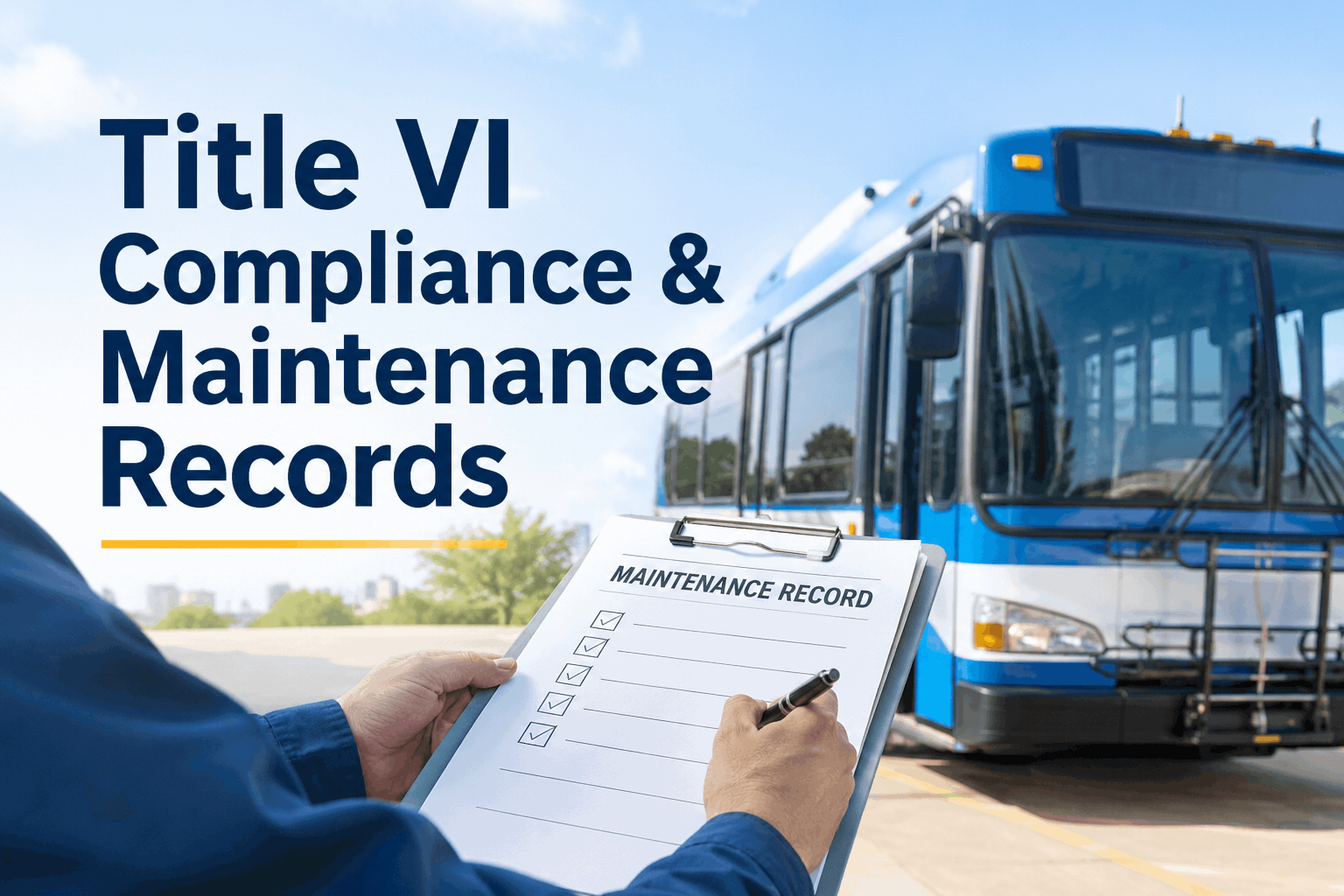
Title VI Transit Compliance & Maintenance Records
Title VI prohibits discrimination based on race, color, or national origin in any federally funded program — and for transit agencies, that extends to which buses run on which routes. Here's where maintenance and fleet records fit into a requirement most people file under "civil rights," not "fleet management."
Every layer is submitted together as one Title VI Program — but layers 3 and 4 are the ones fleet and maintenance data directly supports.
What Title VI Actually Requires
Title VI of the Civil Rights Act of 1964 prohibits discrimination based on race, color, or national origin in any program receiving federal funds. FTA recipients submit a Title VI Program every three years, on a schedule FTA sets, covering public notice and complaint procedures, a public participation and language assistance plan, board-approved service standards and policies, and — for larger fixed-route providers — demographic analysis and equity monitoring results.
The Four Required Service Standards
Every fixed-route provider must set, and monitor, standards across four areas — by mode.
Vehicle load
How full vehicles run relative to capacity, by route and mode.
Vehicle headway
Scheduled time between vehicles on the same route.
On-time performance
How often service runs within the agency's defined on-time window.
Service availability
How access to service is distributed across the service area.
These standards get monitored and the results reported to the board — which means the underlying data has to exist and be current, not reconstructed at submission time. Start tracking service and fleet data in one place.
Vehicle Assignment: Where Maintenance Data Meets Civil Rights Compliance
Alongside transit amenities, vehicle assignment is one of two required Title VI service policies. In plain terms, it means an agency has to be able to show that older, lower-capacity, or less reliable buses aren't disproportionately assigned to routes serving minority or low-income communities. Answering that convincingly takes fleet data most agencies already collect — vehicle age, capacity, and maintenance history, mapped against which routes each vehicle actually runs.
Swipe sideways to see all columns.
What Reviewers Check First
- Board-approved service standards exist for load, headway, on-time performance, and availability
- Vehicle assignment policy is documented and consistent with actual fleet deployment
- Monitoring results are current and were presented to the board, not just drafted for submission
- Vehicle age, condition, and downtime data can be broken down by route, not just fleet-wide
- A Title VI equity analysis is on file for any maintenance or storage facility built since the last submission
Walk through this checklist against your current fleet data ahead of your next submission.
Expert Review: Spreadsheet Equity Reports vs. Fleet Data Built for It
Swipe sideways to see all columns.
Content here is grounded in FTA's Title VI Program Checklist and Circular guidance on required service standards and policies — the connection between maintenance data and vehicle assignment monitoring is a practical reading of that requirement, not a line-by-line FTA directive on recordkeeping systems. Talk through what your current records can already prove.
The Bottom Line
Title VI compliance is a civil rights requirement, but a meaningful part of it is answered with fleet data: which vehicles run which routes, how old and reliable they are, and whether that pattern holds up across every community you serve. Agencies with that data already organized walk into a Title VI submission with evidence. Agencies without it walk in with a narrative and hope the monitoring data catches up in time.