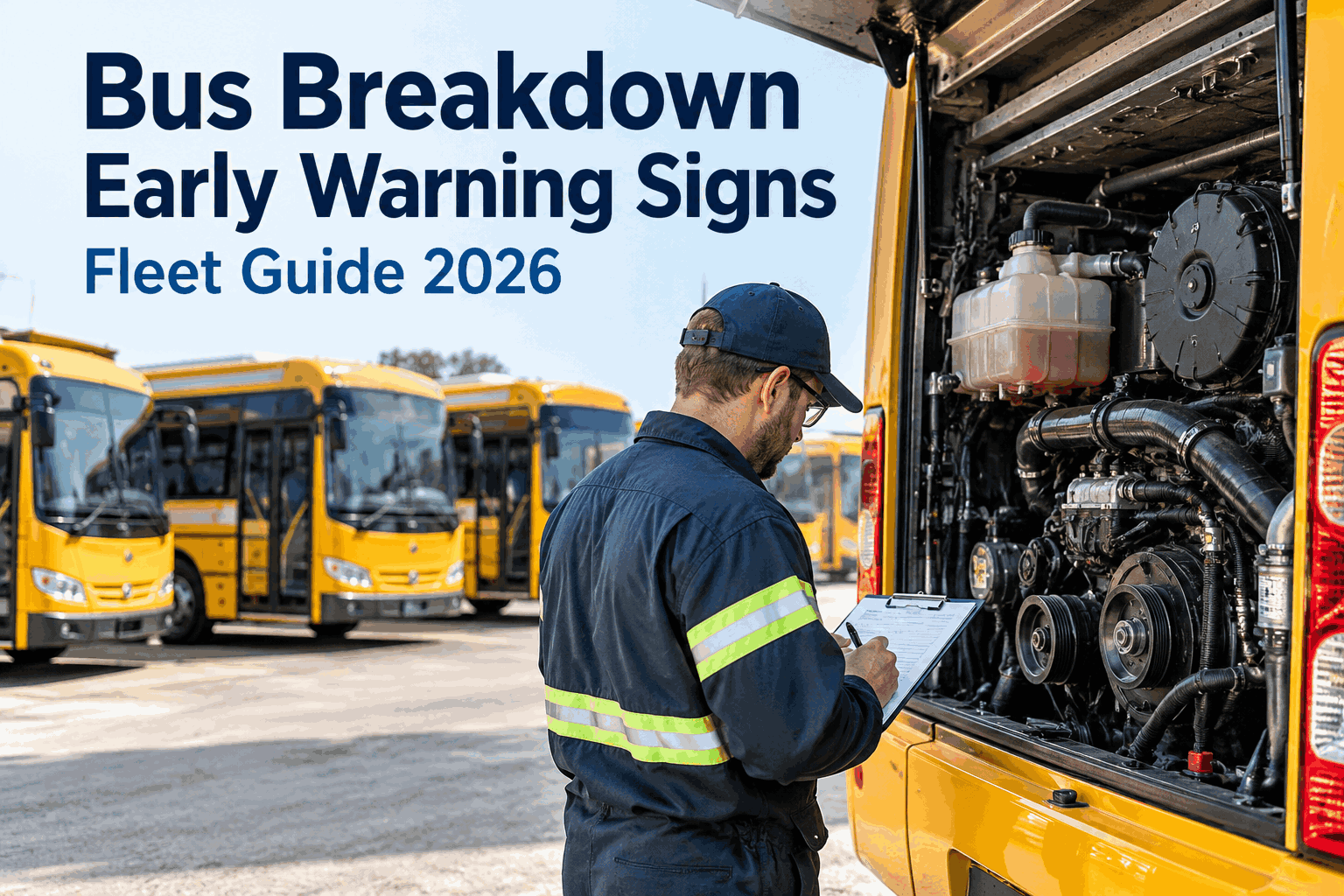
By the time a bus dies on route, it had been warning you for weeks — just not out loud. Most fleets wait for the noise, the smoke, or the dash light, but the earliest bus breakdown early warning signs don't show up on the bus at all. They show up in your maintenance records first: a defect that keeps coming back, a PM slipping past due, a repair bill creeping up on one unit. The paperwork warns you before the bus does.
Bus Breakdown Early Warning Signs: Fleet Guide 2026
A breakdown announces itself in your data weeks before it strands a bus. Here are the early warning signs hiding in your records — and how to catch them before the road call.
The Warning Signs Live in Your Data First
There are two kinds of warning: what the bus does, and what the records show. The bus's signals are loud but late; the record's signals are quiet but early — and that's the window most fleets sleep through.
- Whatnoises, codes, smells, dash lights
- Timingdays before failure — late
- Whereon the bus, felt by the driver
- Problemoften too late to plan around
- Whatdefect clusters, PM slips, cost trends
- Timingweeks before failure — early
- Wherein your maintenance records
- Advantagetime to plan the fix, not react
Physical signs aren't wrong — they're just last. By the time a driver hears the noise, the data had already flagged the unit weeks earlier. Watching only the bus means you're always a step behind.
The physical, on-the-bus symptoms are worth knowing too — our 7 signs a bus is about to break down covers those. This guide is about the signals that come earlier, in the records. Book a demo to see data warning signs surfaced.
The Four Data Signals That Precede a Breakdown
Almost every breakdown leaves a trail in the records before it happens. Four signals show up again and again — and each is something you can see without touching a wrench.
A recurring defect
The same item flagged two or three times running is a component telling you it's failing — before it fails completely.
A slipping PM
A preventive service creeping past due is a breakdown being scheduled — the protection you skipped is exactly what fails next.
A rising repair trend
One bus generating more work orders or cost than its peers is a unit sliding toward a major failure — the trend is the tell.
A component past its life
A major part beyond its expected mileage or hours is running on borrowed time — its own life data is the warning.
The strongest signal is when two stack up — a recurring defect on a bus whose repair trend is also climbing. That combination is a road call waiting to happen, and it's fully visible in the data now.
These record-based signals complement telematics fault codes — together, data and diagnostics turn predictive maintenance from a buzzword into a daily habit. Sign up free and watch for these four signals.
Reactive vs. Proactive: The Same Bus, Two Outcomes
The gap between a fleet that reads its data and one that waits for the noise is the gap between a planned fix and a road call. Same failing bus, two very different weeks.
- Data signals go unread across separate reports
- Waits for the driver to report a noise
- Bus fails on route — a covered run, a tow
- Emergency repair at premium cost and time
- Collateral damage to related parts
- Downtime you didn't choose
- The signal is flagged weeks out
- Bus scheduled into the shop on your terms
- Fixed during planned downtime, no tow
- Routine repair cost, parts on hand
- Caught before it took out anything else
- Downtime you controlled
The failure was the same in both columns. The only difference was whether someone read the early signal — and that turned an unplanned road call into a scheduled shop visit.
Moving from the left column to the right is the whole point of breakdown prevention — and it starts with reading signals you already have. Book a walkthrough to shift from reactive to proactive.
How to Catch the Signals Before the Breakdown
Reading the early signals is a habit, not a hunch. Four steps turn scattered records into a warning system that flags the bus before it fails.
Get Every Defect & Repair in One Place
Signals only appear when inspections, work orders, and PM live in one system. Scattered across paper and spreadsheets, the pattern is invisible.
Watch for the Four Signals
Track recurring defects, PM slipping past due, rising per-bus repair trends, and components past their life — the leading indicators of a failure.
Set Alerts, Don't Rely on Memory
Let the system flag a bus when a signal crosses a threshold, so a warning reaches you automatically instead of waiting for someone to notice.
Schedule the Fix on Your Terms
When a signal fires, bring the bus in during planned downtime — a routine repair instead of a road call, at your convenience, not the road's.
Step 1 is the unlock: signals need one home. A recurring defect and a rising cost trend on the same bus only connect when both live in the same system — on paper, they never meet.
The signals also line up with what the bus itself reports — pairing records with CAN bus diagnostics gives you both the early and the late warning. Sign up free and turn records into early warnings.
The BusCMMS Analytics Behind Bus Breakdown Early Warning Signs
Early warning is a data problem: the signals exist, but only if inspections, work orders, and PM are connected and watched. BusCMMS ties them together and flags the bus before it fails.
Recurring-Defect Detection
Flags when the same item is reported again on a bus, surfacing the failing component before it fully lets go.
Overdue-PM Alerts
Flags preventive services slipping past due, so the protection you're about to skip gets done before it becomes the failure.
Per-Bus Repair Trends
Tracks work-order frequency and cost per unit, so a bus trending toward a major failure stands out from its peers.
Component-Life Tracking
Watches each major part against its expected life, so one running past its mileage or hours gets flagged as at-risk.
Automatic Risk Alerts
Sends the warning to you when a signal crosses a threshold, so early detection doesn't depend on someone remembering to check.
Telematics Integration
Pairs record signals with fault codes and odometer data from Samsara, Geotab, and others for both early and late warnings.
A generic tool stores the records; a bus-built platform reads them for the warning and tells you which bus is next — BusCMMS is typically live in 2–4 weeks, turning data you already have into a next-to-fail watch list.
A Maintenance Director's Take
Key Takeaways on Bus Breakdown Early Warning Signs
The earliest warning isn't a noise — it's a pattern in your data. Five things to act on.
Data warns first
Records flag weeks out; the bus warns days out.
Four signals to watch
Recurring defect, slipping PM, cost trend, aged part.
Stacked signals = danger
Two on one bus is a road call waiting to happen.
Signals need one home
Scattered records hide the pattern completely.
Fix on your terms
Read it early, schedule it, skip the road call.
Read the signals you already have and the breakdown becomes a scheduled repair — caught weeks early, fixed in the bay. Book a walkthrough to build early warning for your fleet.