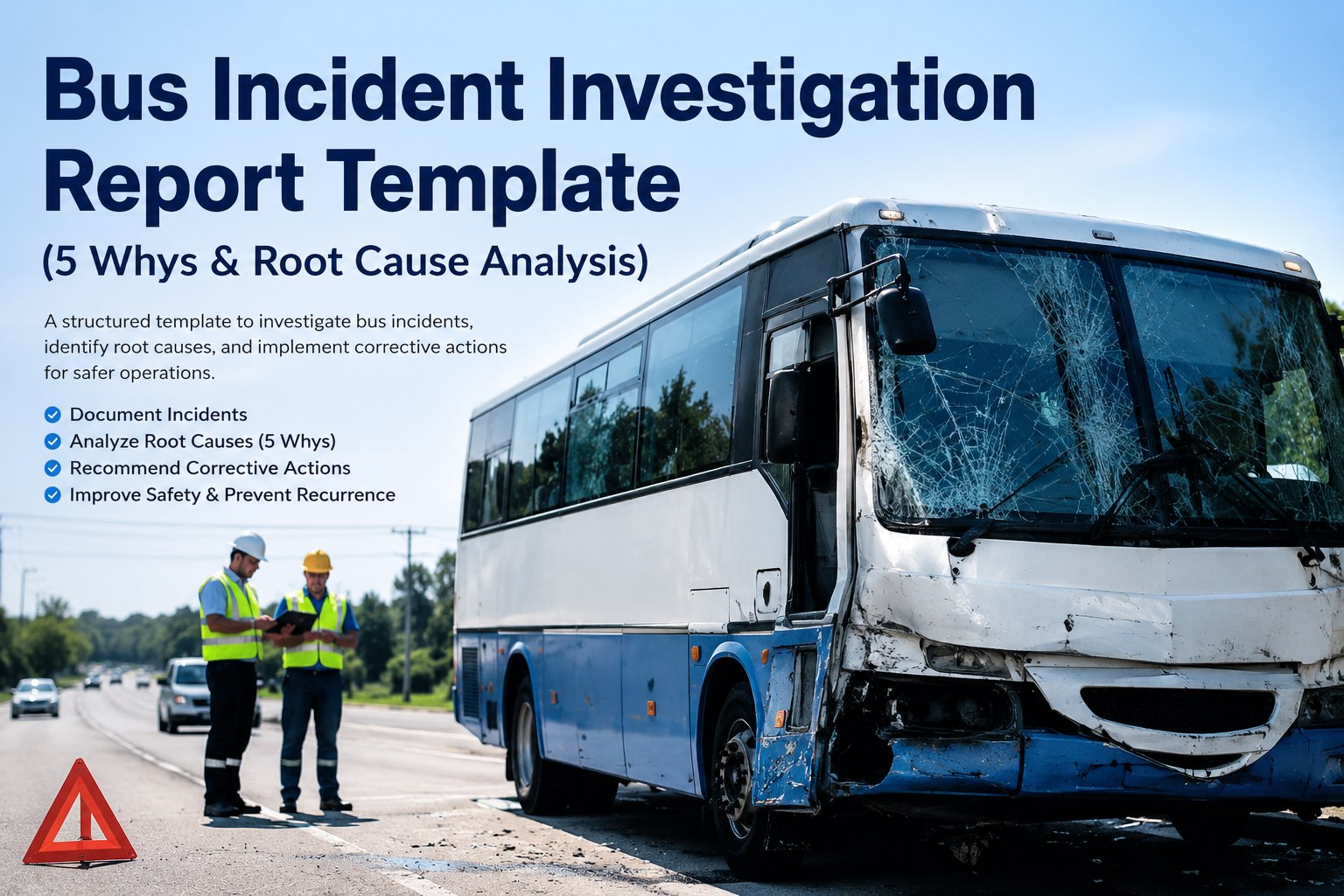
Your dispatch phone rings at 2:15 PM. Bus 24 has just rear-ended a stopped sedan at a controlled intersection. No injuries this time, but the bus front bumper is destroyed, the sedan is totaled, the driver is shaken, and 27 middle school students on board are calling their parents. Within 48 hours you need a written incident investigation report -- for the insurance carrier, for FMCSA compliance, for the school district superintendent, and honestly for yourself, to understand what actually went wrong and how to stop it from happening again. This template + 5 Whys methodology gives you the framework to do it right.
Bus Incident Investigation Report Template (5 Whys & Root Cause Analysis)
A complete investigation template plus the 5 Whys methodology every fleet safety officer should know -- with evidence checklists, root cause categories, corrective action framework, and the digital documentation trail that satisfies insurance, FMCSA, and district review.
Structured Investigation Is Not Optional
Every bus incident triggers multiple accountability chains. The report you produce in 48 hours will follow the incident through every one of them.
Federal reporting
Reportable accidents (fatality, injury requiring off-scene care, or disabling damage) must be documented and available for FMCSA review. Records retained 3 years minimum.
Carrier documentation
Insurance carriers require formal incident reports for any claim. Incomplete or delayed documentation increases premiums and can trigger non-renewal.
Litigation defense
Parent lawsuits, injured passenger claims, and third-party collision claims all rely on the investigation record. Poor documentation costs money in court.
Repeat incident risk
Every incident that does not produce a corrective action becomes an incident that repeats. Structured RCA is the difference between one incident and a pattern.
Book a demo to see how BusCMMS logs incidents + investigation trails + corrective actions per bus.
The 8-Section Bus Incident Investigation Report Template
A complete report template. Fill each section in order to produce documentation that satisfies insurance, FMCSA, district review, and internal safety needs.
-
01
Incident Header
Date, time, location, bus number, driver name and CDL number, route number, weather and road conditions, and report author. Every field required. This is the metadata that makes the report searchable years later.
-
02
Incident Narrative
Written description of what happened in chronological order, in the driver's own words when possible. Include events immediately before, during, and after the incident. Facts only -- no conclusions yet.
-
03
People Involved
All parties: driver, passengers (with count and demographic if applicable), witnesses, other vehicles/drivers, pedestrians, emergency responders. Contact information for anyone not on the bus.
-
04
Injuries + Damages
Injuries with medical treatment status (on-scene, transported, later). Property damage estimates for bus, other vehicles, third-party property. Note whether tow was required (relevant for FMCSA reportable classification).
-
05
Vehicle Inspection Status
Pre-trip DVIR record for the day, any recent PM cycles, any open work orders, any driver-reported issues in prior 30 days. This proves the vehicle was in service condition (or exposes maintenance issues that contributed).
-
06
Evidence Log
Photos of scene, damage, injuries. Witness statements (written when possible, transcribed if verbal). Interior + exterior camera footage. GPS/telematics data at time of incident. Police report if applicable. Every evidence item logged with source and date.
-
07
Root Cause Analysis (5 Whys)
Structured drill-down from surface incident to root cause using the 5 Whys methodology (Section 03 below). Multiple contributing factors possible. Every "why" documented with the evidence supporting it.
-
08
Corrective Actions + Follow-Up
Immediate actions taken. Short-term corrections (retraining, policy update, equipment repair). Long-term systemic changes. Assigned owner + deadline for each action. Follow-up review date scheduled.
How to Actually Run a 5 Whys Analysis
The method sounds simple but goes wrong the same three ways in every organization. Here is what to do -- and what not to do.
- Start with the observed incident -- specific, factual, non-judgmental description
- Ask "why did this happen?" and answer with a fact, not an opinion
- Take that answer as the new subject and ask "why?" again
- Continue until the answer is a policy gap, procedure failure, or systemic issue
- Verify each "why" with evidence from the investigation
- Document alternative root causes if the evidence supports more than one path
- Stopping at "the driver made a mistake" -- that is a symptom, not a cause
- Blaming a person as the root cause -- root causes are systems, not people
- Assuming five levels is enough -- some incidents need three, some need seven
- Skipping evidence verification for any "why" in the chain
- Producing corrective actions that only address the surface symptom
- Rushing to close the report before the RCA is defensible
The Evidence Log Every Bus Incident Needs
Evidence must be captured within hours of the incident, not days. Insurance carriers and legal counsel prioritize contemporaneous documentation.
Photos of scene + damage
Multiple angles of bus damage, other vehicles, scene layout, road conditions, weather visibility. Digital camera or phone -- documented with time and location metadata.
Driver written statement
Driver's own words about what happened, in narrative form. Signed and dated. Before memory degrades or lawyers intervene.
Witness statements
Passengers who saw the incident, other drivers, pedestrians. Contact information for anyone who may need follow-up. Note if statements were verbal or written.
Camera footage
Interior + exterior camera footage from the bus. Download and preserve -- some systems auto-overwrite within days. Include 5 minutes before + after the incident.
Telematics + GPS data
Speed, braking pattern, GPS location, engine data at time of incident. Fault codes from the bus ECU. Pre-incident driver behavior scoring if available.
Vehicle inspection records
Pre-trip DVIR from day of incident. Most recent PM inspection. Any open work orders. Driver-reported issues in prior 30 days.
Police report
Copy of police report if applicable. Officer name and badge for follow-up. Note any citations issued to any party. Preserve as-received without modification.
Drug + alcohol testing
Post-accident drug + alcohol test results (within 8 hr alcohol / 32 hr drugs for FMCSA reportable accidents). Chain of custody documented.
Book a demo to see how BusCMMS captures + preserves incident evidence per bus incident.
The 4 Root Cause Categories to Consider
Every incident traces to one or more of these four categories. Most incidents involve multiple factors -- rare that a single category explains it all.
Human Factors
Driver behavior, training gaps, fatigue, distraction, communication failures. Usually the surface layer of investigation -- do not stop here.
- Inadequate training on route or vehicle
- Fatigue from hours worked or personal circumstances
- Distraction from phone, dispatch, passengers
- Communication failure between driver and dispatch
Vehicle Factors
Mechanical condition, PM compliance, equipment failure, warning system issues. The DVIR + maintenance history from Section 05 of the template surfaces this.
- Missed PM cycles or deferred repairs
- Equipment failure (brakes, steering, tires)
- Warning systems not functioning (stop arm, lights, PA)
- DVIR items reported and unresolved
Environmental Factors
Weather, road conditions, traffic, visibility, other drivers. Contextual factors that influenced the incident but were not caused by the fleet.
- Adverse weather (rain, snow, ice, fog)
- Road conditions (potholes, construction, poor lighting)
- Traffic patterns (heavy volume, rush hour)
- Third-party driver behavior contributing
Procedural + Policy Factors
The systemic root causes -- policies, procedures, or gaps that allowed the surface event. Where the 5 Whys drilling should always end.
- Missing or inadequate written policy
- Policy exists but not enforced or trained on
- Dispatch or communication protocol gap
- Reporting or accountability structure failure
The 3-Tier Corrective Action Framework
Every incident should produce actions at three time horizons. Skipping any tier means the incident is likely to repeat in some form.
-
Tier 1 Immediate (0-24 hours)
Actions taken during the incident and same-day response. Hazard secured, injured parties treated, evidence captured, driver assessed for fitness. No corrective action tier can substitute for this.
-
Tier 2 Short-Term (1-30 days)
Driver retraining if applicable, policy communication to all drivers, equipment repair or replacement, temporary route adjustment. Address the specific incident conditions to prevent immediate recurrence.
-
Tier 3 Long-Term (30-180 days)
Systemic changes -- new policies, training program updates, equipment standard changes, procedural revisions. Address the root cause identified in the 5 Whys so the pattern does not recur across the fleet.
Book a demo to see how BusCMMS tracks corrective actions with assigned owners + deadlines.
How BusCMMS Integrates Incident Investigation
Paper investigation reports get lost in filing cabinets. Digital incident records build a searchable, defensible fleet safety history.
Incident logged per bus
Every incident linked to the specific bus with date, time, driver, route, and severity classification. Fleet-wide incident dashboards surface patterns across buses, drivers, or route segments.
Evidence attachment
Photos, witness statements, camera footage links, police reports, and drug/alcohol test results all attached to the incident record. Nothing lost, nothing overwritten.
Auto-linked DVIR + PM records
Pre-trip DVIR from day of incident, most recent PM record, and open work orders auto-attached to the incident report. Section 05 of the template fills itself from the CMMS database.
Corrective action tracking
Every corrective action assigned to an owner with a deadline. Overdue actions surface in the safety dashboard. Follow-up reviews scheduled and tracked.
The 48-hour report deadline after an incident is only stressful when the documentation is scattered across paper, email, phone photos, and text messages. When everything is in one place, the report writes itself. Book a demo to see the incident investigation workflow live.
What counts as a reportable bus incident under FMCSA rules?
FMCSA defines a reportable accident as one that results in (a) a fatality, (b) an injury requiring medical treatment away from the scene, or (c) disabling damage requiring the vehicle to be towed. These trigger post-accident drug + alcohol testing requirements and formal documentation retention (3 years minimum). Non-reportable incidents should still be internally documented for insurance, legal defense, and pattern identification -- FMCSA classification is a floor, not a ceiling.
How is 5 Whys different from just asking "what went wrong?"
Asking "what went wrong" usually stops at the surface -- "the driver made a mistake" or "the equipment failed". 5 Whys forces the investigation past that layer to the systemic cause. Each answer becomes the subject of the next "why" question. The rule is to keep going until you reach a policy, procedure, training, or organizational gap -- something the fleet can actually change. Blaming a person is not a root cause because it does not produce a preventive action.
How quickly should a bus incident investigation report be completed?
Evidence capture should begin within hours -- photos, driver statement, witness contact, camera footage preservation. The full investigation report should be complete within 48-72 hours for insurance and internal review. Corrective actions may extend longer (Tier 1 immediate / Tier 2 within 30 days / Tier 3 within 180 days) but the report itself should not wait for corrective actions to be complete -- initial documentation stands separately.
Who should conduct the incident investigation?
Usually the fleet safety officer, transportation director, or maintenance manager -- someone independent of the driver involved and with authority to implement corrective actions. Large agencies may have a dedicated safety investigator. For serious incidents (fatality, major injury, legal exposure), a third-party investigator or insurance-appointed adjuster may lead the formal investigation while the fleet still produces its internal report. Never have the involved driver investigate their own incident.
How does BusCMMS help with incident investigation and reporting?
BusCMMS captures incident records per bus with attached evidence (photos, statements, camera footage links), auto-links DVIR + PM records from the day of the incident, tracks corrective actions with assigned owners and deadlines, and surfaces fleet-wide incident patterns across buses, drivers, and routes. The 48-hour report deadline stops being stressful when the documentation is centralized. Book a 20-minute demo to see the workflow live, or start a 30-day free trial.