It is 4:47 PM. Your driver just pulled Bus #27 back into the lot after six stops, 43 students, and a route that ran 12 minutes late because of construction on Route 9. She parks it, grabs her bag, and walks to her car. No post-trip inspection. No DVIR filed. No one checks whether the stop arm that felt sluggish at Jefferson Elementary is actually broken. Tomorrow morning a different driver takes Bus #27 out at 6:15 AM, runs the pre-trip in four minutes, checks every box and pulls out of the lot. The stop arm fails at the second pickup. A student steps into traffic. That is not a hypothetical. FMCSA estimates that proper bus post-trip inspection procedures and DVIRs prevent approximately 14,000 accidents every year, yet 95% of all paper DVIRs report no defects. The post-trip is not a formality. It is the inspection that gives your shop the overnight window to fix what your driver found today so tomorrow's route starts clean.
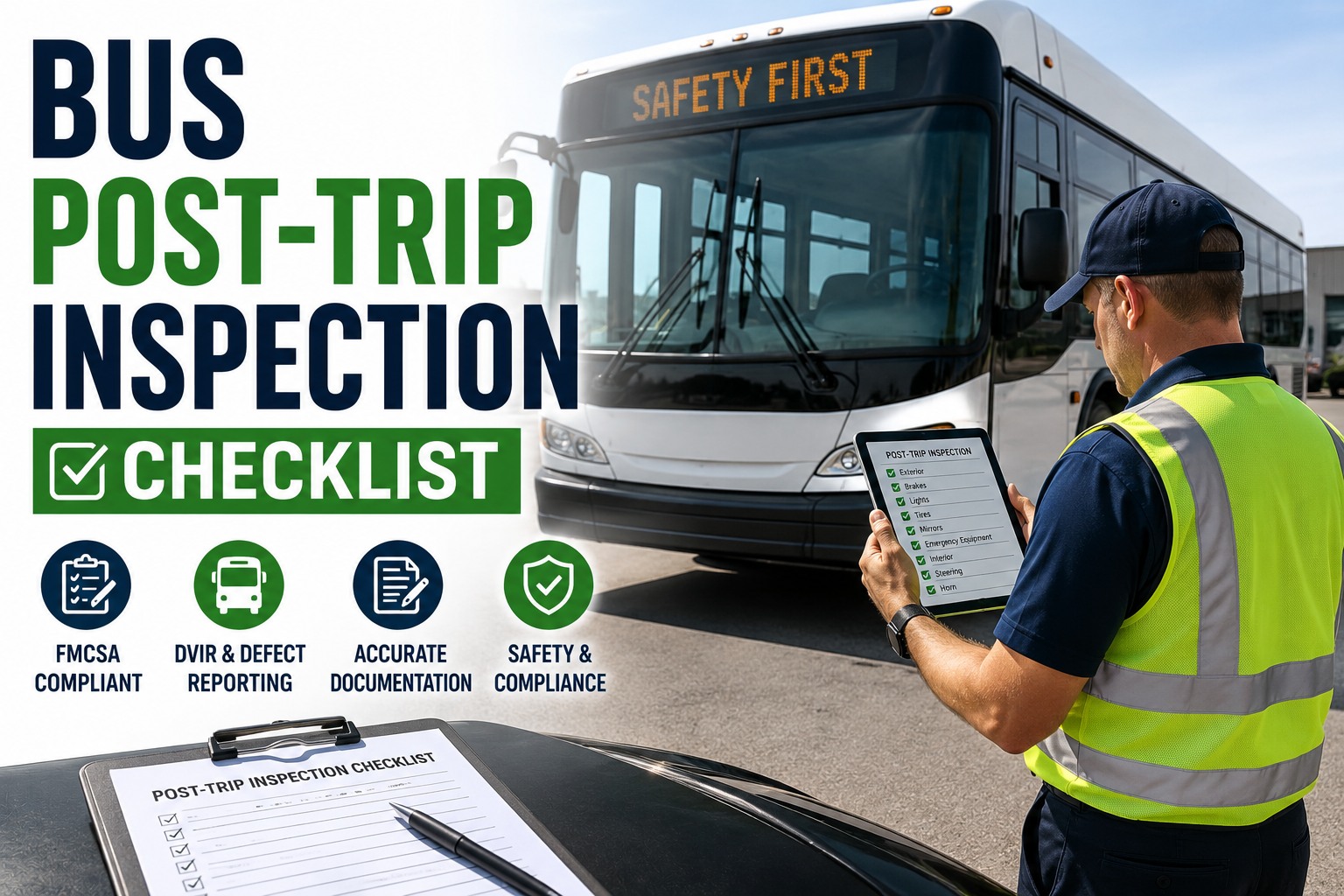
Bus Post-Trip Inspection Checklist: FMCSA DVIR, Defect Reporting & Compliance
The complete checklist, 3-signature DVIR chain, common violations, and how to go digital in 2026
- 14,000accidents prevented/yr by DVIRs
- $15,420fine per unrepaired defect
- 93%of carriers fail audits
What FMCSA Actually Requires for Bus Post-Trip Inspections
Here is a regulatory nuance that trips up most fleet managers: FMCSA does not technically mandate a formal "post-trip inspection" the way it mandates pre-trip checks under 49 CFR 392.7. What it requires under 49 CFR 396.11 is a DVIR -- a Driver Vehicle Inspection Report -- filed at the completion of each day's work documenting any defects discovered during or after operation. The practical effect is the same, but the distinction matters during audits.
And here is the critical difference for bus fleets: unlike property-carrying trucks, passenger-carrying CMVs including school buses and transit buses must submit a DVIR every single day regardless of whether any defects are found. That one rule trips up more bus fleets than any other compliance gap. Book a demo to see how BusCMMS enforces daily DVIR completion across your fleet.
Daily DVIR Required
Bus drivers must file a DVIR at end of every operating day -- even when no defects are found. This applies to all passenger-carrying CMVs.
3-Signature Chain
Driver signs DVIR. Carrier certifies repairs. Next driver reviews and signs before operating. All three retained 90 days minimum.
eDVIR Rule Is Live
FMCSA's March 23, 2026 final rule explicitly authorizes electronic DVIRs. Digital signatures, mobile submission, cloud storage -- fully compliant.
The Complete Bus Post-Trip Inspection Checklist
Every item below covers the 11 FMCSA-mandated components under 49 CFR 396.11 plus school bus-specific safety equipment that goes beyond the federal minimum. Use this as your walk-around reference. Sign up free to get this entire checklist pre-loaded as a digital DVIR.
Zone 1: Brakes, Steering & Drivetrain
- Service brakes -- pedal firm, no pulling, no unusual noise
- Parking brake -- holds on grade, engages and releases fully
- Air brake pressure builds correctly, no audible leaks
- Steering mechanism -- no excess play or looseness
- Coupling devices secure, safety chains in place (if applicable)
Zone 2: Lights, Mirrors & Visibility
- Headlights (high/low), brake lights, turn signals operational
- Clearance lights, hazards, and reflectors all functioning
- All mirrors clean, adjusted, firmly mounted -- no cracks
- Windshield wipers clear effectively, washer fluid works
- Horn audible and functional when activated
Zone 3: Tires, Wheels & Body
- Tires -- no cuts, bulges, tread above 4/32", proper inflation
- Wheels and rims -- no cracks, lug nuts tight, no rust streaks
- Body panels secure, no sharp edges or protruding damage
- Exhaust system -- no leaks, secure mounting (diesel buses)
- Fluid leaks -- check under bus for oil, coolant, or fuel
Zone 4: Emergency & Safety Equipment
- Fire extinguisher charged, mounted securely, pin in place
- First aid kit stocked, accessible, seal intact
- Three reflective warning triangles present and accessible
- Body fluid cleanup kit present and properly stocked
- Seat belts functional (if equipped), all seats secure
Zone 5: School Bus-Specific Safety Items
- Stop arm deploys fully, retracts cleanly
- Crossing gate extends and retracts properly
- 8-light warning system -- all 8 flash in sequence
- All emergency exits open freely, alarms sound
- Student crossover mirrors clean and adjusted
- Child check / alarm system activated and verified
- Wheelchair lift / ramp operational (if equipped)
- Full aisle walk-through -- no students left behind
The 3-Signature DVIR Chain That Auditors Check First
The DVIR is not a single document with a single signature. It is a 3-step chain of accountability, and breaking any link is a citable violation. This is where most bus fleets fail their audits. Book a demo to see how BusCMMS enforces the full 3-signature chain digitally.
Driver Files DVIR
End of shift: documents vehicle condition and all defects found during operation. Signs the report.
49 CFR 396.11Carrier Certifies Repairs
Mechanic reviews defects, completes repairs, certifies on original DVIR. Bus cannot dispatch until signed.
49 CFR 396.11(c)Next Driver Reviews & Signs
Before operating, next driver reviews prior DVIR and signs confirming repairs were made and bus is safe.
49 CFR 396.13What a Missing Post-Trip DVIR Actually Costs Your Fleet
DVIR violations are among the most frequently cited findings during DOT audits. Only 7% of motor carriers pass without a single violation. The 2026 CSA overhaul makes this worse: "Driver Observed" violations are now scored in a separate category that directly impacts your safety rating and insurance rates. Book a demo to see real-time DVIR compliance dashboards.
5 Post-Trip DVIR Mistakes That Cause Most Audit Failures
After reviewing audit outcomes for bus fleets, five DVIR mistakes account for the overwhelming majority of violations. None involve drivers deliberately skipping inspections. They are all system failures that paper enables and digital tools prevent.
-
01
Applying "No Defect = No DVIR" to Buses
The 2014 exemption applies only to property-carrying trucks. Bus fleets must file every single day regardless. Many transportation directors from freight backgrounds get this wrong.
-
02
Broken 3-Signature Chain
Driver files DVIR but the mechanic certification or next driver acknowledgment is missing. Retaining only the original without all three is an incomplete record auditors cite immediately.
-
03
Dispatching Before Repair Certification
Defect reported, but the bus goes out the next morning before the mechanic signs off. That is a $15,420 violation per occurrence and grounds for an out-of-service order.
-
04
Records Not Retrievable in 48 Hours
FMCSA offsite audits request digital records with 48-hour turnaround. Paper DVIRs buried in filing cabinets, drop boxes, or driver cubbies do not meet this standard.
-
05
"No Defects" on 95% of Reports
When nearly every DVIR says nothing is wrong, auditors know inspections are rushed. Digital DVIRs with photo capture find defects on 8-12% of inspections -- a far more realistic rate.
Every one of these failures is preventable with a system that enforces completion, captures all three signatures, and stores records audit-ready. Sign up free and run your first digital post-trip DVIR today.
Paper DVIRs vs. Digital DVIRs: What the Data Shows
FMCSA's March 23, 2026 final rule explicitly authorizing electronic DVIRs removed any remaining ambiguity. But the real argument for going digital is not regulatory -- it is operational. Book a demo to see the digital DVIR workflow on a driver's phone.
Paper DVIR
- 73% audit pass rate
- 95% report "no defects"
- 3-signature chain breaks often
- 48-hour retrieval: filing cabinets
- Defects reach shop 1-2 days late
- Average completion: 90 seconds
Digital DVIR
- 96% audit pass rate
- 8-12% realistic defect rate
- 3-signature chain auto-enforced
- 48-hour retrieval: instant cloud
- Defects alert shop in real time
- Average completion: 4-5 minutes
What Transportation Directors Say About Going Digital
"We had 14 years of paper DVIRs in filing cabinets. When DOT showed up for an offsite audit and asked for 90 days of records within 48 hours, we could not produce them. After switching to BusCMMS, every DVIR is searchable by bus number, date, driver, or defect type in seconds. We passed our next review clean."
Transportation Director -- 112-bus school district, Ohio
"Our post-trip defect rate went from 2% on paper to 11% on digital. Not because our buses got worse -- because our drivers actually started looking. The photo requirement alone changed everything. You cannot take a photo of a tire and not notice the nail in it."
Fleet Maintenance Supervisor -- 74-bus transit agency, Georgia
These results are consistent across fleets that transition from paper to digital. The system change drives the behavior change. Book a demo to see defect-to-work-order automation for your fleet.
How BusCMMS Digitizes the Entire Post-Trip Workflow
BusCMMS is purpose-built for bus fleets. Your post-trip DVIR templates already include the 11 FMCSA items plus school bus safety equipment -- stop arms, crossing gates, emergency exits, 8-light systems, student mirrors, child check -- on day one. No setup, no building forms from scratch. Book a demo to see pre-loaded bus DVIR templates in action.
Guided Walk-Around Zones
Sequential zones prevent skipping items. Pass/fail gates enforce thoroughness on every inspection.
Photo-Verified Defects
Timestamped, GPS-tagged photos for every defect. Audit-grade documentation from the driver's phone.
Auto-Generated Work Orders
Any defect instantly creates a work order in the maintenance queue. Your shop knows before the driver leaves the lot.
3-Signature Enforcement
Digital signatures with timestamps. Bus cannot be marked "available" until driver, mechanic, and next driver all sign.
90+ Day Cloud Retention
Every DVIR searchable by bus, date, driver, or defect. Produce any record in seconds for FMCSA's 48-hour window.
Compliance Dashboard
See which buses filed today, which have open defects, which broke the signature chain -- all in real time.
BusCMMS reports that fleets using digital DVIRs reduce DOT violation rates by up to 68% and cut emergency roadside repairs by half within the first year. Sign up free and run your first digital DVIR in under 5 minutes.
The Bottom Line on Bus Post-Trip Inspections in 2026
Whether you run 12 school buses or 300 transit coaches, the post-trip DVIR is your first line of defense against roadside breakdowns, audit failures, and preventable incidents. Make every post-trip count. Book a demo to see how BusCMMS makes post-trip compliance the default.
Is a post-trip DVIR required even if no defects are found on a bus?
Yes. Unlike property-carrying trucks, passenger-carrying CMVs including school buses and transit buses must submit a DVIR at the end of every operating day regardless of whether any defects are found. This has been the requirement since 2020 and is one of the most commonly misunderstood DVIR rules in bus fleet operations.
What are the 11 FMCSA-required items on a bus post-trip DVIR?
Under 49 CFR 396.11, every DVIR must cover: service brakes (including trailer connections), parking brake, steering mechanism, lighting devices and reflectors, tires, horn, windshield wipers, mirrors, coupling devices, wheels and rims, and emergency equipment. School buses typically add stop arm, crossing gate, 8-light system, emergency exits, student mirrors, and child check system to the checklist.
How long must bus DVIR records be retained?
FMCSA requires DVIRs to be retained for a minimum of 90 days (3 months) from the date of inspection. This includes the original driver-signed DVIR, the carrier's repair certification, and the next driver's review acknowledgment. Best practice is 12-24 months since lawsuits and audits can reference records years later, and digital storage makes extended retention essentially free.
Are electronic DVIRs legal for bus fleets in 2026?
Yes, fully. FMCSA published a final rule on February 19, 2026 (effective March 23, 2026) explicitly authorizing electronic DVIRs under 49 CFR 396.11 and 396.13. Digital signatures, mobile submission, and cloud storage are all compliant. Electronic DVIRs were already permissible since 2018 under 49 CFR 390.32, but the 2026 rule removes all remaining ambiguity.
What is the fine for dispatching a bus with an unrepaired DVIR defect?
Dispatching a commercial motor vehicle with an unrepaired safety defect documented on a DVIR can result in fines up to $15,420 per occurrence. The carrier is also subject to potential out-of-service orders. Under 49 CFR 396.11(c), the carrier must certify repairs on the original DVIR before the vehicle can be dispatched again.