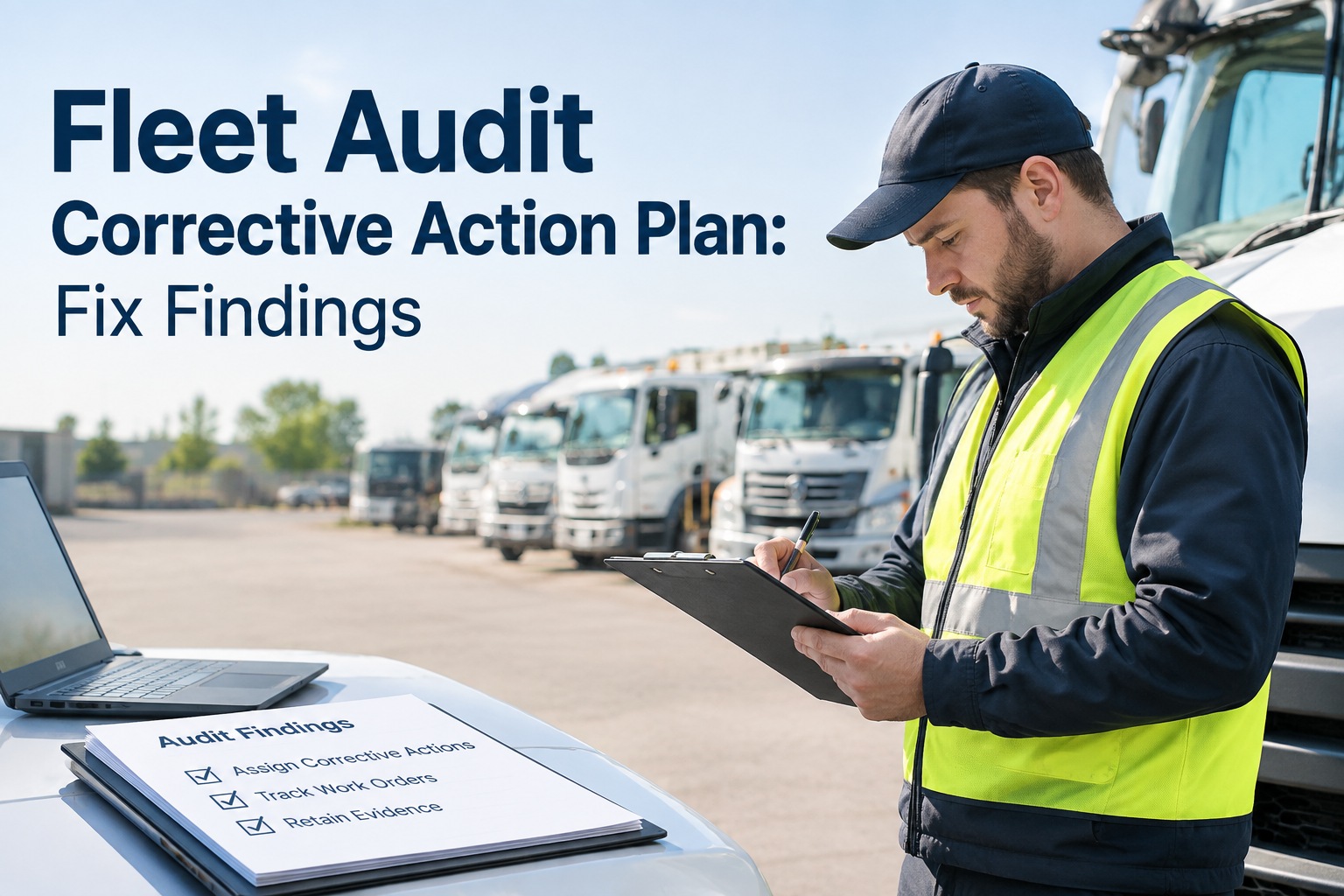
The audit closeout meeting ends. The inspector hands you a list of findings and a deadline — usually 30, 60, or 90 days to submit a written corrective action plan. What you do in the next week decides whether this becomes a paperwork exercise that closes cleanly, or a nine-month back-and-forth that ends with your next triennial already flagged.
Fleet Audit Corrective Action Plan: How to Close Findings Cleanly
The CAP structure regulators expect, the deadline mechanics that decide the outcome, and the evidence workflow that gets findings closed on the first submission.
- 30-90Day Deadline
- 3Severity Tiers
- 1stSubmission Close
What a Corrective Action Plan Actually Is (And Is Not)
A fleet audit corrective action plan is the formal written response you submit to the auditor showing exactly how each finding will be closed. It is not a promise. It is not a status update. It is a structured document that, when accepted, converts an open finding into a closed one and clears the record. Get it right and the audit closes cleanly. Get it wrong and the regulator sends it back for revision, or worse — issues a follow-up review.
The regulator is not evaluating your intentions. They are evaluating whether the written CAP is complete, whether the remediation is actually being performed, and whether you can produce evidence that proves it. Every finding in the CAP has to survive that three-part test on its own.
Most CAPs that come back for revision fail on the same point — the fleet described what they would do without specifying who owns it, by when, and what evidence will prove closure. A CAP that just says "we will retrain drivers on DVIR completion" is unfinished. A CAP that says "12 drivers retrained by Nov 15, verified by signed training log attached as Exhibit B" is finished. Book a demo to see the CAP workflow structure in a live BusCMMS environment.
The Three Severity Tiers That Decide Your Response Window
Not every finding runs on the same clock. Regulators categorize findings by severity, and each tier carries a different response deadline, a different level of documentation, and a different consequence if the CAP is late or rejected. Knowing which tier a finding falls into is the first thing to establish before starting the response.
Critical · Safety Direct
Findings tied to immediate safety exposure — brake defects fleet-wide, driver qualification file gaps, out-of-service violations, HOS falsification.
Major · Systemic
Systemic process gaps — inadequate PM documentation, DVIR retention shortfalls, missed inspection intervals, incomplete training records.
Minor · Documentation
Isolated documentation gaps — missing single-form signatures, incomplete record fields, filing errors that do not indicate systemic issues.
The mistake most safety directors make is treating all findings on the longest available clock. The Tier 1 findings need immediate action even before the formal CAP is submitted — an inspector who returns in 30 days and sees no interim safety measure in place will escalate the finding, regardless of what the CAP promises for day 90.
The Anatomy of a CAP Response the Regulator Will Accept
Every finding in the plan gets the same structured response. Six components per finding, in the same order, in a format the reviewer can scan quickly. This is the pattern that gets CAPs closed on the first submission.
-
01
Finding Restatement
Verbatim quote of the finding as written in the audit report, including the citation reference (49 CFR section, state statute, or grant agreement clause).
-
02
Root Cause Analysis
Why this finding occurred — not who to blame, but what process, training gap, or system deficiency allowed it. Reviewers reject CAPs that skip this.
-
03
Corrective Actions & Owner
Specific actions being taken, each assigned to a named individual with a role — not "the shop" or "operations." Actions must address the root cause, not just the symptom.
-
04
Completion Milestones
Specific dates for each corrective action, ordered so interim safety measures land first and permanent process changes land inside the response window.
-
05
Evidence Package
Attached exhibits proving the actions were completed — WO closeouts, training logs, updated SOPs, sample records showing the fix in production.
-
06
Preventive Measures Going Forward
The permanent process change that stops this from recurring — automated PM triggers, mandatory sign-off, retention enforcement, whatever addresses the root cause structurally.
Notice component six. This is where reviewers separate a fleet that fixed one finding from a fleet that fixed a category of findings. A CAP that only closes the specific instance without describing the systemic prevention typically gets marked for follow-up review. A CAP that ties the fix to a permanent system change closes and stays closed. Sign up free and structure your next CAP inside the platform.
The Evidence That Actually Closes a Finding
Different findings need different evidence to close. Submitting the wrong type — a policy document when the reviewer wanted operational proof, or a summary when they wanted source records — is the second most common reason CAPs come back for revision. Here is what closes each of the common finding categories.
The pattern is consistent across all seven — the reviewer wants both the specific fix and the systemic change. A completed WO closes the individual finding. A permanent process change closes the category. CAPs that submit both together get accepted quickly; CAPs that submit only one get returned. Book a demo to see evidence packages generated per finding type.
Where Most CAPs Actually Break Down
The failure modes are consistent across every fleet that ends up in a second-round CAP submission. Recognizing them early is what separates a clean closure from a nine-month back-and-forth.
The Verbal Assignment
Findings assigned in a hallway conversation instead of a tracked work order. Two weeks later nobody remembers who owned what, and the deadline is 30 days closer.
Evidence Reconstructed Late
Corrective work is done but the proof is assembled in the last week before submission — dates guessed, sign-offs missing, exhibits incomplete.
Symptom Fix Without Root Cause
The specific bus gets fixed but the process that let the failure happen is not changed. Reviewer accepts the individual fix, flags for follow-up on the pattern.
Missing Interim Safety Measure
Tier 1 finding sits on the 90-day clock without interim action. When the follow-up review lands, the fleet has no documented bridging control in place.
Owner Left the Organization
The named CAP owner departed mid-window and nobody transitioned the workflow. The remediation is unowned when the deadline arrives.
Split-System Evidence
Corrective WOs in one system, training records in another, updated SOPs in a shared drive. Nobody can assemble the closure package without cross-referencing four sources.
Five of the six failures above share the same root cause — no single system carrying the CAP workflow from finding through closure. Fix that and most of the failure modes disappear on their own.
How BusCMMS Runs the CAP Workflow End to End
BusCMMS treats each audit finding as a structured record with its own workflow — assigned owner, deadline, corrective work orders, evidence attachment, and closure sign-off. The CAP submission package generates from that record automatically, so the document you submit to the regulator is a byproduct of doing the work, not a separate assembly project.
-
Finding-Level Records
Each audit finding logged as its own record with citation, severity tier, deadline, and owner. No hallway assignments — every finding has a system-tracked home.
-
Corrective Work Order Linkage
Each finding spawns one or more corrective WOs tied back to it. When the WO closes with sign-off, the finding advances. Full traceability, no orphan work.
-
Deadline Tracking
Countdown per finding with milestone markers. Automated alerts before critical checkpoints so nothing runs to the wire silently.
-
Evidence Attachment
Photos, WO closeouts, training logs, updated SOPs attach directly to the finding record. Everything the reviewer needs lives in one place.
-
Named Owner with Handoff
Every finding has a system-tracked owner. If that person leaves or reassigns, the workflow reassigns cleanly — no orphaned CAPs.
-
CAP Submission Package
One-click export of the complete CAP document — every finding, response structure, evidence exhibits, and closure sign-offs formatted for regulator submission.
Because BusCMMS is built for bus fleets specifically, the finding categories, evidence types, and CAP formats align to what FMCSA, FTA, and state DOT reviewers actually expect from a bus operator — not generic maintenance findings retrofitted from trucking or manufacturing platforms.
The Practitioner View: Why Structure Beats Effort on Every CAP
That is the pattern that separates fleets with recurring CAP cycles from fleets that close audits cleanly. The number of findings matters less than the workflow underneath. A fleet with a real CAP system handles four findings the same way it would handle forty — as tracked records with owners, deadlines, and evidence. Fleets without that structure get eaten alive by two findings. Sign up free and turn your next audit response into normal operations.
The Bottom Line on Fleet Audit Corrective Action Plans
A corrective action plan is not a document you write. It is a workflow you execute — from the moment the findings land through the closure evidence going back to the regulator. Fleets that run the workflow inside a structured system spend weeks on CAPs instead of months, close on first submission instead of second or third, and turn each finding into a permanent process improvement instead of a one-time fix. The audit is going to happen either way. What decides the outcome is whether the system underneath your response is built for the work. Book a demo to see the CAP workflow end to end on your fleet.
What is a fleet audit corrective action plan?
A fleet audit corrective action plan (CAP) is the formal written response a fleet submits to a regulator after an audit — typically FMCSA compliance review, FTA triennial review, or state DOT inspection — that identifies findings. The CAP documents each finding, the root cause, the specific corrective actions being taken, the assigned owner, completion milestones, the evidence proving closure, and the systemic preventive measures. A CAP is a structured remediation document, not a status update or promise of future action.
How long does a fleet have to submit a corrective action plan?
Response deadlines depend on finding severity. Tier 1 critical findings — those tied to immediate safety exposure — typically require action inside 15 to 30 days, sometimes with interim safety measures required immediately. Tier 2 major systemic findings usually run on a 30 to 60-day window. Tier 3 minor documentation findings typically allow 60 to 90 days. The specific deadline is stated in the audit closeout letter. Missing a deadline can escalate the finding severity and trigger a follow-up review.
What causes a corrective action plan to get rejected?
The most common rejection reasons are describing corrective actions without a named owner, listing actions without a specific completion date, submitting summary evidence when source records are required, addressing only the specific instance without describing the systemic prevention, missing interim safety measures on Tier 1 findings, and providing evidence assembled from multiple systems that the reviewer cannot cross-verify. Rejected CAPs must be revised and resubmitted, often on a shortened deadline.
What evidence do regulators want to close a finding?
Evidence requirements vary by finding type. A missed PM needs the completed WO plus subsequent on-time PM history. A DVIR retention gap needs an updated retention policy plus sample DVIRs from the required window. A driver qualification file gap needs the complete DQ file plus a new intake SOP. An unclosed recall needs the closed WO, OEM completion form, and confirmation. Across every category, reviewers want both the specific fix (proving the individual issue is closed) and the systemic change (proving the category cannot recur).
How does BusCMMS help manage corrective action plans?
BusCMMS treats each audit finding as a structured record with citation, severity tier, deadline, owner, and linked corrective work orders. Photos, WO closeouts, training logs, and updated SOPs attach directly to the finding record as evidence. Deadline countdowns and automated alerts keep milestones visible. When it is time to submit, a one-click export generates the complete CAP document — every finding, response structure, evidence exhibits, and closure sign-offs — formatted for regulator submission. The document is a byproduct of the workflow, not a separate assembly project.