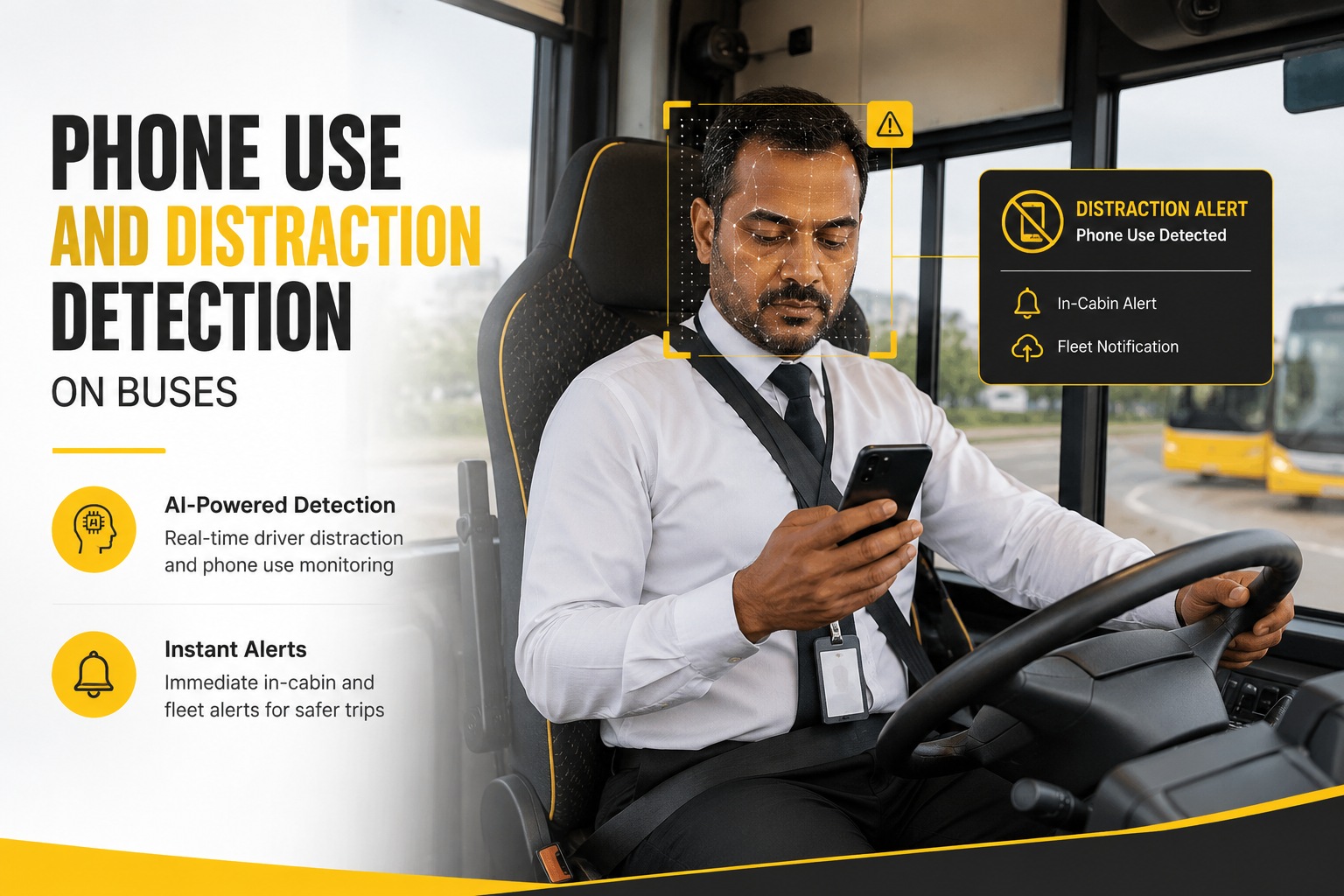
A driver glancing at a phone for even two seconds at 35 mph covers over 100 feet essentially blind. Distracted driving detection bus systems use AI to spot a handheld device in a driver's hand or against their ear in real time, flagging the moment it happens rather than waiting for a near-miss to surface it after the fact. See how a video event becomes a closed work order in BusCMMS.
Phone Use and Distraction Detection on Buses
What the federal handheld-device rule actually covers, how detection avoids drowning safety staff in false positives, and how districts structure discipline around video evidence.
What the Federal Rule Actually Prohibits
Naming the regulation precisely matters here.
The federal prohibition on handheld mobile phone use by commercial motor vehicle drivers is set out at 49 CFR 392.82, which bars a CMV driver from holding a mobile phone to make a call, reaching for a phone in a way that requires leaving a seated driving position, or pressing more than a single button to initiate, answer, or end a call while driving. Note that this handheld-use prohibition sits in Part 392, not Part 395 — 49 CFR Part 395 governs hours of service and electronic logging device requirements, a related but separate set of rules, with specific exceptions carved out for school bus operations. Getting the citation right matters if a district needs to defend a policy decision in front of a board or a hearing officer.
How Handheld Device Detection Actually Works
Distinguishing a phone in hand from a hand near an ear.
In-cab AI systems trained on driver-facing video look for the specific visual signature of a handheld device — a hand positioned near the ear in a call posture, a phone held at eye level, or a driver looking down at a device in their lap for an extended period. Well-tuned systems distinguish this from superficially similar but harmless behavior: scratching an ear, adjusting glasses, or glancing at a dashboard-mounted device that isn't handheld at all. That distinction is exactly where a poorly tuned system starts generating the false-positive volume that undermines the entire program.
The Objection Worth Naming: Alert Volume Kills the Program
Too many alerts is functionally the same as no alerts.
This is the failure that quietly defeats most distraction-detection rollouts: alert volume climbs so high that safety staff stop reviewing footage in any consistent way, and a real violation drowns in a flood of false positives from ordinary driver movement — scratching an ear, wiping sweat, adjusting a visor. A program built on an unfiltered feed doesn't just waste staff time, it also becomes indefensible in a disciplinary hearing, since a driver can reasonably point out that the system flags harmless behavior constantly. Detection has to be tuned tightly enough that a flagged event is something a supervisor can stand behind without hesitation.
A Scenario From a Real Bus Operation
Video evidence turned a disputed claim into a documented conversation.
A school district running 60 buses received a parent complaint alleging a driver was texting while stopped at a rail crossing. Without video, the claim would have come down to the parent's word against the driver's. The district pulled the flagged event log for that bus and time window and found a confirmed handheld-device detection matching the exact timestamp of the complaint. Rather than an unresolved dispute, the district had a specific clip to review directly with the driver — leading to a documented first-tier coaching conversation rather than a drawn-out he-said-she-said investigation.
Before we had video, a complaint like that turned into weeks of back-and-forth with no way to actually resolve it. Now we pull the clip, and either it confirms the complaint or it clears the driver. Either way, it's resolved in a day instead of dragging on.
Not sure if your current detection system is tuned tightly enough to hold up in a disciplinary review? That's worth checking. Talk to the team about a detection audit →
AI Detection First, So You're Not Waiting on a Complaint
The wedge BusCMMS solves that a standalone camera vendor can't.
BusCMMS is an AI-native bus fleet operations platform, and the wedge here is sequencing: AI defect and event detection runs first, so the platform surfaces the worst-performing bus and the riskiest route before anyone opens a manual report. A confirmed phone-use event doesn't sit waiting for a parent complaint to trigger a review — it shows up on the fleet dashboard the moment it's detected, already tied to the driver record and ready for the next tier of the district's own discipline policy.
Frequently Asked Questions
What does federal law actually prohibit regarding phone use while driving a bus?
49 CFR 392.82 prohibits a commercial motor vehicle driver from holding a mobile phone to make a call, reaching for a phone in a way that requires leaving a seated driving position, or pressing more than a single button to operate it while driving.
How does AI distinguish real phone use from harmless driver movement?
Well-tuned detection looks for a sustained handheld-device posture — a phone held at eye level or against the ear for a meaningful duration — rather than flagging any hand-near-face motion, which would otherwise capture harmless behavior like adjusting glasses or scratching an ear.
Why do some distraction detection programs generate too many false alerts?
A system tuned to flag any hand movement near the face generates a large volume of false positives from ordinary driver behavior, which causes safety staff to stop reviewing the queue consistently and lets genuine violations blend into the noise.
How do districts typically structure discipline around a confirmed phone-use event?
Many districts use a progressive discipline ladder: a documented coaching conversation for a first confirmed event, escalating through written warnings and formal review for repeated events within the same term, with each tier anchored to a specific reviewed clip.
Do hours-of-service rules under 49 CFR Part 395 apply to school bus drivers?
49 CFR Part 395 governs hours of service and includes electronic logging device provisions under Subpart B, but school bus operations carry specific exceptions under that same part, distinct from the handheld-device prohibition in Part 392.