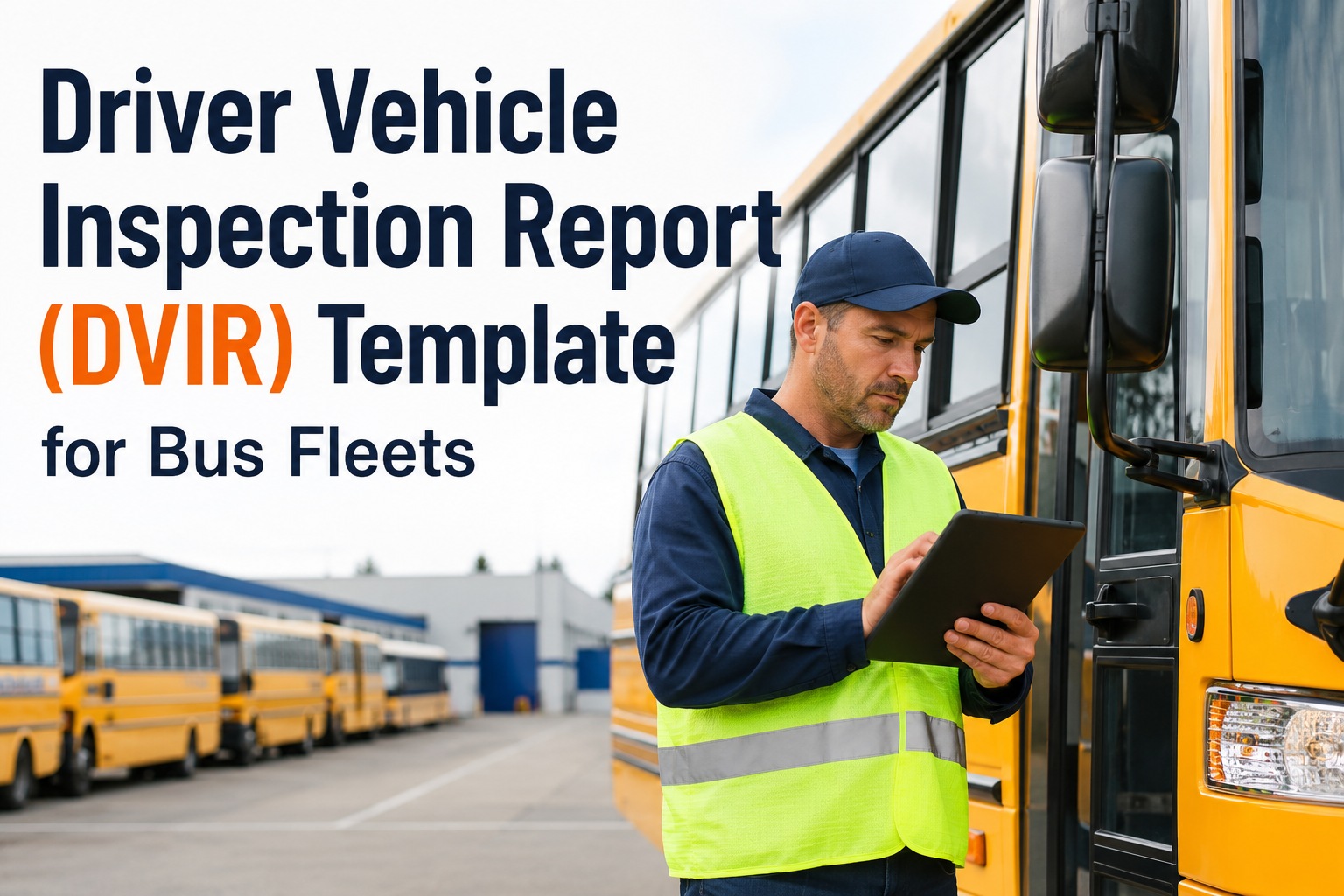
Your FMCSA auditor gives you 48 hours to produce the last 90 days of driver vehicle inspection reports for your school bus fleet. Not sample records. Every DVIR, every bus, every day. Driver signature, mechanic certification if a defect was flagged, next-driver review. If your DVIRs live on paper in a shop office binder, you have a problem. If they live in a spreadsheet, you have a bigger one. This is the driver vehicle inspection report template that gets bus fleets through those 48 hours without a citation, plus the exact fields 49 CFR 396.11 requires and why FMCSA finally made electronic DVIRs explicitly legal in March 2026. Bus fleets that get this wrong pay $1,584 per day per violation. The ones that get it right barely notice audit season.
The Driver Vehicle Inspection Report Template for Bus Fleets in 2026
Every field FMCSA requires, the three-signature chain explained clearly, and the exact fields that make audits routine instead of frantic — built for school bus, transit and motorcoach operations.
eDVIR-compliant with the March 2026 FMCSA final rule · built for bus fleets only
Daily Vehicle Inspection Report
49 CFR 396.11 · Bus fleet templateRequired Inspection Items · 49 CFR 396.11
- Service brakes
- Parking brake
- Steering mechanism
- !Lighting devices
- Tires
- Horn
- Windshield wipers
- Rear vision mirrors
- Wheels & rims
- Emergency equipment
- Stop arm & crossing gate
- Emergency exits & buzzer
Rear tail light, driver side, bulb out. Bus flagged for maintenance before next revenue day. Work order auto-created.
The Driver Vehicle Inspection Report Rules FMCSA Actually Enforces
A driver vehicle inspection report is not a form. It is a chain of evidence created under 49 CFR 396.11 that connects three parties -- the driver who found the defect, the mechanic who certified the repair, and the next driver who reviewed and signed off before operating the bus. Break any link in that chain and the whole record is incomplete. Auditors do not grade incomplete records on a curve.
Bus fleets face a stricter version of the DVIR rule than freight carriers. A property-carrying truck only needs a DVIR when a defect is found. A passenger-carrying bus needs a DVIR every single operating day, whether the driver found anything or not. That is one of the top compliance gaps FMCSA cites during audits, and it applies to school bus, transit, and motorcoach operations equally. Book a demo to see the daily DVIR workflow built for bus fleets.
The Three-Signature Chain That Makes a DVIR Legally Complete
Every complete DVIR carries up to three signatures. A driver signature at end of workday under 396.11(a). A mechanic certification of repair or no-repair-needed under 396.11(b) when a defect was noted. A next-driver review and acknowledgment under 396.13 before the bus rolls again. Missing any one of these three is one of the most-cited violations in DOT audits.
-
1
Driver
Signs the DVIR at the end of every workday, listing any defect found during operation. Bus fleets file daily regardless of defect status.
§396.11(a) -
2
Mechanic
Certifies the defect was repaired, or that no repair was needed to make the bus safe. Bus cannot return to service without this signature.
§396.11(b) -
3
Next Driver
Reviews the previous DVIR before operating the bus. If defects were listed, acknowledges the repair certification. This closes the chain.
§396.13
Paper-based fleets consistently fail this chain. Records get lost, mechanic certifications never make it back to the file, next-driver reviews go unsigned. Digital DVIRs enforce every link automatically because the system will not close the record until each signature is captured. Book a demo to see the three-signature chain enforced live.
The 11 Required Elements Every DVIR Template Must Include
FMCSA 49 CFR 396.11 harmonizes DVIR requirements with the pre-trip inspection items in 49 CFR 392.7. Every DVIR template must address these eleven parts and accessories. Any defect that affects safe operation or could cause a breakdown gets documented against one of these categories.
- 01Service Brakes
- 02Parking Brake
- 03Steering Mechanism
- 04Lighting Devices & Reflectors
- 05Tires
- 06Horn
- 07Windshield Wipers
- 08Rear Vision Mirrors
- 09Coupling Devices
- 10Wheels & Rims
- 11Emergency Equipment
Bus-Specific DVIR Items Beyond the FMCSA Minimums
The 11 elements above cover any commercial motor vehicle. Buses need more. Passenger safety equipment, boarding devices, and student-safety hardware all belong on a bus DVIR alongside the FMCSA minimums, whether the fleet operates yellow school buses, transit, or charter coaches. State DOT inspection standards typically require these items even when the federal rule technically does not.
-
Stop Arm & Crossing Gate
School bus stop arm deploys fully with 8-light warning system; crossing gate extends without binding.
-
Emergency Exits & Buzzer
Rear door, side door, roof hatch, and pushout windows checked functional. Warning buzzer sounds on open.
-
Student Mirrors & Cross-View
Cross-view mirrors positioned to see the danger zone at every side of the bus, no cracks or fogging.
-
Wheelchair Lift & Securement
Lift cycles fully, interlock engages, four-point securement anchors accept straps, safety belt intact.
-
Fire Extinguisher & First Aid
Fire extinguisher pressure in green, seal intact. First aid kit stocked, in-date, mounted in access location.
-
Reflective Triangles & Flares
Three reflective triangles present. Flares in-date if used. Reflective vest available for driver egress at roadside.
A generic truck DVIR template will not surface any of these. A bus-specific DVIR template loads them automatically alongside the federal 11 so nothing gets missed. Book a demo to see a bus-specific DVIR template pre-loaded for your fleet type.
Paper DVIR Template vs Digital DVIR: What Actually Changes Day to Day
The March 2026 FMCSA final rule did more than authorize eDVIRs. It signaled that FMCSA expects the industry to move digital, and audit expectations follow that expectation. Here is what actually changes on the shop floor when a bus fleet retires paper DVIRs.
Paper DVIR
The old wayDigital DVIR (BusCMMS)
2026 standard- Time per DVIR 12–15 minutes 3–4 minutes
- Signature capture Physical scan, delayed Digital timestamp, instant
- Defect handoff Manual paper handoff Auto work order created
- Record retention Binder in shop office Cloud, 3+ year default
- Audit retrieval Hours to days One-click export
- Compliance risk High · lost or incomplete Low · system-enforced
FMCSA audits DVIR records in the vast majority of compliance reviews and only about 7% of motor carriers pass without a single violation. The fleets that pass clean have almost universally moved off paper. Book a demo to see the digital DVIR export that auditors accept in one click.
What a Transportation Director Actually Watches
I have been through five FMCSA audits in twelve years. The one thing that separated a clean review from a cited review was not whether we had DVIRs. Everyone has DVIRs. It was whether the mechanic certification and the next-driver review were on the same document as the driver signature, dated, and immediately findable. On paper, that combination almost never survives a full quarter. On a digital system, the record cannot even close without it. That is not a nice-to-have. That is the compliance itself.
Her point holds regardless of fleet size. The three-signature chain is the compliance mechanism, and it is exactly the mechanism paper is worst at holding together. A DVIR template is only as good as the workflow behind it. Book a demo to see the three-signature audit trail in BusCMMS.
How BusCMMS Turns This DVIR Template Into a Digital Workflow
A template on paper still requires paper. A template inside a bus-specific CMMS enforces every FMCSA rule automatically. Here is what changes the day a fleet moves this DVIR template into BusCMMS.
-
Bus-Specific DVIR On A Tablet
Driver taps through the 11 required items plus bus-specific stops arms, exits, and lifts in under four minutes.
-
Enforced 3-Signature Chain
Driver signs, mechanic certifies, next driver reviews. Record cannot close until all three are captured with timestamps.
-
Auto Work Orders on Defects
Any flagged defect on the DVIR generates a work order and pulls the bus from the next-day schedule automatically.
-
Fleet-Wide Dashboard
See open defects, missing signatures, and DVIR completion rate across every bus in a single view.
-
Audit-Ready Export
Produce any DVIR for any bus, any day, in one click. FMCSA-formatted for the 48-hour audit window.
-
3-Month+ Retention Built In
Every DVIR, mechanic certification, and next-driver review stored past the FMCSA minimum by default.
BusCMMS reports that fleets moving DVIRs into its platform typically hit near-100% completion rates in the first month and produce audit-ready DVIR exports on demand. Those are BusCMMS’s own reported figures from its bus-fleet customer base — and they line up with what transportation directors describe when the three-signature chain finally has a system behind it. Book a demo to see the DVIR completion dashboard live.
Do bus fleets need to submit a DVIR every day, or only when defects are found?
Every operating day. Passenger-carrying commercial motor vehicles — including school buses, transit buses, motorcoaches, and shuttles — must file a DVIR at the end of every workday whether defects were found or not, under 49 CFR 396.11. This is one of the top compliance gaps FMCSA cites during audits. Freight trucks changed to a defects-only DVIR rule in 2014, but that change never applied to passenger-carrying vehicles.
Are electronic DVIRs legally compliant for bus fleets in 2026?
Yes. FMCSA issued a final rule under docket FMCSA-2025-0115, effective March 23, 2026, explicitly authorizing electronic DVIRs in 49 CFR 396.11 and 396.13. Electronic DVIRs were already permitted under 49 CFR 390.32 since 2018, but the 2026 rule removed any remaining ambiguity. The digital system must timestamp entries, link driver identity to each signature, and retain records for at least three months. BusCMMS is built to meet all of these requirements out of the box.
What are the 11 required elements on a DVIR under 49 CFR 396.11?
The 11 required parts and accessories, harmonized with pre-trip requirements under 49 CFR 392.7, are: service brakes (including trailer brake connections), parking brake, steering mechanism, lighting devices and reflectors, tires, horn, windshield wipers, rear vision mirrors, coupling devices, wheels and rims, and emergency equipment. Any defect affecting safe operation or likely to cause a breakdown must be documented against one of these categories. Bus fleets should also add passenger-specific items such as stop arms, emergency exits, wheelchair lifts, and student mirrors.
How long must bus fleets retain DVIR records?
The minimum retention period under 49 CFR 396.11(a)(4) is three months from the date of inspection. This covers three separate documents: the driver-signed DVIR, the mechanic or carrier repair certification, and the next-driver review acknowledgment under 396.13. All three must be retained. With FMCSA offsite audits routinely arriving with 48-hour notice to produce digital records, every DVIR for every bus in the past 90 days must be immediately retrievable with all three signatures documented.
What is the penalty for missing or incomplete DVIRs?
FMCSA can impose civil penalties of up to $1,584 per day per violation for missing or incomplete DVIR records. Serious or repeated violations can trigger an out-of-service order for the entire fleet. The financial cost is often less painful than the CSA score impact, which can raise audit frequency, insurance premiums, and contract eligibility for years. Fleets that move DVIRs to digital systems typically eliminate the missing-signature failure mode entirely because the record cannot close without every required signature captured.