Only 7 percent of motor carriers pass a focused DVIR compliance review without a single violation. The gap is not driver effort -- it's the paper workflow. 73% of paper DVIRs never reach the office intact, versus 96% audit pass rates for digital fleets. On March 23, 2026, the FMCSA final rule (Docket FMCSA-2025-0115) added explicit electronic DVIR authorization language to 49 CFR 396.11 and 396.13, removing the last regulatory ambiguity between paper and electronic. Digital signatures, cloud storage and mobile submission are now unambiguously compliant. For bus fleets, the daily submission rule has not changed -- passenger-carrying CMVs still submit a DVIR every operating day, defect or no defect. This is the practical 2026 walkthrough of the 11-item inspection checklist, the 3-signature chain, the 3 mistakes causing most violations, and the audit-ready workflow. See BusCMMS run pre-loaded eDVIRs on your fleet → book a 20-min demo.
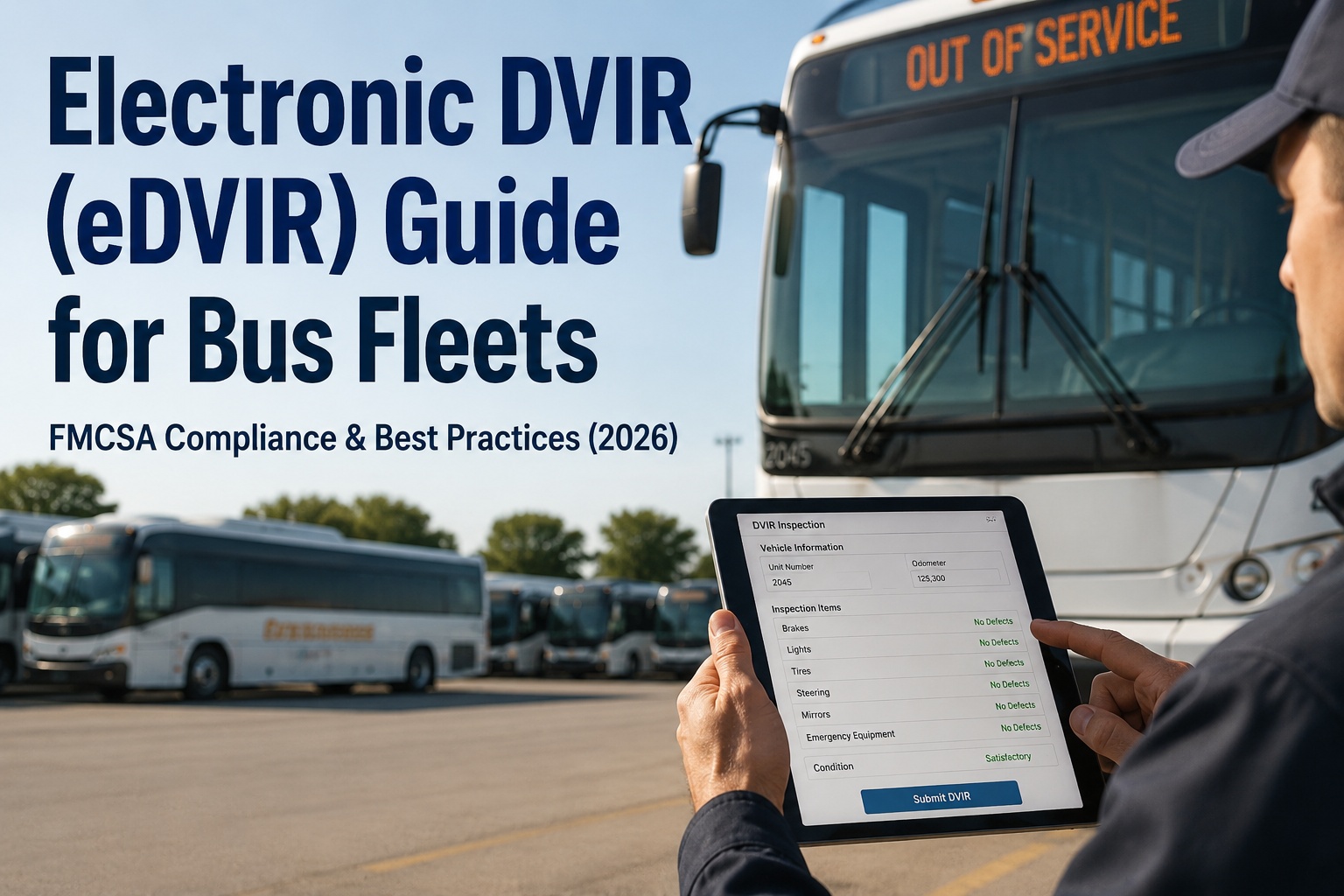
Electronic DVIR Guide for Bus Fleets
The FMCSA compliance framework, 11-item checklist, 3-signature chain, and the mistakes that cause most audit violations.
- Illegible signatures
- Missing carbon copies
- Lost in transit
- Timestamped signatures
- Cloud-stored 90+ days
- Photo-verified defects
The March 23, 2026 Rule: What Changed, What Didn't
FMCSA cleaned up the last piece of paper-vs-digital ambiguity. Everything else stayed the same.
Electronic DVIRs were technically permitted under 49 CFR 390.32 since 2018 -- but the paper-centric language in 396.11 and 396.13 meant different auditors interpreted digital records differently. Some accepted them without question. Others demanded wet-ink originals. That interpretive gap created real audit risk. Federal Register Vol. 91, No. 33, published February 19, 2026, closed the gap with a clarifying sentence in both sections. Effective March 23, 2026, backed by ATA, OOIDA, and NTTC.
Explicit eDVIR authorization
- +Electronic creationDVIRs may be created and maintained electronically under 396.11 and 396.13
- +E-signature chainAll 3 signatures (driver, mechanic, next driver) valid as digital under E-SIGN Act
- +Cloud storage authorizedMobile submission and cloud retention explicitly compliant
- +Interpretive risk removedAuditor discretion on paper vs digital no longer a factor
Everything else in 396.11 / 396.13
- =Daily DVIR for busesPassenger-carrying CMVs still file every operating day -- no defect required
- =11-component inspectionThe mandatory categories under 396.11(a)(2) are unchanged
- =3-signature chain intactDriver, mechanic (when applicable), and next driver -- all still required
- =90-day retention minimumPer 396.11(a)(4). Best practice remains 1+ year
The rule did not mandate eDVIRs -- paper remains legal. FMCSA's stated purpose was to encourage carriers to adopt cost-saving electronic methods. See BusCMMS run 49 CFR 396.11-compliant eDVIRs → book a demo.
The 11-Item Inspection Checklist (49 CFR 396.11(a)(2))
The federally mandated categories, grouped by system. Bus-specific items added at the end.
FMCSA specifies 11 mandatory categories every DVIR must cover. Missing a single category on the inspection form is a citable violation -- even if the driver visually inspected the item and the vehicle was safe. Bus-specific items (stop arms, wheelchair lifts, student mirrors) sit inside the "emergency equipment" and "coupling devices" categories per FMCSA guidance for passenger-carrying CMVs.
Braking & Steering
- 01Service brakes (including parking brake)
- 02Steering mechanism
Visibility & Signaling
- 03Lighting devices and reflectors
- 04Windshield wipers
- 05Rear vision mirrors
- 06Horn
Tires, Wheels & Coupling
- 07Tires
- 08Wheels and rims
- 09Coupling devices (if applicable)
Emergency Equipment
- 10Emergency equipment (extinguisher, warning triangles)
- 11All items required by 49 CFR 393
Bus-specific items that ride inside these categories
Generic DVIR forms miss bus items entirely. Purpose-built eDVIRs cover all 11 categories plus the passenger-carrier specifics. See BusCMMS's pre-loaded bus DVIR forms → book a demo.
The 3-Signature Compliance Chain
Where paper workflows quietly break the chain daily -- and where digital enforces it.
Driver Signature
Driver signs at end of every operating day. For bus fleets, this is required whether defects are found or not. Missing this signature is the most common violation in freight-transitioning bus fleets.
Mechanic / Carrier Signature
Only required when a defect was flagged. Certifies either the repair was completed OR that no repair was necessary. This is where paper workflows break most: DVIRs get filed before the mechanic sees them, or the certification never gets added to the record.
Next Driver Acknowledgment
Before operating, the next driver must review the most recent DVIR and sign acknowledging any repairs were made or unnecessary. This is where paper chains die: driver takes the bus without checking the glovebox folder, and the chain has an unfilled slot forever.
Where paper chains break
Every paper DVIR requires three humans in the same place at the right time with the right piece of paper. When shift change happens at 5am and the mechanic isn't on site until 7am, slot 2 gets filed empty. When the next driver takes the bus at 5:30am without checking the glovebox folder, slot 3 is empty too. Digital chains enforce order: the eDVIR cannot close until slot 2 is filled, and the next driver's mobile app blocks the bus start until slot 3 is captured.
3 DVIR Mistakes Causing Most Bus-Fleet Violations
FMCSA audit outcome analysis. None of them involve drivers deliberately skipping inspections.
Applying the "no defect, no DVIR" rule to buses
Freight rule misapplied to passenger CMVsSince 2014, property-carrying CMVs (freight trucks) don't file a DVIR when no defects are found. Passenger-carrying CMVs -- including school buses, transit buses, and motorcoaches -- still must file every operating day. Transportation directors coming from freight often apply the wrong rule for months before an audit surfaces it. Every missing daily DVIR is a separate violation.
Missing signature 2 or signature 3 in the chain
49 CFR 396.11(a)(3)(ii) · 396.13Signature 1 (driver post-trip) almost always happens because it's tied to the end of shift. Signature 2 (mechanic certifying repair) and Signature 3 (next driver pre-trip acknowledgment) are where paper workflows break constantly. The DVIR gets filed with slots 2 and 3 empty. On audit, FMCSA sees a defect flagged, no repair certification, and no acknowledgment -- the exact pattern of a fleet ignoring a known defect.
Failing the 90-day retention audit
49 CFR 396.11(a)(4) · 48-hour audit demandFMCSA compliance reviews arrive with a 48-hour demand to produce the last 90 days of DVIRs. Paper fleets scramble through glovebox folders, filing cabinets, and driver clipboards. Missing days show up immediately. Best practice retention is 1+ year, but the legal minimum is 90 days -- and 73% of paper DVIRs never reach the office intact, meaning the 90-day audit trail is full of gaps that were never captured, not just misfiled.
Every one of these 3 mistakes is a paper-workflow failure, not a driver failure. See BusCMMS enforce every step of the DVIR chain → book a demo.
Paper vs Digital: The Practical Head-to-Head
What changes operationally when a bus fleet moves from clipboards to eDVIR.
What actually happens
- Time per DVIR: 8-12 minutes (write + file + distribute)
- Legibility: Handwriting quality varies driver to driver
- Missing signatures: Slot 2 and 3 empty on 40-60% of forms
- Retention: Filing cabinet, glovebox folder, driver clipboard
- Audit response: 48-hour demand triggers scramble
- Photo defects: Not possible
- Signature valid: Wet-ink only under old interpretation
What operational change looks like
- Time per DVIR: 3-4 minutes (guided checklist)
- Legibility: Typed, GPS-tagged, timestamped
- Missing signatures: Chain enforced -- cannot skip
- Retention: Cloud, instantly searchable, 1+ year default
- Audit response: 90-day export in 15 minutes
- Photo defects: Captured inline with the flag
- Signature valid: E-SIGN Act-compliant digital, explicitly authorized post-Mar 23, 2026
The operational payback
On a 40-bus fleet running 2 shifts per day, moving from paper to digital saves roughly 8 minutes per DVIR times 80 DVIRs per day = 10.7 hours per day recovered. Over a school year, that's nearly 2,000 hours not spent chasing paper. And the audit exposure differential -- 73% vs 96% pass rate -- is where the real financial risk sits.
Time saved is real. Audit exposure removed is the bigger number. See BusCMMS run paper-to-digital DVIR migration → book a demo.
Where BusCMMS Fits Your eDVIR Program
Six ways the March 23 rule becomes daily operational reality.
Pre-Loaded Bus DVIR Forms
All 11 FMCSA categories plus bus-specific items -- stop arms, wheelchair lifts, student mirrors, 8-light warning system -- pre-loaded. No form configuration on day 1.
3-Signature Chain Enforcement
eDVIR cannot close with slot 2 empty. Next bus start blocked until slot 3 acknowledgment. No more silent gaps in the compliance chain.
Daily Submission Auto-Flag
Missing DVIR flags that same evening per bus. Passenger-CMV daily rule enforced automatically -- freight-transitioning fleets protected from the M1 mistake.
Photo-Verified Defect Capture
Driver flags a defect and attaches a photo inline. Defect syncs to work order queue automatically. Photo lives in the DVIR record for audit defense.
90-Day Audit Export
48-hour FMCSA demand for the last 90 days of DVIRs met in 15 minutes with 100% coverage. Date-range export, PDF or CSV.
Timestamped E-Signature Chain
Every signature carries device fingerprint, GPS coordinate, and timestamp per E-SIGN Act. Explicitly compliant under the March 23, 2026 FMCSA rule.
We ran paper DVIRs for years. Audit came in April with a 48-hour demand for 90 days of records across 34 buses. We found 27 days with gaps -- forms lost, signatures missing, mechanic slot empty on defects that we knew were actually repaired. Fine landed at $9,400. Moved to digital eDVIRs in BusCMMS three weeks later. Next audit, we exported 90 days in 12 minutes with every signature, every timestamp, every defect photo. Zero violations. The rule change on March 23 removed the last excuse I had for staying on paper.
Audit could arrive with 48 hours' notice. The 90-day trail starts today. Sign up free and run your first eDVIR →
Frequently Asked Questions
Are electronic DVIRs legal for bus fleets in 2026?
Yes, fully legal and now explicitly authorized. FMCSA published final rule Docket FMCSA-2025-0115 on February 19, 2026 (Federal Register Vol. 91, No. 33), effective March 23, 2026, which added explicit electronic DVIR authorization language to 49 CFR 396.11 and 396.13. Electronic DVIRs were technically permitted under 49 CFR 390.32 since 2018, but the previous paper-centric wording in 396.11 and 396.13 left interpretive ambiguity that different auditors treated inconsistently. The 2026 rule removes that ambiguity in a single clarifying sentence. Electronic creation, cloud storage, mobile submission, and E-SIGN Act-compliant digital signatures for all three parties in the signature chain are now unambiguously compliant. Paper DVIRs also remain legal -- the rule did not mandate electronic, but FMCSA explicitly stated the purpose is to encourage carriers to adopt cost-saving electronic methods. The rule was supported by ATA, OOIDA, and NTTC.
Do bus drivers still need to file a DVIR when no defects are found?
Yes -- and this is the most common bus-fleet compliance mistake. Since 2014, property-carrying commercial motor vehicles (freight trucks) have not been required to file a DVIR when no defects were found. Passenger-carrying CMVs -- including school buses, transit buses, motorcoaches, and charter buses -- were explicitly excluded from that exemption and must submit a DVIR every operating day, defect or no defect. Transportation directors who came from freight operations often apply the freight rule to buses for months before an audit surfaces the gap. Every missing daily DVIR is a separate citable violation under 49 CFR 396.11. If a passenger-carrying operation somehow ends the day without a submitted DVIR, that is a violation even if the bus was mechanically flawless.
What are the 11 mandatory DVIR inspection categories under 396.11(a)(2)?
FMCSA requires every DVIR to cover 11 categories: (1) service brakes including parking brake, (2) steering mechanism, (3) lighting devices and reflectors, (4) tires, (5) horn, (6) windshield wipers, (7) rear vision mirrors, (8) coupling devices where applicable, (9) wheels and rims, (10) emergency equipment (fire extinguisher, warning triangles), and (11) all items required by 49 CFR Part 393. For passenger-carrying CMVs, bus-specific items ride inside these categories per FMCSA guidance: stop arms, crossing gates, emergency exits, student mirrors (crossover and convex), wheelchair lifts and ADA equipment, 8-light warning systems, backup alarm functionality, and passenger seating and belts. Missing any single category on the DVIR form is a citable violation -- even if the driver visually inspected the item and the bus was safe. Purpose-built bus eDVIR forms cover all 11 categories plus the passenger-carrier specifics; generic freight DVIR forms leave bus items out entirely.
What is the 3-signature DVIR chain and where do fleets break it?
The 3-signature compliance chain codified in 49 CFR 396.11(a)(3) and 396.13 requires: (1) the driver's post-trip signature at end of every operating day, (2) the mechanic or carrier signature certifying that a flagged defect was either repaired or determined not to need repair -- only required when a defect was found, and (3) the next driver's pre-trip acknowledgment before operating. Signature 1 almost always happens because it's tied to end of shift. Signatures 2 and 3 are where paper workflows break constantly -- if the mechanic isn't on site at shift change, slot 2 stays empty; if the next driver doesn't open the glovebox folder, slot 3 stays empty too. On audit, FMCSA sees a defect flagged, no repair certification, and no acknowledgment -- the exact pattern of a fleet ignoring a known defect. Digital eDVIR chains enforce order: the report cannot close until slot 2 is filled, and the next driver's mobile app blocks the bus start until slot 3 is captured.
How long must a bus fleet retain DVIR records?
Minimum 90 days (3 months) from the date the report was prepared, per 49 CFR 396.11(a)(4). This applies to the DVIR itself, the mechanic's repair certification, and the next driver's acknowledgment. Best practice is 1 year or longer, particularly for passenger-carrying fleets where litigation exposure is higher. Digital storage makes extended retention essentially free -- cloud costs for years of DVIRs are marginal compared to audit and litigation defense value. FMCSA compliance reviews typically arrive with a 48-hour demand to produce the last 90 days of DVIR records. Paper fleets scramble through filing cabinets and glovebox folders and often find missing days that were never actually captured (73% of paper DVIRs never reach the office intact). Digital eDVIR systems produce the 90-day range in 15 minutes or less as a date-filtered export -- one reason digital fleets pass focused compliance reviews at 96% versus 73% for paper. BusCMMS retains DVIRs for the life of the account by default with instant date-range export for audit response.