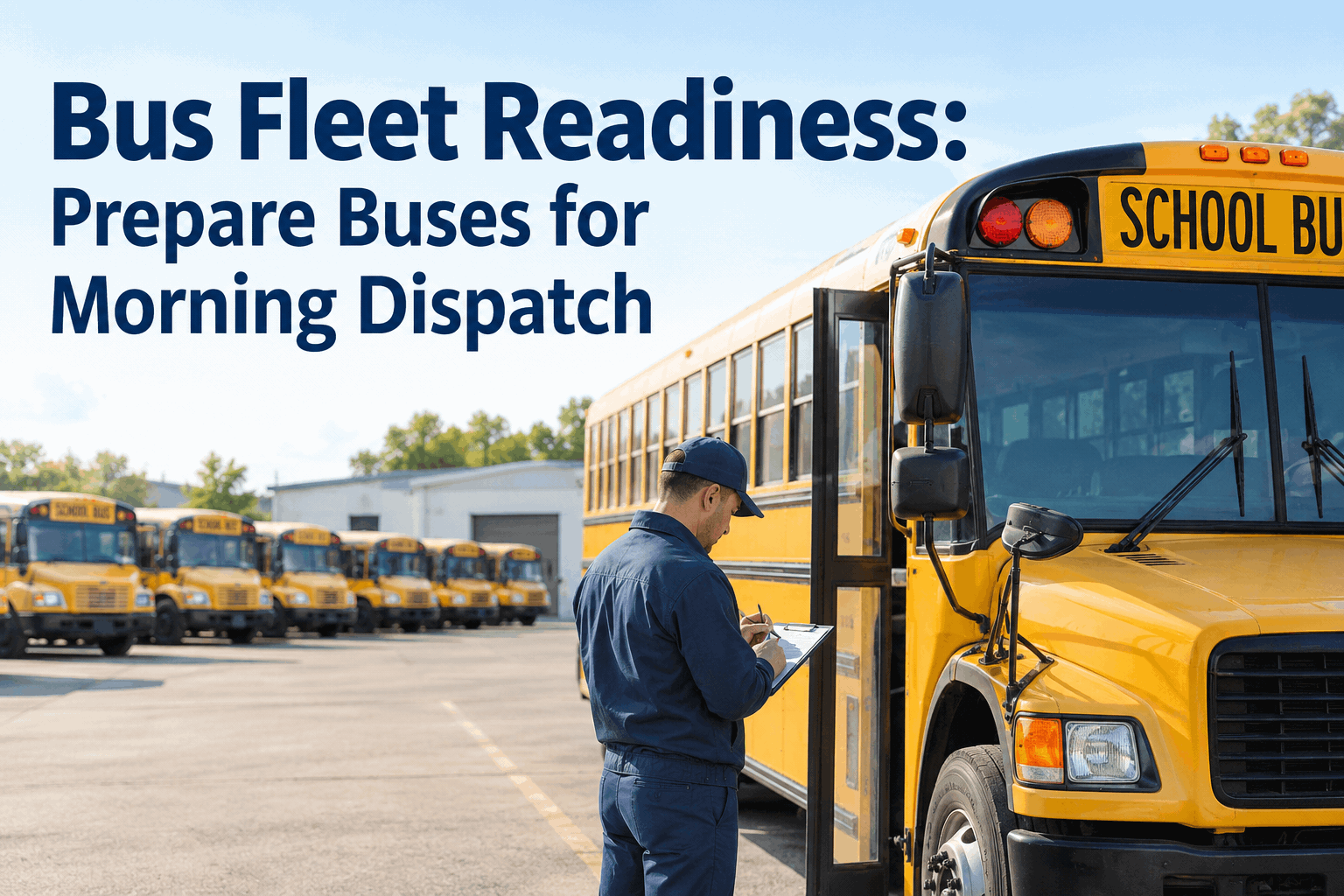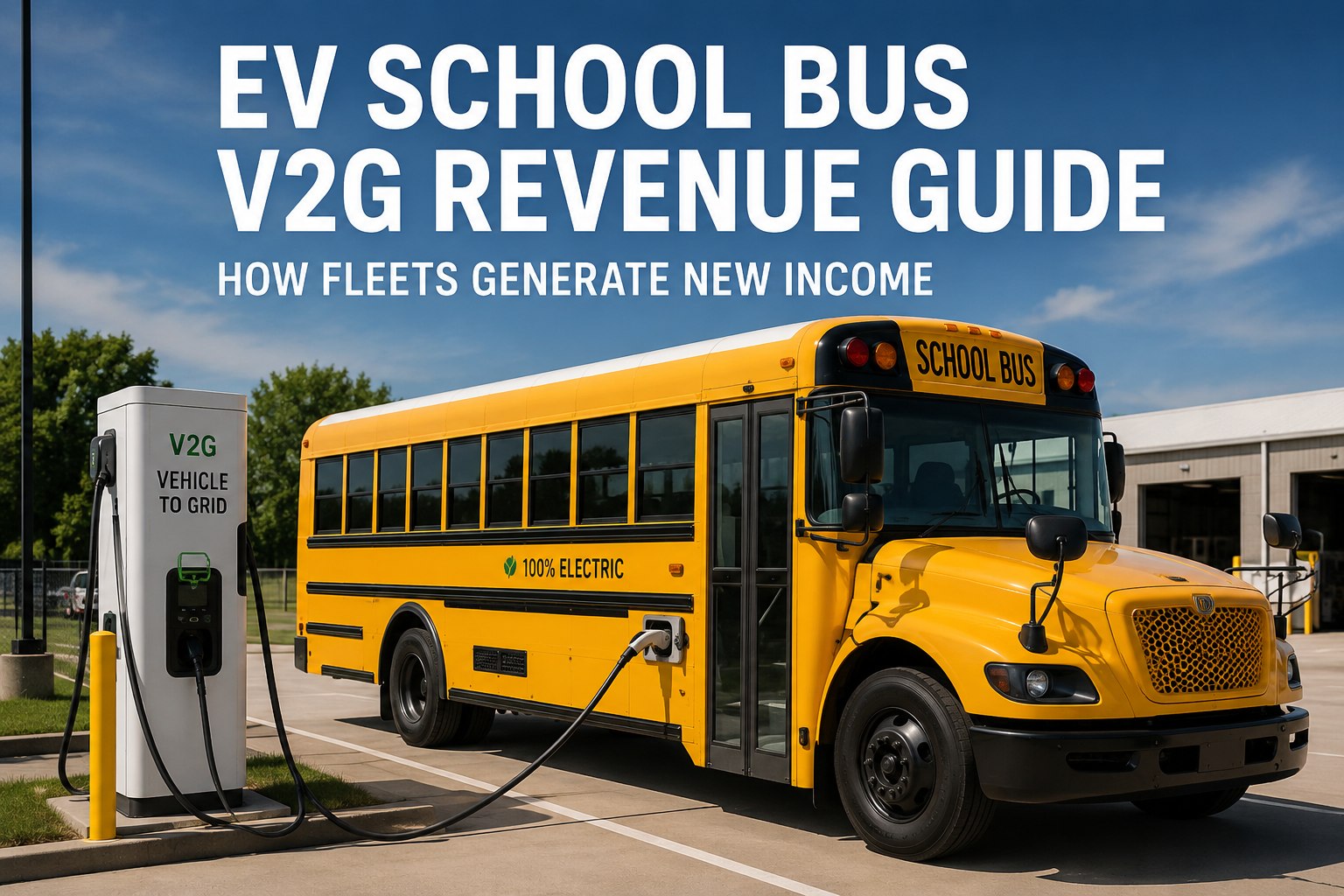
Your electric school bus completes its morning route at 8:47 a.m., pulls into the yard, and sits. It sits through third period. Sits through lunch. Sits through afternoon meetings. Sits until 2:35 p.m. when the afternoon run starts. That is roughly six hours every school day when the most expensive asset in your fleet does nothing. Now picture those six hours generating between $3,000 and $6,000 per bus per year in grid-service revenue flowing straight back to the district. Not a hypothetical. Twenty-six utilities across nineteen states already run vehicle-to-grid programs that pay exactly that. This is the EV school bus V2G revenue guide — what it pays, where the programs exist in 2026, how to structure your fleet to earn it without wrecking your battery warranty, and why the districts moving fastest are treating the bus yard as a revenue center, not a cost center.
EV School Bus V2G Revenue: How Fleets Turn Idle Buses Into Grid Income
The 2026 breakdown of vehicle-to-grid revenue streams, real-world earnings, program availability, and the battery-health trade-off that separates fleets earning V2G income from fleets damaging their warranties.
- $3K–$6Kper bus, per year
- 26 utilities19 states in 2026
- $2 / kWhpeak dispatch rate
- 155–220kWh avg battery
Battery health, PM cycles, and warranty tracking built for V2G-participating EV fleets
Why School Buses Are the Perfect Fit for V2G Revenue
Vehicle-to-grid technology lets an electric school bus discharge stored energy back to the utility grid when the grid needs it most. The utility pays the district for that energy. It sounds like a niche experiment. It is not. School buses are the highest-priority target of every serious V2G program in North America because they check every box a utility looks for.
Their batteries are enormous — typically 155 to 220 kWh — roughly two to three times the capacity of a passenger EV. Their schedules are perfectly predictable, so a utility knows exactly when a bus will be plugged in. They sit idle roughly eighteen hours per weekday, plus every weekend and every summer. And school summer breaks line up exactly with peak grid demand in most of the country. The bus does its route. The bus makes money. Book a demo to see how BusCMMS tracks EV battery health across a V2G-participating fleet.
- Charging (grid to bus)
- Route service (student transport)
- Idle window (V2G revenue eligible)
Fifteen of every twenty-four hours are eligible for V2G participation. Every summer weekday, that number jumps closer to twenty. Fleets that ignore those hours are leaving revenue on the table — and, in states with active programs, they are also missing utility rebates that offset the cost of the bidirectional chargers themselves.
The 4 V2G Revenue Streams School Bus Fleets Actually Earn From
Not all V2G payments look the same. A district that participates in one program typically stacks revenue from two or three of the streams below, depending on what the local utility offers. Understanding which stream pays what is the difference between projecting $2,000 and projecting $6,000 per bus per year.
-
Stream 01
Energy Dispatch
The utility calls an event and asks the bus to push a specific amount of energy to the grid over one to five hours. The district is paid per kilowatt-hour delivered.
Typical rate$0.50 – $2.00 per kWh
-
Stream 02
Capacity Payments
The utility pays a flat monthly or annual fee simply for the bus to be available as reserve capacity. The bus rarely dispatches; it just has to be plugged in and ready.
Typical rate$500 – $2,000 per bus / year
-
Stream 03
Frequency Regulation
Small, high-frequency energy exchanges (seconds to minutes) that help the grid maintain 60 Hz. Payments are small per event but the events happen constantly.
Typical rate$0.02 – $0.08 per kWh · high volume
-
Stream 04
Demand Response
Peak-shaving events during summer heat waves or grid stress. The bus discharges to reduce district or grid-wide load. Payments are event-based and can be substantial.
Typical rate$50 – $200 per event · 5–15 events / year
The most successful programs combine capacity payments (predictable income) with occasional energy dispatch (large per-event income). Cajon Valley Union School District in California, one of the earliest V2G deployments, is paid $2 per kWh during San Diego Gas & Electric’s Emergency Load Reduction events — roughly ten events per year of one to five hours each. Book a demo to see BusCMMS track V2G-participating buses alongside diesel.
Real Districts Already Earning V2G Revenue in 2026
V2G is not a pilot concept anymore. Multiple U.S. school districts have already logged years of grid-service revenue, and the utility side of the market accelerated hard in 2026. Three real examples show what the deals actually look like.
-
California · SDG&E Cajon Valley Union School District
Eight electric buses paired with six bidirectional 60 kW DC fast chargers. Participates in San Diego Gas & Electric’s Emergency Load Reduction Program, which pays $2/kWh for energy dispatched during grid stress events.
$2/kWhevent rate~10/yrevents called180 kWhbattery size -
California · PG&E Fremont Unified School District
One of California’s most advanced V2G deployments. Fourteen electric buses, six bidirectional DC fast chargers, participation in PG&E’s Emergency Load Reduction Program via Rule 21 interconnection. Commissioned August 2025.
14 EVsbus fleet6 chargersbidirectionalRule 21interconnect -
Maryland · Potomac Edison FirstEnergy V2G Pilot Program
$11.1 million utility-funded pilot covering the cost difference between diesel and electric buses (up to $250,000 per unit) plus charging infrastructure. Includes V2G evaluation as core program design.
28 busesdeployment$250Kper bus subsidy$11.1Mtotal program
A fourth data point worth noting: Xos began production of V2G-capable school buses in April 2026, joining Blue Bird and Thomas Built in the bidirectional segment. The buses now exist. The utilities are paying. The infrastructure incentives are landing. This is the earliest moment a district can get in and still lock a low-competition rate. Book a demo to see how BusCMMS handles a mixed diesel + V2G-EV fleet.
The Battery-Wear Trade-off Nobody Explains at the Sign-Up Table
Every V2G dispatch is a partial discharge and recharge cycle beyond what the bus needed for routes. That is the honest math a V2G brochure will not put in front of you. A lithium battery has a finite number of full-equivalent cycles before its capacity drops below the warranty threshold. V2G adds cycles. Whether those cycles cost you the warranty depends entirely on two things: how well the fleet manages depth of discharge, and how well it tracks State of Health over time.
Revenue Impact
- $3,000–$6,000 per bus per year in grid revenue
- Utility rebates offsetting bidirectional charger cost
- Reduced total cost of ownership vs. diesel
- Grant preference in EPA and state programs
Battery Impact
- Additional full-equivalent cycles per year
- Faster capacity fade if DOD is unmanaged
- Warranty terms may cap V2G cycles per year
- Requires SOH monitoring per bus
The fleets that win at V2G do three things at once. They participate only in programs where the per-cycle revenue exceeds the per-cycle battery-wear cost. They set depth-of-discharge limits (typically not below 20% and not above 80% for V2G-eligible cycles). They track State of Health per bus, weekly, and pull buses out of V2G rotation the moment capacity drift accelerates. All three of those need a bus-specific maintenance system that understands electric-fleet chemistry. Book a demo to see EV-specific PM templates and SOH tracking in action.
Where V2G Programs Actually Pay in 2026
V2G availability is a patchwork. A district in California, New York, or Colorado today has more program options than a district in the Southeast. That gap is narrowing fast — several state public utility commissions moved on V2G interconnection standards in late 2025 and early 2026 — but the near-term reality is that participation depends on your utility.
Districts serious about V2G revenue should start with a five-step audit: confirm the local utility offers a V2G tariff or pilot; verify the bus manufacturer supports bidirectional charging (Blue Bird, Thomas Built, and Xos as of April 2026); confirm charger vendor supports V2G firmware; review the interconnection application process; and calculate expected revenue against battery-cycle cost per bus. Book a demo to see how BusCMMS integrates PM cycles and battery SOH for V2G planning.
What a Transportation Director Actually Watches
We got into V2G for the revenue. What kept us in it was the discipline it forced on our EV maintenance. Every discharge event is another cycle on the battery, and we cannot afford to find out at year seven that we quietly burned through the warranty because nobody was watching State of Health. Our board sees the V2G income line every month. What they do not see, but what I watch every Monday, is the SOH trend line by bus. If those two curves ever cross wrong, the program stops paying us. So we manage both.
His point is the entire story. V2G revenue is real, but it is not free. It compounds with careful management and disappears with negligence. The fleets earning the top numbers are the ones with real-time visibility into the health of the asset generating that revenue. Book a demo to see per-bus SOH tracking for V2G-participating fleets.
How BusCMMS Protects V2G Revenue With EV Fleet Maintenance
BusCMMS does not run the V2G dispatch. Your bidirectional charger and utility aggregator handle that. What BusCMMS does is keep the buses generating the revenue healthy, warranty-covered, and audit-ready for federal Clean School Bus reporting.
-
EV-Specific PM Templates
Pre-built PM schedules that drop diesel-only items and add HV battery, inverter, and thermal-management checks tuned for V2G fleets.
-
Battery SOH Tracking
Per-bus State of Health tracked over time. Catch capacity drift before it accelerates and before it hits warranty thresholds.
-
Charge Cycle Counter
Track total full-equivalent cycles including V2G-induced cycles for warranty compliance and battery-life forecasting.
-
Warranty Timeline Tracking
Track battery warranty terms and capacity guarantees per bus. Alerts fire before terms expire so no claim gets missed.
-
HV Technician Routing
Auto-routes HV work orders to certified technicians only. Tracks certification expiration and training records.
-
Mixed Fleet Dashboard
Diesel and EV buses on one dashboard. Cost per mile by fuel type, PM compliance, SOH trend — reviewed weekly.
BusCMMS reports that fleets running EV buses on its platform typically hit 95%+ availability and produce grant-ready fleet reports on demand — the same reports that support Clean School Bus Program applications and V2G interconnection filings. Those are BusCMMS’s own reported figures from its bus-fleet customer base. Book a demo to see the mixed diesel + EV fleet dashboard live.
How much V2G revenue can an electric school bus actually generate?
Real-world V2G revenue for electric school buses typically lands between $3,000 and $6,000 per bus per year in 2026, depending on the utility program mix. The Cajon Valley Union School District in California, one of the earliest V2G deployments, receives $2 per kWh dispatched during San Diego Gas & Electric Emergency Load Reduction events. Districts stacking capacity payments, energy dispatch, and demand response programs typically hit the top of the range. Districts with only frequency regulation or single-stream programs hit the lower end.
Does V2G damage the school bus battery or void the warranty?
V2G adds full-equivalent charge cycles beyond what the bus needs for routes, and every cycle contributes to eventual capacity fade. Whether that impacts warranty depends on the specific manufacturer terms — some cap V2G cycles per year, others allow unlimited participation as long as depth-of-discharge stays within specified limits. Fleets that manage V2G within a 20% to 80% state-of-charge window and monitor per-bus State of Health typically preserve warranty coverage while capturing full revenue. BusCMMS tracks charge cycles and SOH trends per bus to support warranty compliance.
Which utilities offer V2G programs for school buses in 2026?
As of 2026, at least 26 U.S. utilities across 19 states run active V2G programs, up from 15 utilities in 2023. Major programs include San Diego Gas & Electric (Emergency Load Reduction), Pacific Gas & Electric (Rule 21 interconnection with ELRP), Con Edison in New York, Xcel Energy in Colorado, Dominion Energy in Virginia, and Potomac Edison in Maryland. New pilot programs from FirstEnergy, National Grid, and Duke Energy have launched or are expanding in 2026.
Do all electric school buses support V2G, or is bidirectional charging a separate feature?
V2G requires two conditions: a bus with bidirectional-capable inverter and battery management, and a bidirectional-capable charger. Not all electric school buses ship V2G-ready. Blue Bird and Thomas Built have offered V2G-capable models since 2023. Xos began production of V2G-capable school buses in April 2026. Existing non-V2G electric buses cannot be retrofitted easily — the drive inverter and BMS have to support reverse power flow. Districts planning V2G revenue should confirm bidirectional capability at purchase.
What does a school district need beyond the bus itself to participate in V2G?
Four things: a bidirectional-capable electric school bus, a bidirectional DC fast charger (typically 60 kW to 150 kW rated), a utility interconnection agreement (in California, for example, this is Rule 21), and a maintenance system that tracks battery health and charge cycles across V2G-participating buses. The utility typically handles dispatch signaling. The district handles battery care. BusCMMS handles the maintenance side — EV-specific PM, SOH tracking, charge cycle counting, and warranty timeline management.