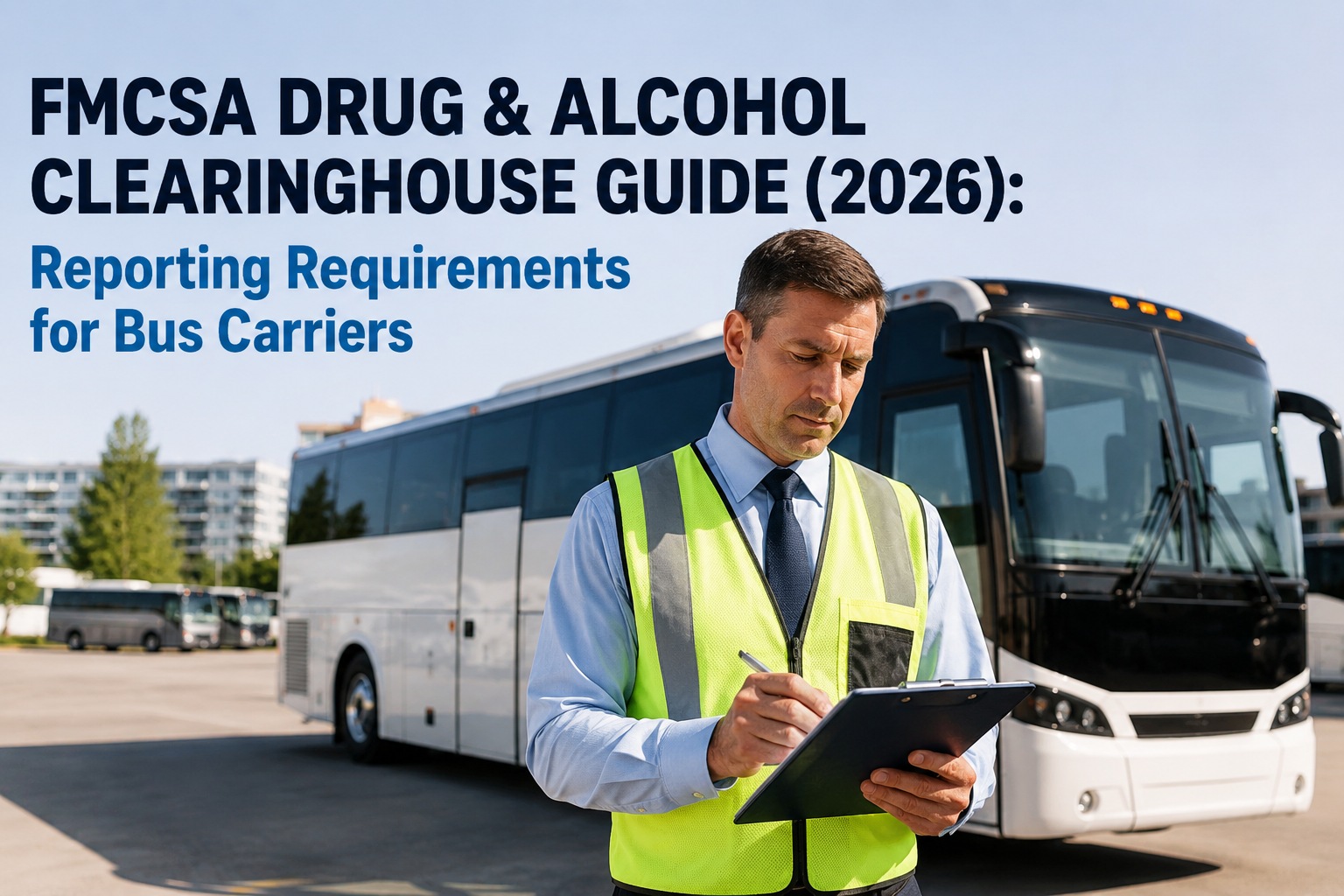
Missing a single Clearinghouse query on a driver who tests clean anyway is still a federal violation. FMCSA logged 7,000+ Clearinghouse-related findings in 2025, and the Clearinghouse II final rule that went live in late 2024 raised the stakes -- a driver in prohibited status now triggers an automatic CDL downgrade by the state DMV within 60 days. This is the practical 2026 walkthrough of what bus carriers actually have to do to stay compliant, when each query fires, and what happens when a violation lands. See how BusCMMS tracks Clearinghouse queries per driver → book a 20-min demo.
FMCSA Drug & Alcohol Clearinghouse Guide for Bus Carriers
The 4 compliance pillars every bus carrier must maintain, the queries that catch audit findings, and the CDL downgrade rule that changes everything.
Register
One-timeEmployer + driver both register via FMCSA portal.
Pre-Employment Query
Every new hireFull query with electronic driver consent.
Annual Query
Every driver, every yearLimited query on every current CDL driver.
Report Violations
Within 24 hoursPositive tests, refusals, RTD completions.
The 2 Query Types: When Each Fires
One before the driver ever gets behind the wheel. One every year they stay.
Pre-Employment Full Query
- Requires electronic driver consent via Clearinghouse portal
- Returns full 5-year violation history
- Includes positive tests, refusals, RTD status
- Must be completed and documented before first shift
- Prohibited status = driver cannot be hired
Annual Limited Query
- Driver's general consent (in writing, on file)
- Returns "any records?" yes/no
- If yes, employer must run full query within 24 hours
- Missing an annual query on a clean driver is still a violation
- Owner-operators must query themselves by Jan 5 each year
The audit trap: The FMCSA looks at every driver you employed during the audit window. If any of them are missing an annual query -- even if the driver is completely clean and no violation exists -- that is a citable finding under 49 CFR §382.701. Missing queries account for the largest category of new-entrant audit failures at bus carriers.
The 5 Violations That Land in the Clearinghouse
All 5 count the same. All 5 trigger prohibited status. All 5 require SAP.
Positive Drug Test
Any DOT-panel drug: marijuana, cocaine, opiates, amphetamines, PCP. Confirmed by MRO.
Positive Alcohol Test
Breath alcohol concentration of 0.04 or higher during safety-sensitive function.
Refusal to Test
Includes failure to show, walkout, tampering, or adulteration. Counts identical to a positive.
Actual Knowledge
Employer observation, DUI conviction, driver admission, or citation for on-duty use.
SAP Non-Completion
Driver fails to complete Substance Abuse Professional program or follow-up testing plan.
Violations stay on record for 5 years or until follow-up testing plan is complete -- whichever is later. See driver Clearinghouse status tracked per VIN in BusCMMS → book a demo.
The 24-Hour Reporting Clock
Clearinghouse II tightened the reporting window. Late = finable.
Event Occurs
Positive test result received from MRO, refusal witnessed, or actual knowledge established.
Driver Removed
Driver immediately removed from all safety-sensitive functions. Same day. Not the next shift.
Documentation Prepared
Test results, chain of custody, driver notification, and MRO paperwork assembled for portal upload.
Report Filed in Portal
Violation logged in Clearinghouse via employer account. Late reporting is now a finable offense.
The 24-hour window is unforgiving. The workflow has to fire the moment the MRO calls. See BusCMMS trigger 24-hour reporting workflow → book a demo.
Clearinghouse II: The CDL Downgrade Rule
The change that closed the "move to another state" loophole.
The old loophole
A driver in prohibited status could cross state lines, apply for a CDL in a new state, and the new state DMV had no visibility into the Clearinghouse record. The FMCSA violation existed, but the CDL itself stayed valid.
The new reality
State DMVs must query the Clearinghouse before issuing or renewing any CDL. Prohibited status triggers automatic CDL downgrade to a standard license within 60 days. The loophole is closed. The driver cannot operate a bus in any state until they complete return-to-duty.
The 60-day countdown
This changes hiring math for every bus carrier: prohibited status is now a career-level event, not a hiring inconvenience. See driver Clearinghouse status alerts in BusCMMS → book a demo.
The Return-to-Duty Path
The only way back for a prohibited driver. 5 steps. No shortcuts.
- 1
SAP Assessment
Within 30 days of violationDriver contacts a qualified Substance Abuse Professional. Face-to-face clinical evaluation. SAP identifies treatment or education requirements.
- 2
SAP-Directed Treatment
Program length variesEducation, treatment, or counseling per SAP's individualized plan. Driver responsible for all costs. No employer subsidy required by regulation.
- 3
Follow-Up Evaluation
After program completionSAP confirms driver completed all required activities and is ready for return-to-duty testing. Documentation goes into the Clearinghouse.
- 4
Return-to-Duty Test
Direct-observation collectionNegative test required before driver returns to safety-sensitive functions. Under direct observation. Cost typically paid by driver or new employer.
- 5
Follow-Up Testing Plan
Minimum 6 tests / 12 monthsSAP-directed unannounced testing schedule -- typically 6+ tests in the first year, up to 5 years total. Only when complete does record clear.
Tracking RTD progress per driver is where most compliance programs miss step 5 -- the follow-up testing plan can run up to 5 years. See per-driver RTD progress in BusCMMS → book a demo.
Where BusCMMS Fits Your Clearinghouse Program
Six ways the audit never catches you off guard.
Annual Query Reminders
Alerts 60 days before each driver's annual query deadline. Missing an annual query on a clean driver is still a violation -- the reminder stops it.
Pre-Employment Query Log
Every new hire's full query documented per driver with date, consent record, and result. Ready for audit inspection at any moment.
Driver Status Tracking
Prohibited, in-RTD, or eligible status per driver. Alerts if any driver's status changes mid-employment.
24-Hour Reporting Workflow
Violation event triggers the reporting checklist immediately -- driver removal, documentation, portal upload -- all within the 24-hour window.
RTD Progress Tracker
SAP assessment, treatment, evaluation, RTD test, and follow-up testing plan tracked per driver. No returns to duty without confirmation.
Audit-Ready Export
One-click export of all Clearinghouse activity for the audit window: queries, consents, violations, RTD status. Ready in minutes, not days.
Our first new-entrant audit was two years ago and the finding that scared me was a missing annual query on a driver who had never had a positive test in her career. Clean driver, five-figure fine potential. We moved every Clearinghouse date into BusCMMS with 60-day reminders per driver. Our second audit last spring: zero Clearinghouse findings. Same 42 drivers, same lookback window. The reminder system is what caught what my spreadsheet missed twice a year.
Annual queries coming due? The reminder system starts today. Sign up free and load your driver list →
Frequently Asked Questions
Do bus carriers have to comply with the FMCSA Clearinghouse?
Yes. Under 49 CFR §382.705, every employer of CDL drivers -- interstate or intrastate, motor carrier, school bus operator, transit agency, motorcoach operator, or owner-operator -- must register with the FMCSA Drug and Alcohol Clearinghouse. This includes all CDL-holding bus drivers regardless of fleet size. Dual FTA/FMCSA regulated employers, common at public transit agencies, still perform FMCSA queries for anyone in safety-sensitive functions. Owner-operators must register as both employer and driver, designate a consortium/TPA to manage testing, and query themselves annually by January 5 each year. Non-CDL bus drivers (some small school vehicle operators) are not covered by Clearinghouse rules but may still be covered by their state's own drug testing framework.
What queries does a bus carrier need to run and when?
Two mandatory queries under 49 CFR §382.701. A pre-employment full query on every new CDL driver before they perform any safety-sensitive function -- this requires electronic driver consent through the Clearinghouse portal and returns the driver's full 5-year violation history. And a limited annual query on every current CDL driver at least once per 12-month period, using the driver's general consent already on file. If the limited query returns "records exist," the employer must run a full query within 24 hours. Missing an annual query on a completely clean driver still counts as a citable finding under FMCSA audit -- the requirement is procedural, not outcome-based. Missing queries were the #1 Clearinghouse-related finding in 2025 with over 7,000 violations reported.
What changed with Clearinghouse II in November 2024?
Three major changes reshape the 2026 compliance landscape. First, state DMVs now must query the Clearinghouse before issuing or renewing a CDL -- prohibited status triggers an automatic CDL downgrade to a standard license within 60 days, closing the loophole that let prohibited drivers get licensed in another state. Second, the 24-hour reporting rule tightened: employers must report positive test results, refusals, and SAP completions within 24 hours of occurrence, and late reporting is now a finable offense. Third, labs and MROs must submit results within hours rather than days. Together these changes make Clearinghouse violations a career-level event for CDL drivers rather than a hiring inconvenience, and raise the audit stakes meaningfully for every bus carrier.
What triggers a Clearinghouse violation?
Five events that all land in the same "prohibited" status. A positive DOT drug test confirmed by the Medical Review Officer -- marijuana, cocaine, opiates, amphetamines, or PCP. A positive DOT alcohol test at 0.04 BAC or higher during a safety-sensitive function. A refusal to test -- including failing to show, walking out, tampering with the sample, or adulteration -- which counts identical to a positive result. Actual knowledge violations such as employer observation, DUI conviction, driver admission, or an on-duty citation. And SAP program non-completion -- the driver stays prohibited until the return-to-duty process is fully complete. Violations remain on the Clearinghouse record for 5 years from the violation date, or until the follow-up testing plan is completed, whichever is later.
How does BusCMMS help bus carriers stay Clearinghouse-compliant?
BusCMMS tracks every driver's Clearinghouse status with automated alerts. Annual query reminders fire 60 days before each driver's deadline, so no annual query gets missed -- the #1 audit finding at bus carriers. Every pre-employment full query is documented per driver with date, consent record, and result, ready for FMCSA inspection at any moment. Driver status (prohibited, in-RTD, eligible) tracks continuously so any change surfaces immediately. When a violation event occurs, a 24-hour reporting workflow guides the reporting checklist -- driver removal, documentation assembly, portal upload -- all within the compliance window. Return-to-duty progress tracks per driver across SAP assessment, treatment, evaluation, RTD test, and follow-up testing plan. One-click audit export delivers the full Clearinghouse activity log for any lookback window. One 42-bus Ohio charter operator reported dropping from a missing-annual-query finding on their first new-entrant audit to zero Clearinghouse findings on their second, using the same driver list.