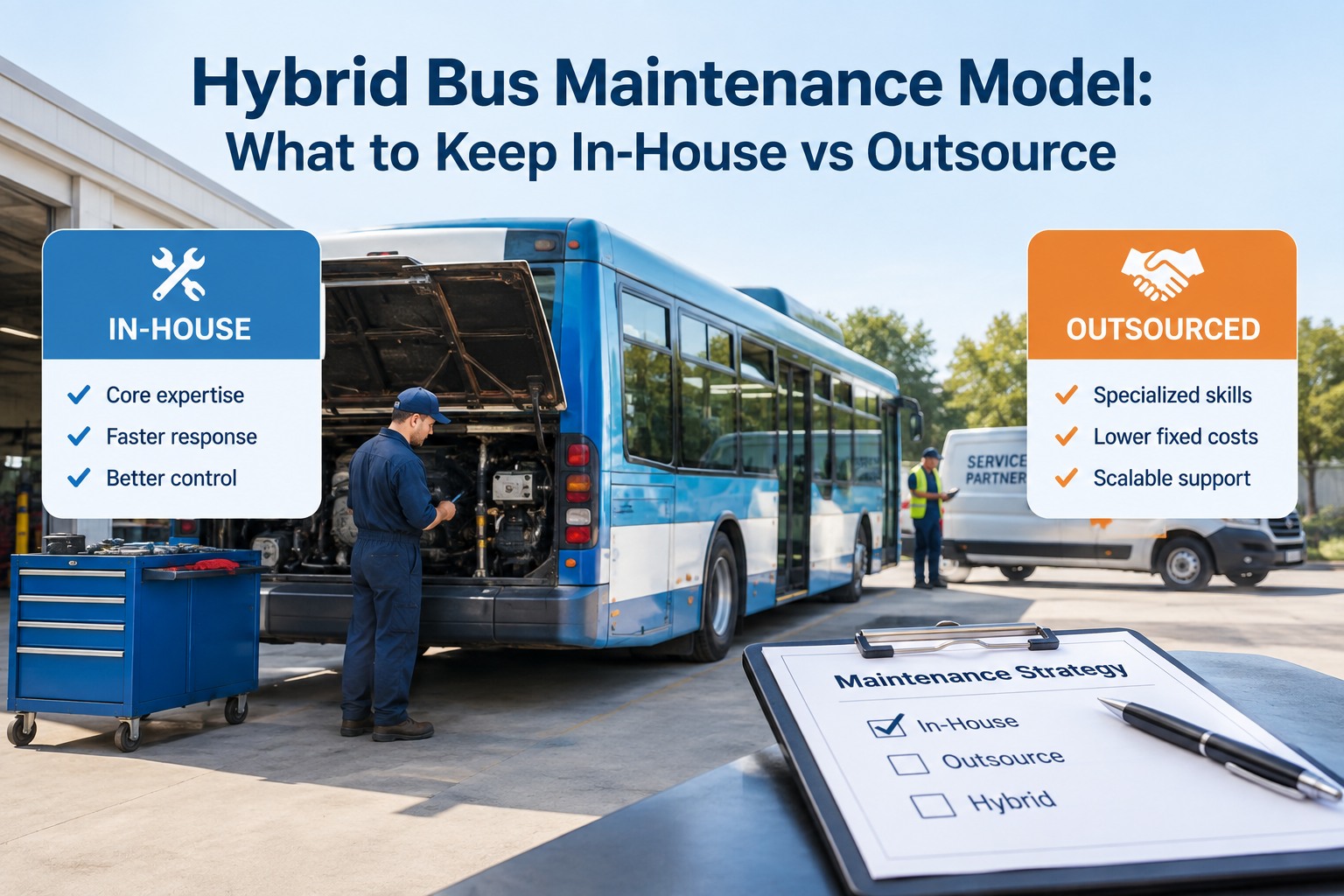
Ask a room of ten bus transportation directors whether they run maintenance in-house or outsourced, and nine will say "both." The honest answer for any fleet above about 20 buses is a hybrid model — some work stays in the shop, some goes to a vendor, and the split is deliberate. What separates the fleets running this well from the ones bleeding money is a simple thing: they know exactly which categories of work belong where, and why. This guide lays out the work-category-by-work-category verdict, the five variables that flip the decision, and the hybrid ratio that fits your fleet size.
The Hybrid Bus Maintenance Model: What to Keep In-House, What to Send Out
A work-category verdict grid, the five variables that flip the answer, and the in-house-versus-outsourced ratio that actually fits your fleet size.
- 10Work Categories
- 5Decision Variables
- 2-3xVendor Cost Premium
- Daily PMs & inspections
- Brake service
- Oil & fluid changes
- Tire rotation
- Basic electrical
- DVIR defect repair
- Engine overhauls
- Transmission rebuilds
- Body & collision
- Warranty repairs
- Emissions after-treatment
- HVAC system overhaul
Why the Hybrid Question Is Really the Only Question
Very few bus fleets operate at the extremes. Fully in-house means owning every specialty tool, employing an emissions specialist, a body shop, a machine shop, and a transmission rebuilder — economically absurd for a 40-bus district. Fully outsourced means paying 2-3x the effective hourly rate on every oil change and every brake pad and being at the vendor's mercy for scheduling — economically absurd for the same fleet. Both extremes leave money on the table. The real question every transportation director faces is not "in-house or outsourced" but "which work belongs where."
Fleets running a deliberate hybrid model consistently outperform both pure-in-house and pure-outsourced fleets on cost per mile. The gap is not the split ratio itself — it is whether the split is documented, tracked, and reviewed against actual cost data quarterly.
The fleets that get this wrong usually get it wrong the same way: they let the split happen by default. A tech quits and never gets replaced, so brake work drifts to the mobile mechanic. The dealer sales rep leans in during a warranty cycle, so engine work drifts to the dealership. Nobody makes an explicit decision, and 18 months later the outsourced share has crept from 30% to 55% and the transportation director cannot explain to the board why maintenance spend is up 22%. The hybrid model works when it is designed. It fails when it is inherited. Book a demo to see in-house versus vendor spend tracked live per bus per category.
The Work-Category Verdict Grid
Not every kind of maintenance work has the same math behind it. Some categories are clearly cheaper in-house at almost any fleet size — the labor rate delta plus scheduling control makes it obvious. Others are almost always cheaper outsourced, because the tooling and expertise cost cannot be amortized across your volume. And a middle band genuinely depends on your specific shop. Here is the verdict category by category.
Daily PMs & Inspections
IN-HOUSEVolume, frequency, and DVIR compliance ownership all point inside. Vendor timing does not match daily route schedules.
Brake Service
IN-HOUSEHigh frequency, moderate skill, safety-critical documentation. Outsourced brake work runs 2-3x the labor cost with worse scheduling control.
Oil & Fluid Changes
IN-HOUSEBread-and-butter PM work. The cheapest labor hour a fleet can produce. Sending this out is textbook overspending.
DVIR Defect Repair
IN-HOUSETurnaround speed is the whole point. A bus with a defect logged at 3pm needs to be back in service for the 6am route.
HVAC Repair
DEPENDSDiagnostics and component swap in-house if the shop has HVAC-certified tech; system-level overhaul usually outsourced.
Electrical Diagnostics
DEPENDSBasic in-house, complex networked-system faults may need dealer scan-tool access and OEM diagnostic license.
Wheelchair Lift Certification
DEPENDSRepairs in-house; annual load-test certification and manufacturer-certified inspection often outsourced to authorized service center.
Engine Overhaul
OUTSOURCEFrequency too low to justify in-house expertise, tooling, and clean-room space. Specialty rebuild shops are more economical.
Transmission Rebuild
OUTSOURCESame math as engine overhaul. Send core to specialty rebuilder, receive rebuilt unit. Do not carry the tooling.
Body & Collision Repair
OUTSOURCEFrame straightening, paint booth, and body panel replacement require dedicated facility that cannot be amortized on bus volume.
Warranty Work
OUTSOURCEMust go to authorized dealer or the warranty is void. Non-negotiable during coverage window.
Emissions After-Treatment
OUTSOURCEDPF regeneration, DEF system diagnostics, and NOx sensor calibration typically need OEM tools and certified tech. Send to dealer.
Print this grid. Hand it to your shop foreman. Compare it against what your shop actually does today. If any of the six "in-house" categories are drifting to the mobile mechanic or dealer, that is the first place to look for cost recovery. If any of the four "outsource" categories are being attempted in-house without the right tooling, that is a quality risk worth flagging.
The 5 Variables That Flip the Verdict
The verdict grid above is the starting point, not the final answer. Five variables can push a category from "clearly in-house" to "actually you should send this out" — or the other way around. When a category sits in your Depends column, these five variables are how you decide.
Fleet Size
The single biggest driver. Below 20 buses, the shop cannot absorb specialty labor. Above 60, almost everything except engine, transmission, body, and warranty makes sense inside. Between 20 and 60 is where the hybrid ratio has to be tuned.
Tech Skill Coverage
A shop with an HVAC-certified tech and a Cummins-experienced diesel guy can pull work inside that would otherwise ship out. Lose that tech and the same work flips. Bench strength directly moves the line.
Bay & Tooling Capacity
If bays are chronically full and PMs are already slipping, adding non-critical work in-house makes the whole shop worse. Sometimes outsourcing a category you could technically do in-house is the right call because bay hours are the real constraint.
Route-Coverage Urgency
When a spare-bus buffer is thin, in-house wins on turnaround even at higher unit cost. A 6am route depending on a bus getting fixed tonight cannot afford a vendor's Tuesday appointment slot.
Vendor Quality & Distance
A trusted vendor 8 miles away with 48-hour turnaround changes the math on many depends-category items. A mediocre vendor 40 miles away drives everything back inside — even work you would rather not do.
Notice the range of the sliders. Fleet size tilts strongly in-house at scale. Bay capacity and vendor quality can push the other way even at scale. That is exactly why the hybrid decision has to be per-category and per-fleet, not a one-size-fits-all formula. Sign up free and start tracking which categories your fleet is actually paying more for outside than inside.
The Hybrid Ratio by Fleet Size
The right in-house-versus-outsourced ratio is a moving target that tracks fleet size closely. Small fleets structurally cannot support broad in-house capability. Large fleets structurally cannot afford to send common work out. Here is where different fleet sizes typically converge — and the gold band is the range that most fleets in each tier find themselves in once they run the numbers honestly.
If your fleet's actual ratio sits far outside its tier's typical range, ask why. A 30-bus operation running 80% in-house probably has under-utilized techs and could either grow into the capacity or reduce it. A 200-bus fleet running 40% in-house is almost certainly overspending on work that could come back inside. Neither is automatically wrong — but both should be able to explain the deviation with data, not habit. Book a demo to see your fleet's actual ratio plotted against the tier benchmark.
The Vendor Selection Scorecard
Whatever gets outsourced needs to go to a vendor that actually performs. The failure mode is the same across most fleets: the vendor was chosen for one of the wrong reasons — cheapest quote, closest location, or someone knew someone — and never re-evaluated as work built up. The scorecard below is the quick weighted framework for picking a vendor and, more importantly, re-scoring the vendors you already use.
The two categories that surprise fleets when they start scoring honestly are rework rate and documentation quality. Both are invisible until a CMMS is logging vendor work orders on the same bus timeline as in-house work — then patterns show up fast. "That transmission shop's rebuilds are coming back at 40% inside a year" or "the mobile mechanic's invoices are missing odometer on 6 of the last 10 jobs" — those are decisions that were impossible to see on paper and obvious on the dashboard.
How BusCMMS Runs the Hybrid Model
A hybrid maintenance model is only as good as the data that supports it. If in-house work lives in one system and vendor invoices live in a shared drive somewhere, there is no way to compare category cost, track vendor SLAs, or catch the drift when outsourced share creeps up quarter over quarter. BusCMMS handles both work streams in a single per-bus timeline.
-
Vendor Work Orders on Bus Timeline
Every outsourced job logged as a Vendor work order against the same bus. Odometer, cost, parts, and vendor ID captured on the same record type as in-house work.
-
In-House vs Vendor Cost Split
Dashboards show total spend per bus, per category, per month — with in-house and vendor breakdowns side by side. The drift becomes visible before it becomes expensive.
-
Vendor SLA & Rework Tracking
Turnaround time captured per vendor work order; rework rate calculated from work orders reopened for the same defect within 60-90 days.
-
Category-Level Cost Comparison
Filter cost by work type — brake service, HVAC, transmission — with in-house per-hour cost calculated against vendor invoice. Direct answer to "should we bring this inside?"
-
DOT-Compliant Vendor Records
Vendor invoices attached to the bus record with odometer, parts, and tech certification captured — FMCSA and state DOT auditors see one continuous maintenance history, not paper vs digital.
-
Board-Ready Hybrid Reports
One-click export of in-house vs vendor spend by category and by bus — the exact numbers a board wants to see when the maintenance model comes up.
Because BusCMMS is built for bus fleets specifically, the vendor work order form already carries the bus-specific fields — wheelchair lift certification numbers, emissions test results, DPF servicing intervals — that generic fleet software leaves out and generic vendors do not know to capture.
The Practitioner View: What Getting the Split Right Looks Like
The number in that story is not the $180K. It is the fact that no one could see it for years. Hybrid maintenance economics are invisible without the data infrastructure to compare in-house and vendor spend on the same terms. Once the data is there, the corrections almost make themselves. Sign up free and get 30 days of hybrid-spend visibility on your fleet.
The Bottom Line on the Hybrid Model
The hybrid bus maintenance model is not a compromise between in-house and outsourced. It is the correct answer for essentially every fleet between 20 and 500 buses — and the only variable that actually matters is whether the split is being designed or being inherited. The verdict grid tells you where to start. The five decision variables tell you how to handle the depends categories. The fleet-size ratio tells you whether your actual split is in the right range. And the vendor scorecard keeps the outsourced side honest. Underneath all four, the same requirement: one system logging both in-house and vendor work orders on the same bus timeline. That is what turns hybrid maintenance from guesswork into strategy. Book a demo to see the hybrid model running on your fleet's actual data.
What is a hybrid bus maintenance model?
A hybrid maintenance model splits maintenance work between an in-house shop and outside vendors based on which category of work is cheaper and faster inside versus outside. Typically the fleet keeps daily PMs, brake service, fluid changes, tire rotation, basic electrical, and DVIR defect repair in-house, while sending engine overhauls, transmission rebuilds, body and collision, warranty work, and emissions after-treatment to specialty vendors. A middle band — HVAC, complex electrical diagnostics, wheelchair lift certification — depends on the individual fleet's shop capability, size, and vendor network.
What bus maintenance work should always be outsourced?
Four categories are almost always outsourced regardless of fleet size. Warranty work must go to an authorized dealer or coverage voids — non-negotiable during the warranty window. Engine overhauls and transmission rebuilds happen too infrequently on any single fleet to justify the tooling, clean-room space, and specialized labor required. Body and collision repair requires a paint booth and frame equipment that cannot be amortized on bus volume. Emissions after-treatment (DPF service, DEF diagnostics, NOx sensor calibration) typically needs OEM diagnostic tools and certified technicians only available at the dealer.
What is the right in-house to outsourced ratio for my fleet?
The ratio scales with fleet size. Under 20 buses, expect roughly 15-50% in-house — the shop cannot support broad specialty labor. Between 20 and 50 buses, 40-65% is typical. From 50 to 100 buses, 55-80%. From 100 to 250 buses, 65-85%. Above 250 buses, 70-90%. If your fleet sits far outside the range for its tier, the split is probably drifting from history rather than being designed — either under-utilizing techs and paying vendors for work the shop could do, or attempting complex work inside without the tooling to do it well.
How do I decide whether to bring outsourced bus work back in-house?
Five variables drive the decision. Fleet size — larger fleets support broader in-house capability. Tech skill coverage — a shop with the right certifications can pull work inside that would otherwise ship out. Bay and tooling capacity — if bays are chronically full, outsourcing a category you could do in-house may still be the right call. Route coverage urgency — thin spare-bus buffers favor in-house because of turnaround control. Vendor quality and distance — a trusted local vendor can keep work outside profitably; a poor or distant one drives everything back inside. A CMMS that captures actual per-category cost for both in-house and vendor work makes this analysis straightforward.
How does BusCMMS help manage a hybrid bus maintenance model?
BusCMMS logs every vendor work order alongside in-house work orders on the same per-bus timeline — with odometer, cost, parts, and tech certification captured on both. Dashboards break spend down by in-house versus vendor, by work category, and by bus, so the hybrid ratio and its drift become visible monthly instead of once a year. Vendor SLA and rework tracking surface which outside shops are actually performing. Every vendor invoice sits inside the DOT-compliant maintenance record instead of a shared drive, so FMCSA and state auditors see one continuous history. Board-ready reports export in-house versus vendor spend in one click.