The grant is not really over when the bus arrives. The paperwork obligation runs the full useful life of the asset — often 12 years — and if you cannot produce the maintenance history when the FTA triennial reviewer or the state grant auditor asks, the exposure is not a fine. It is a disallowed cost or a clawback against the original awardand it lands on finance.
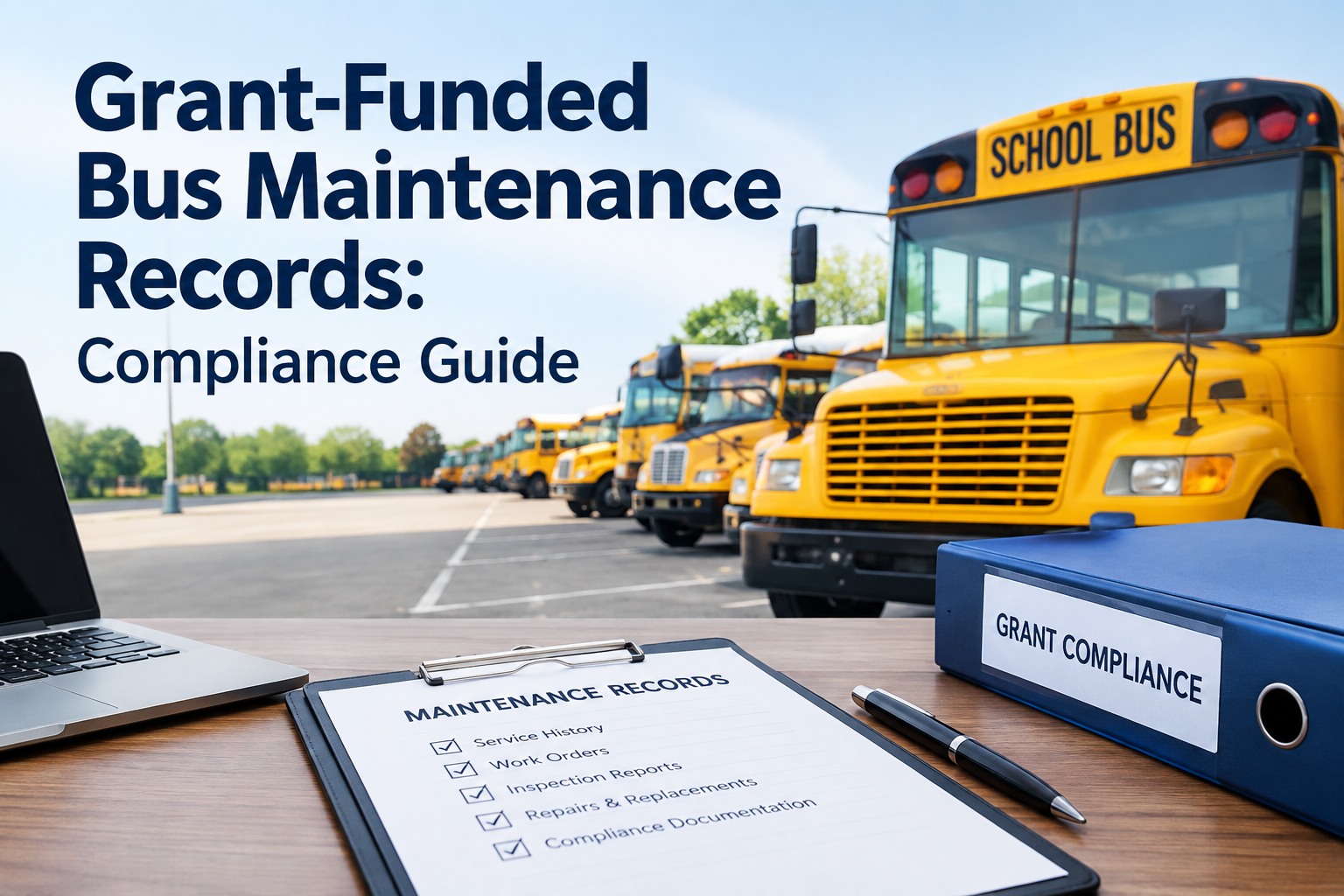
Grant-Funded Bus Maintenance Records: The Compliance Guide
What auditors want on FTA-funded and grant-funded buses, how long to keep it, and how to produce it on demand without a scramble.
- 12 yrUseful Life
- 3 yrPost-Disposition
- 1 ClickAudit Export
Why Grant-Funded Bus Records Are a Different Compliance Category
Every bus in your fleet needs maintenance records for DOT and safety compliance. Grant-funded buses need those same records plus a second layer that ties every dollar spent, every mile driven, and every service event back to the funding source that paid for the asset. Miss that layer and the same PM history that would pass a state DOT inspection can fail an FTA triennial review.
Each funding source has its own reporting cadence and its own definition of "adequate maintenance." FTA-funded assets fall under 49 CFR Part 5325 and the recipient's Transit Asset Management (TAM) plan. EPA Clean School Bus grants require condition and utilization data. State grants have their own audit windows. One bus can carry obligations from two or three of these at once. Book a demo to see funding-source tagging in a live BusCMMS environment.
What an FTA or Grant Auditor Actually Requests
The audit request usually arrives with a bus number or a VIN. The reviewer wants the complete maintenance evidence file for that specific asset across the useful-life period. Here is what belongs in that file — and what most fleets are missing when the request lands.
Asset Identification & Funding Trail
VIN, funding source code, grant award year, federal share percentage, in-service date, planned useful-life end date.
PM Schedule & Compliance History
Written PM schedule per bus (OEM-based or agency-defined), completion records with dates, mileage at service, technician sign-off.
DVIR & Inspection Records
Daily pre-trip and post-trip DVIRs, state annual inspections, ADA 90-day lift inspections — all retrievable per VIN per date.
Work Order Complete Set
Every WO opened and closed on the bus with labor hours, parts, part numbers, invoice references, technician and supervisor sign-offs.
Cost & Mileage Ledger
Total maintenance cost by period, cost per mile, cumulative mileage, fuel or energy consumption by month.
Recall & Warranty Documentation
Every NHTSA recall against the VIN with closure evidence, warranty claims filed and captured amounts, OEM correspondence.
Utilization & Availability Data
Days in service versus days out of service, revenue-service hours, route assignments — the utilization side of the TAM plan.
Disposition Record (if applicable)
If the bus reached end of useful life and was retired, sold, or transferred — documentation of the disposition and any residual value.
If any of those eight categories is thin or missing, the auditor will note it. If several are, the finding escalates from a note to a corrective action plan or, in the worst case, a partial recapture of the federal share on that asset. Sign up free and see all eight categories tracked per bus in one place.
The Actual Financial Exposure When Records Are Thin
Finance directors underweight this risk because grant compliance findings do not always trigger cash penalties. What they do trigger is worse — future funding constraints and disallowed costs that come out of the operating budget instead. Here is where the exposure actually lives.
Disallowed Costs
Maintenance costs charged to the grant that cannot be substantiated with WO detail must be repaid from local funds. On a mid-size fleet, a 12-month gap can run into six figures.
Federal Share Recapture
If an FTA-funded bus is disposed of before useful life without adequate maintenance documentation, the federal share may be recaptured on a straight-line basis.
Corrective Action Plan
Triennial review findings that require a CAP consume months of finance and operations time and get flagged in the agency's public record.
Future Award Risk
A history of compliance findings weighs on discretionary grant scoring. Formula funds keep flowing; competitive awards get harder to win.
The pattern most finance directors miss: none of these show up on this year's P&L. They show up two or three years later when the next triennial lands or the next competitive grant application gets marked down. The maintenance records you keep today are the audit defense you need in 2029.
Retention Timeline: How Long Every Record Type Must Live
Retention is where paper-based programs fail hardest. The rule most agencies work from is "records for the useful life of the asset plus three years post-disposition" — but the specific pieces have their own clocks. Miss a retention window and the record might as well not exist.
Auditors also want the records to be reproducible in their original form — not summarized after the fact. A PM history recreated from memory does not satisfy retention; the WO with the original timestamp and technician sign-off does. This is where paper binders and shared spreadsheets fail: the record exists, but not in a form that can be produced on demand five years later.
Paper & Spreadsheet vs. CMMS-Based Grant Records
Most agencies did not build their records program for grant audits — it grew organically out of the shop's workflow. That is usually why it fails when the audit request lands. Here is what changes when grant-record tracking moves out of paper and Excel and into a bus-specific CMMS.
The spreadsheet column above is not exaggeration. The average small transit agency spends three to four weeks on triennial review preparation because assembling records across VIN, funding source, and date range from separate systems is genuinely hard. A CMMS that stores the data in the right structure from day one turns that scramble into a filter and a download. Book a demo to see triennial-ready exports on a sample fleet.
How BusCMMS Handles Grant Reporting
BusCMMS treats funding source as a first-class field on the asset record — the same way it treats VIN, year, or fuel type. Once tagged, every WO, DVIR, part issue, and mileage reading on that bus is automatically linked to the grant that paid for it. That is the foundation the reporting layer sits on.
-
Funding-Source Tagging
Every asset carries its grant code, federal share percentage, award year, and useful-life horizon on the record. Filter any report by any grant.
-
Per-VIN Evidence File
Single-click compilation of the full maintenance history for any bus across the useful life — PMs, WOs, DVIRs, recalls, warranty in one PDF.
-
Cost per Mile by Grant
Dashboards show maintenance cost per mile filtered by funding source. Answers the FTA question of "what did you spend on our assets" in seconds.
-
Useful-Life Countdown
Every asset shows years and miles remaining against its useful-life horizon. Supports capital planning and TAM plan updates.
-
Retention Enforcement
All records held permanently in original form with authenticated timestamps. No document leaves a mandatory retention window unfiled.
-
Triennial-Ready Export
One-click package generation for FTA triennial review, NTD submission, and state grant audits. No spreadsheet assembly.
Because BusCMMS was designed for bus fleets specifically — not adapted from generic trucking or manufacturing software — the reporting layer already understands FTA funding categories, TAM plan requirements, and the record structure a transit auditor expects. Nothing has to be custom-built to make the reports look right.
The Practitioner View: What Audit Prep Looks Like Before and After
The finance-time saving is the number that gets attention, but the bigger value is downstream — clean triennial records feed directly into stronger discretionary grant applications. Agencies with clean audit histories score better on competitive awards, which affects the capital budget three and five years out. Sign up free and get your first grant-tagged asset records loaded this month.
The Bottom Line on Grant-Funded Bus Records
Grant-funded bus maintenance records are not a maintenance problem — they are a finance and compliance problem that the shop happens to generate the raw data for. Solving it means making sure the raw data is captured in the right structure from day one, tied to the right funding source, retained through the right window, and exportable in the right format when the audit request lands. That is not extra work. It is the same maintenance work, done in a system that respects the reporting obligation. Book a demo to see BusCMMS running on your grant portfolio.
What maintenance records must be kept for grant-funded buses?
FTA and other federal grant programs generally require the full maintenance evidence file for each grant-funded asset — asset identification with funding source, written PM schedule and completion records, DVIRs and inspection records, complete work order history with labor and parts detail, cost and mileage ledger, recall and warranty documentation, utilization data, and disposition records when applicable. The records must be reproducible in original form, not summarized after the fact, and retained for the useful life of the bus plus three years post-disposition.
How long must grant-funded bus records be retained?
The general rule under federal grant record retention is the useful life of the asset plus three years after disposition. For a transit bus with a 12-year useful life, that means records must be available for roughly 15 years. Some record types have their own minimum windows layered on top — daily DVIRs must be held at least 90 days under FMCSA rules, annual state inspections typically 14 months. Grant-related documents (award, purchase, disposition) run on the longer useful-life-plus-three clock.
What happens if maintenance records are missing during an FTA triennial review?
Findings escalate by severity. A minor gap gets noted in the report. A pattern of missing records triggers a corrective action plan requiring the agency to fix the underlying record-keeping process, with follow-up review. In serious cases — costs charged to the grant that cannot be substantiated — the FTA can require disallowed costs to be repaid from local funds. Systematic non-compliance affects the agency's rating for discretionary grant awards in future funding cycles.
Do school districts need to keep the same records for grant-funded buses?
School districts using state grants, EPA Clean School Bus Program funds, or federal pass-through funding for buses generally must retain records that substantiate how the funds were spent and that the assets are maintained per program requirements. The exact record set varies by program, but the principles are consistent: asset identification tied to the funding source, maintenance history retrievable per VIN, cost documentation, and retention through the useful life. State auditors expect the same discipline that transit agencies apply.
How does BusCMMS help with grant-funded bus record keeping?
BusCMMS treats funding source as a first-class field on every asset record, so every work order, DVIR, part issue, and mileage reading is automatically linked to the grant that paid for the bus. Dashboards show cost per mile by funding source, useful-life countdowns, and PM compliance filtered per grant. A one-click evidence file compiles the full maintenance history per VIN for triennial reviews, NTD submissions, and state grant audits — replacing weeks of manual assembly with a filter and a download.