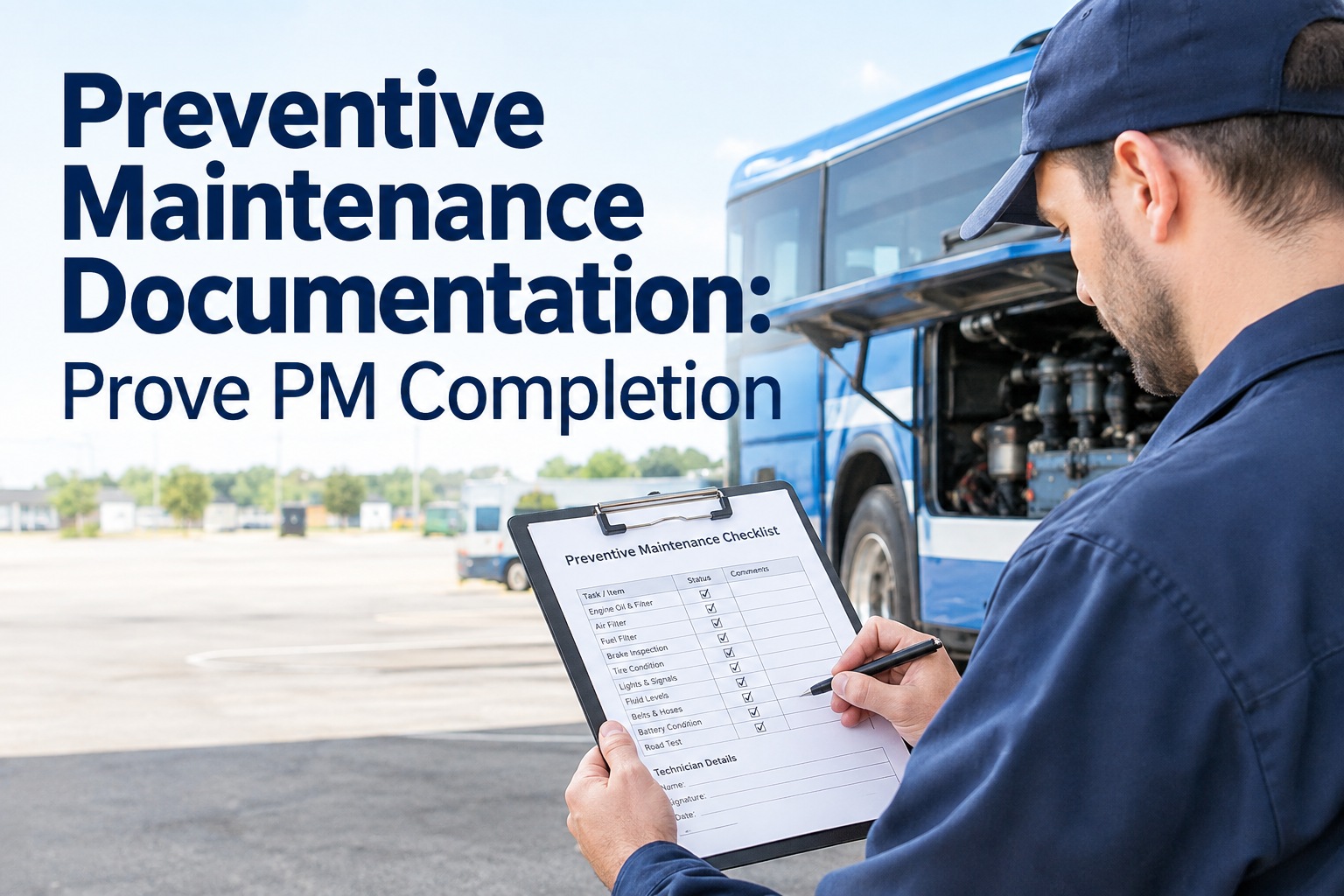
A tech spends three hours on a scheduled brake and chassis inspection. Two months later a wheel-off incident lands your fleet in a state DOT investigation, and the auditor asks for the PM record. You pull it up: date, mileage, "PM completed." No parts, no torque values, no photos, no technician sign-off. On paper the PM was done. In the audit record, it might as well not have been.
Preventive Maintenance Documentation: How to Prove PM Was Actually Performed
The seven required fields on every PM record, common documentation failures, and how to enforce completeness across the whole shop.
- 7Required Fields
- 3-5xEmergency Cost Ratio
- 100%Digital Traceable
Why Preventive Maintenance Documentation Matters More Than the PM Itself
A PM that was done but not documented has almost the same legal standing as a PM that was never done at all. That is not a rhetorical flourish — it is how DOT inspectors, insurance investigators, and plaintiff attorneys treat the gap. If the record does not exist, the work does not exist for the purpose of establishing what your fleet did to prevent the incident. This is why preventive maintenance documentation is a separate discipline from preventive maintenance itself.
The rule that governs everything below: a maintenance activity has legal and audit weight only if it can be reproduced, on demand, from a permanent record with the seven fields intact. Anything less is a story, not evidence.
The failure mode is almost always the same — the shop is doing the work but recording it thin. Tech finishes a PM, writes "done" in the log, moves on. Six months later nobody remembers which brake pad brand went on, whether the torque was verified, or which tech did the work. The bus is fine. The record is not. Book a demo to see complete PM records auto-generated on your fleet.
The Seven Fields That Make a PM Record Actually Complete
Every audit-worthy PM record contains the same seven data points. Miss one and the record has a gap; miss two and it does not stand up to a serious review. Here is the specification, in the order an auditor reads them.
-
01
Asset Identification
Bus number and VIN — not just the internal number. The VIN is what ties this record to the federal recall database, the warranty period, and the funding source.
EXAMPLE Bus 042 · VIN 1BAKGCPA5JF012*** -
02
PM Type & Interval Reference
Which PM schedule item this satisfies — A-service, B-service, annual, 6,000-mile, whatever the taxonomy is — with a reference to the schedule that triggered it.
EXAMPLE B-Service (6,000 mi interval) · Auto-triggered from odometer -
03
Date, Time, and Mileage
Actual completion timestamp — not "sometime that week." Odometer reading at service, not from last week's fuel log.
EXAMPLE Sep 18, 2026 · 09:14 · Odometer 146,208 mi -
04
Task-Level Completion
Every checklist item on the PM schedule marked pass, fail, or corrected. A single "PM complete" checkbox at the top does not satisfy this — the auditor wants line items.
EXAMPLE Brake pad measurement · 8mm · Pass. Air lines inspected · No leaks · Pass. -
05
Parts & Fluids Line Items
Every part consumed with part number, quantity, and lot number where applicable. Every fluid with brand, spec, and volume. Not "oil change" — "15W-40 CJ-4, 12 quarts."
EXAMPLE Oil filter P/N LF9080 (qty 1) · Delo 400 15W-40 (12 qt) -
06
Technician Identification & Labor
Authenticated technician sign-in (not just initials on paper), plus labor hours logged. Ties the specific work to the specific person if a defect surfaces later.
EXAMPLE M. Ramirez · Tech ID 4471 · 2.4 hrs logged -
07
Supervisor Sign-Off & Timestamp
Second authenticated user closes the WO with a timestamp. This is what turns a completed task into a released, audit-worthy record.
EXAMPLE D. Chen · Supervisor · Sep 18, 2026 · 11:47
Every one of those seven has to be retrievable per bus, per date, and per PM interval — years later, without hunting through folders. That is the standard. Anything short of it is a documentation gap that an inspector or attorney will find and use.
The Five Failures That Make PM Records Fall Apart
These are the five patterns that show up over and over when a fleet's PM records get reviewed. If any of them is happening in your shop, the exposure is real — even if the actual maintenance work is good.
The Single-Checkbox PM
A 40-item PM schedule reduced to one "PM completed" checkbox with no line-item results. The auditor cannot tell which items were actually inspected.
Batch Backfilling
Tech does five PMs in a week, records all five on Friday afternoon from memory. Timestamps and mileage readings are approximations, not measurements.
Parts Without Numbers
"Replaced filter" instead of "Replaced P/N LF9080." When a manufacturing defect gets called out later, the record cannot confirm whether your part was in the affected lot.
Anonymous Sign-Off
Initials on a paper log, or a shared shop login, or no sign-off at all. Cannot tie the work to a specific technician if a defect surfaces on that bus later.
Split-System Storage
PM checklist in one folder, parts issue in the inventory system, labor hours in payroll. Nobody can reconstruct a complete record without cross-referencing three sources.
All five of these failures share the same root cause: no single system holding the complete PM record. The fix is not more discipline from the techs — they already have a full day of work. The fix is a system that captures the seven fields as a byproduct of the workflow, not as extra paperwork. Sign up free and see structured PM records replace loose documentation.
Thin PM Record vs. Complete PM Record: Side by Side
The clearest way to see what "documented" actually means is to look at the same PM captured two ways. Same bus, same work, same technician. The only difference is what the record captures.
What Most Shops Actually Have
- Date · 9/18
- Bus · 42
- PM · done
- Oil change · complete
- Brakes · ok
- Tech · MR
What an Audit Actually Needs
- Bus 042 · VIN 1BAKGCPA5JF012***
- B-Service (6K interval) · auto-triggered
- Sep 18, 2026 · 09:14 · 146,208 mi
- 38 of 40 checklist items pass · 2 corrected
- Filter P/N LF9080 (1) · Delo 15W-40 (12 qt)
- M. Ramirez · ID 4471 · 2.4 hrs
- Sup D. Chen · signed 11:47
Notice the labor hours are the same. The parts consumed are the same. The technician skill applied is the same. The only real difference is which system captured the record, and how much structure it enforced at the point of capture. Book a demo to see the complete-record workflow on real PM work.
How BusCMMS Enforces PM Documentation Discipline
BusCMMS treats a PM as a structured work order, not a checkbox. Every PM opens with the seven required fields as its container, and the WO cannot close until each field is populated. That is the mechanical enforcement — the tech does not have to remember to log a torque value, because the WO will not advance without it.
-
Auto-Triggered PM Work Orders
PMs open automatically when mileage or calendar thresholds hit. The trigger source is captured on the WO — proves the schedule ran the work, not memory.
-
Line-Item Task Completion
Every checklist item captured individually as pass, fail, or corrected. No single-checkbox close — the WO holds line-item results.
-
Structured Parts Logging
Parts issued through inventory carry P/N, lot number, and quantity onto the WO automatically. No manual retyping, no "replaced filter" ambiguity.
-
Authenticated Sign-Off
Technicians log in individually — no shared shop accounts. Supervisor close-out is a second authenticated action with a timestamp on the record.
-
Real-Time Timestamping
Every action carries a real timestamp captured at the moment. No batch backfilling on Friday afternoon — the record shows when the work actually happened.
-
Per-VIN PM History Export
Full PM history per bus exports as a single PDF — every WO, every field, every timestamp. Ready for DOT, insurance, or legal review in one click.
Because BusCMMS is built for bus fleets specifically, the PM templates ship pre-loaded with the checklist items a school bus, transit bus, or motorcoach actually needs — stop arm, crossing gate, wheelchair lift, air brake components. The structure is already correct on day one; the tech just does the work.
The Practitioner View: Why Documentation Discipline Changes Everything Downstream
That is the pattern. The value of documentation shows up when something goes wrong — and if the record is not already complete before the incident, there is no way to build it after. This is why documentation discipline cannot be a project you get to next quarter. It is a system-level enforcement that has to be in place before the incident, not after. Sign up free and lock in complete PM records starting with your next service.
The Bottom Line on PM Documentation
Preventive maintenance documentation is not about generating paperwork. It is about capturing the seven required fields as a byproduct of doing the actual PM work — so when the audit, insurance investigation, or legal request lands, the record already exists in the form it needs to be in. Fleets that build this discipline into their system spend zero time on record scrambles. Fleets that do not spend most of their audit prep reconstructing what already happened. The maintenance work is the same in both cases. The record is what separates them. Book a demo to see PM documentation locked down on your fleet.
What is preventive maintenance documentation?
Preventive maintenance documentation is the structured record of every PM activity performed on a bus — capturing asset identification (bus and VIN), the PM type and interval, actual date and time and mileage of completion, line-item task results, parts and fluids consumed with part numbers, technician identification and labor hours, and supervisor sign-off. The purpose is to produce a permanent, retrievable record that proves the work was performed, when, by whom, and to what standard, so it stands up to DOT audits, insurance investigations, and legal review.
Why is documenting preventive maintenance as important as performing it?
In an audit, insurance claim, or lawsuit, work that cannot be documented is treated as work that did not happen. Auditors and investigators do not accept "we did it, we just did not write it down" as a defense. Without a complete record, the fleet cannot prove which items were inspected, what parts were installed, when the work was completed, or which technician performed it. The maintenance activity has legal and audit weight only if it can be reproduced on demand from a permanent record.
What are the required fields on a complete PM record?
A complete PM record contains seven fields: asset identification (bus number and VIN), PM type and interval reference, exact date and time and mileage of completion, line-item task completion with pass/fail results per checklist item, parts and fluids used with part numbers and quantities, technician identification with labor hours, and supervisor sign-off with an authenticated timestamp. Missing any one field creates a gap that an auditor or investigator can flag; missing two or more typically fails the record entirely.
What are common failures in PM documentation?
Five patterns come up repeatedly: single-checkbox PMs where a 40-item schedule is closed with one "complete" checkbox; batch backfilling where a week of PMs is recorded from memory on Friday; parts logged as generic descriptions instead of specific part numbers; anonymous sign-off with initials or shared shop logins instead of authenticated technician IDs; and split-system storage where the checklist, parts issue, and labor hours live in three separate systems that no one can reconcile after the fact.
How does BusCMMS enforce PM documentation completeness?
BusCMMS treats each PM as a structured work order with the seven required fields built in as its container. PMs auto-trigger from mileage or calendar thresholds, capture line-item checklist results, pull parts detail directly from inventory issues, require authenticated technician login, timestamp every action in real time, and only close after supervisor sign-off. The full PM history for any bus exports as a single PDF ready for DOT, insurance, or legal review — no assembly required.