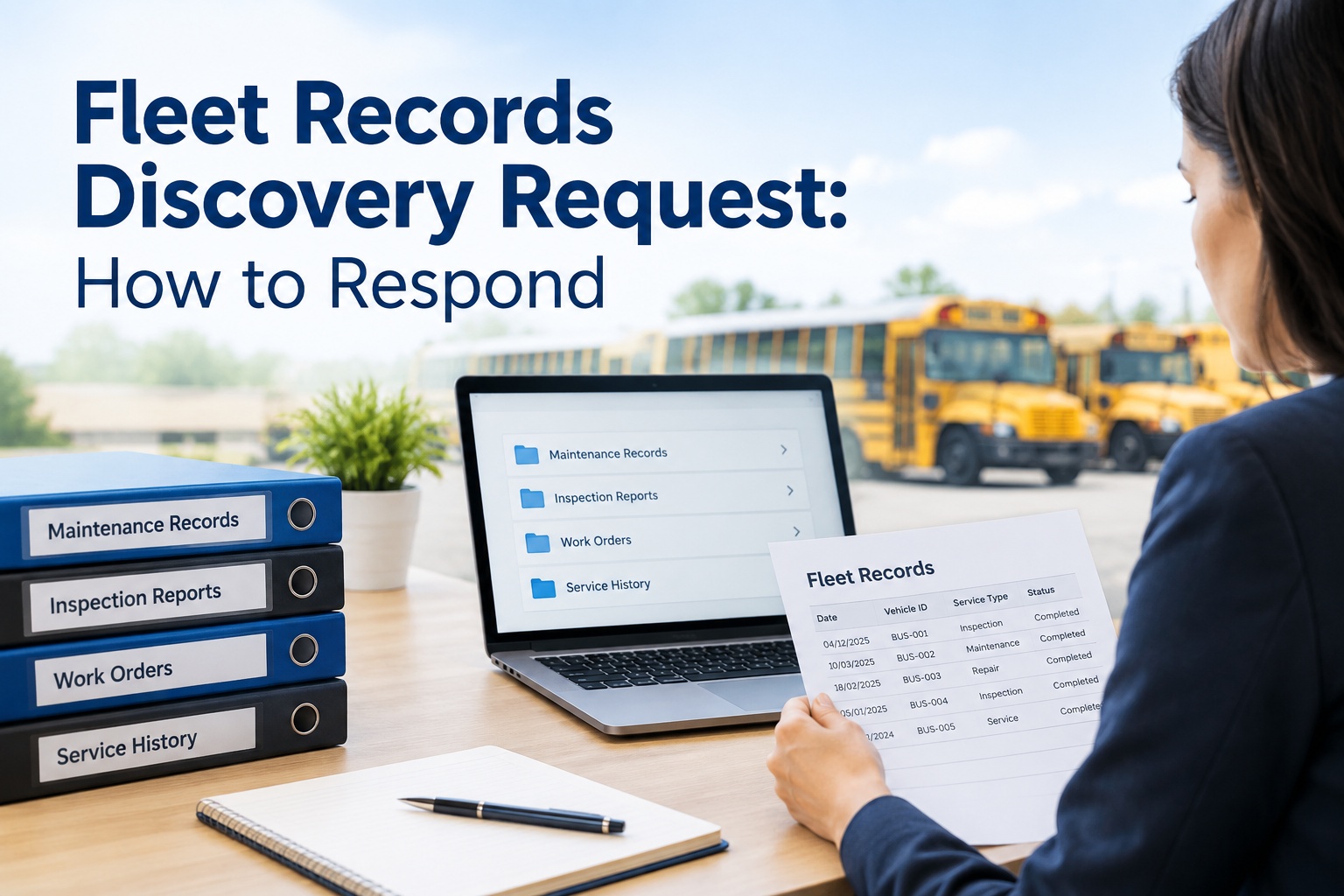
The envelope from opposing counsel arrives on a Tuesday. Inside is a discovery request naming a specific bus, a date range, and a list of record categories the attorney wants produced within 30 days. What happens next is not a maintenance question — it is a legal exposure question, and how your records were kept before the envelope arrived decides most of the outcome.
Fleet Records Discovery Request: How to Respond Without Making Things Worse
What plaintiff's counsel actually asks for, how to structure the production, and the retention posture that determines whether discovery becomes a liability.
- 30 DayTypical Response
- 7+ YrRecords Requested
- CourtEnforceable
Why Discovery Requests Are the Highest-Stakes Records Event
A DOT audit finding is bad. A grant compliance finding is worse. A discovery request in active litigation is a category above both, because the audience is not a regulator trying to help you improve — it is an attorney trying to build a case against your fleet. Everything you produce becomes evidence. Everything you cannot produce becomes an inference the jury is invited to draw.
The rule that governs everything else: when records that should exist cannot be produced, courts can instruct the jury to infer the missing records would have been unfavorable. This is called an adverse inference. It is often more damaging than any single record itself.
The exposure is not what you did or did not do in maintenance. The exposure is whether your records prove what you did — and whether the gaps in your records suggest what you did not. This is why records posture matters more than records volume. A fleet with complete, timestamped, retrievable records typically produces cleanly. A fleet with paper binders and shared spreadsheets often cannot, and pays for that when the case values it. Book a demo to see litigation-ready records posture on a live fleet.
Anatomy of a Real Discovery Request: What Attorneys Actually Ask For
Discovery requests in fleet incidents follow a predictable pattern. Understanding the pattern lets you prepare for what is likely to be asked before the envelope ever arrives. Here are the record categories that show up in nearly every plaintiff-side production request on a bus fleet.
Asset History
- Complete maintenance history for the subject bus
- All WOs opened and closed on the VIN, full date range
- Parts consumption records tied to WOs
- Odometer / mileage log by service date
Inspection Records
- Every DVIR filed by every driver on the subject bus
- State annual inspection reports
- ADA 90-day wheelchair lift certifications
- Post-incident inspection reports
Personnel Records
- Driver qualification file for the assigned driver
- Training records tied to the incident condition
- Technician certification records
- Sign-off attribution on every relevant WO
Systemic Records
- Written PM schedules and SOPs in effect at the time
- OOS release policies
- Similar incidents involving comparable vehicles
- Recall closure documentation for the subject bus
The request is designed to establish a story — either that a specific failure caused the incident, or that a pattern of systemic neglect made it foreseeable. Category D is where discovery typically becomes most damaging, because "similar incidents" and "SOPs in effect at the time" expand the scope from one bus to fleet-wide practice. A fleet whose records can produce Category D cleanly frames the story on its own terms; a fleet that cannot produce it lets opposing counsel frame it. Sign up free and see per-VIN evidence exports available on demand.
The Response Decision Matrix: Produce, Object, Redact, or Withhold
Not every requested record gets produced as-is. For each item in the request, counsel makes one of four decisions — and the decision has to be defensible on the record. This is not the maintenance manager's call; it belongs to legal counsel with the maintenance team supplying the underlying records. But understanding the four options helps the records team support the response.
Produce
Record is responsive, within scope, and not privileged. Produced in the requested form with Bates numbering and a production log.
Object & Narrow
Request is overbroad, unduly burdensome, or seeks irrelevant material. Counsel files a formal objection proposing a narrower production.
Produce with Redaction
Record contains produceable content plus material subject to privacy law (student PII, driver medical). The record is produced with those portions redacted per statute.
Withhold on Privilege
Record is attorney-client communication, work product, or otherwise privileged. Withheld with a privilege log describing what is being held and on what basis.
The fifth option — losing or destroying records after litigation is anticipated — is what triggers sanctions. Once litigation is reasonably foreseeable, a legal hold suspends all normal retention destruction. Records that "went missing" between the incident and the discovery response are the fastest path to an adverse inference instruction and, in serious cases, monetary sanctions against the fleet.
Day One to Day Thirty: The Production Workflow
The 30-day response window is not a suggestion. Miss it without a formal extension and the fleet is in noncompliance with a court process. Here is the workflow that keeps production on schedule and defensible from the day the envelope arrives.
Log the Request & Trigger Legal Hold
Discovery request goes to counsel and to records custodian same day. Legal hold notice issued to every custodian who touches relevant records — shop, dispatch, HR, IT. Normal retention destruction paused on the subject asset.
Scope Review with Counsel
Counsel reviews each request item against the four decisions (produce / object / redact / withhold). Records custodian identifies where each category actually lives and what production volume looks like.
Compile Responsive Records
Records extracted per VIN, per date range, per category. Chain of custody documented — who pulled what, from which system, with what timestamps. This is where fleets on paper or spreadsheet systems typically fall behind.
Attorney Review & Redaction
Counsel reviews the compiled set for privilege, redacts protected information per statute (FERPA, HIPAA, driver PII), builds the privilege log for anything withheld.
Bates Numbering & Production Log
Every page numbered sequentially, production log created listing every document with source, date, and Bates range. This is what makes the production defensible if any record's origin is later challenged.
Serve Response
Response served on opposing counsel with the production, formal objections, redaction basis, and privilege log. Preservation obligation continues until case resolution — legal hold stays in effect.
Day 6-15 is where the entire workflow lives or dies. A fleet with structured records completes it in a couple of days. A fleet reconstructing from paper folders and multiple systems can burn the full ten days there and still miss items — which then either delay the production or, worse, get discovered later as omissions. Book a demo to see how BusCMMS compresses Day 6-15 into an export.
The Records Postures That Get Fleets in Trouble
These are the patterns opposing counsel looks for during depositions of the records custodian. Any one of them can be developed into an argument that the fleet's records are unreliable — which then undermines everything else the fleet produces.
No Contemporaneous Timestamps
Records dated by the writer without a system timestamp. Opposing counsel argues the date is unverifiable — was the WO closed the day it says, or reconstructed later?
Shared or Anonymous Sign-Off
Initials on paper, shared shop login, no way to tie a specific technician to specific work. Turns "who did this" into a deposition question with no clean answer.
Gaps Without Explanation
Missing PMs, missing DVIRs, missing months. The gap itself becomes evidence — even if the actual work was performed but not recorded.
Post-Incident Record Edits
Any record modified after the incident date without a system-tracked audit trail suggests spoliation. Even legitimate cleanup edits look bad if they cannot be reconstructed.
Records Custodian Cannot Explain the System
Deposed custodian cannot describe how records are captured, retained, or retrieved. Opposing counsel builds a foundation argument that the entire record set is unreliable.
All five of those postures are what happens when records live across paper folders, spreadsheets, and disconnected systems. Fixing them is not primarily a legal problem — it is a records infrastructure problem that legal exposure surfaces. The fix has to happen before an incident, not after.
How BusCMMS Supports a Defensible Records Posture
BusCMMS was built to hold fleet records in the form a legal production actually needs them in — authenticated timestamps, chain of custody, per-VIN retrieval, retention integrity. Nothing in the platform is specifically a "legal feature." The point is that the same discipline that makes maintenance records complete for audits makes them defensible in litigation, because it is the same underlying requirement.
-
System-Timestamped Records
Every action carries a system-generated timestamp at the moment of capture — not a user-entered date. Opposing counsel cannot argue reconstruction.
-
Authenticated User Attribution
Every sign-off tied to a unique authenticated login. Chain of custody from technician to supervisor is preserved on the record itself.
-
Per-VIN Production Export
Full record history for any bus across any date range exports in one operation — WOs, DVIRs, PMs, parts, recalls, sign-offs. Ready for counsel review.
-
Retention Integrity
Records held permanently in original form. No accidental destruction, no "the folder got misplaced" — the retention obligation is enforced by the system.
-
Change Audit Trail
Any edit to any record is logged with the original value, the new value, the user, and the timestamp. No silent post-incident modifications.
-
Deposition-Ready Reporting
Records custodian can explain the system on the stand — because every capture path, retention rule, and retrieval method is documented in the platform itself.
Because BusCMMS was built for bus fleets specifically, the record structure aligns to what plaintiff-side attorneys typically ask for — per-VIN maintenance history, DVIRs with driver attribution, PM completion tied to a scheduled interval. Nothing has to be reconstructed to look right for a legal production.
The Practitioner View: What Records Posture Looks Like Under Deposition
That is what a defensible records posture actually buys — not a guaranteed outcome, but the ability to remove records reliability as an attack surface. When opposing counsel cannot make the records the argument, the case turns on the actual merits. Fleets that get this right settle faster, on better terms, and avoid the multi-year litigation trajectories that eat operational budget. Sign up free and put a defensible records posture in place before you need it.
The Bottom Line on Fleet Discovery Requests
A discovery request is the moment your records posture becomes a legal exposure or a legal defense — and there is no way to change which one it is after the envelope arrives. The work happens years earlier, in whether every WO closed with a timestamp, whether every sign-off had an authenticated user, whether every record went into a system that retained it in original form. Fleets that treat records posture as infrastructure — not a project you get to later — hand counsel a clean production and let the case turn on the merits. Fleets that treat it as an afterthought find out what an adverse inference is at the worst possible time. Book a demo to see litigation-ready records posture on your own fleet.
What is a fleet records discovery request?
A fleet records discovery request is a formal legal demand for maintenance, inspection, personnel, and systemic records related to a bus, a driver, or an incident. It typically arrives during civil litigation from opposing counsel, but can also come from an insurance carrier's counsel, a plaintiff's attorney pre-suit, or under a public records law. The request has a court-set response deadline, typically 30 days, and failure to produce responsive records can result in sanctions or an adverse inference instruction to the jury.
How long does a fleet have to respond to a discovery request?
Standard response window is 30 days from service under most state and federal civil procedure rules. Extensions can be requested through counsel but must be formally negotiated with opposing counsel or approved by the court — a fleet that simply misses the deadline is in noncompliance with a court process. Once litigation is reasonably foreseeable, a legal hold obligation attaches earlier than the formal request, meaning records must be preserved from the moment the incident happens, not from the moment the request arrives.
What records are typically requested in a bus fleet discovery?
Requests usually cover four categories: asset history (complete maintenance record, WOs, parts, mileage for the subject bus), inspection records (every DVIR, state annual inspections, ADA lift certifications, post-incident inspections), personnel records (driver qualification file, training records, technician certifications, sign-off attribution), and systemic records (written PM schedules and SOPs in effect, OOS release policies, similar incidents, recall closure). The date range often extends to the full ownership period of the vehicle.
What happens if the fleet cannot produce requested records?
The consequences escalate by severity. Minor gaps get noted and the missing items may be re-requested. Systematic inability to produce responsive records can result in monetary sanctions against the fleet, exclusion of the fleet's own defense evidence at trial, and — most damaging — an adverse inference instruction, where the court tells the jury it may infer the missing records would have been unfavorable to the fleet. Records destroyed after litigation was reasonably foreseeable trigger spoliation findings, which are treated as more serious than pre-litigation gaps.
How does BusCMMS support fleet discovery response?
BusCMMS captures every record with a system-generated timestamp at the moment of capture, ties every action to a unique authenticated user, holds records permanently in original form, and logs every change with the original value, new value, user, and timestamp. Full per-VIN production exports compile the complete record history for any bus across any date range in one operation. Because the platform was built for bus fleets, the records already align to the categories plaintiff-side counsel typically requests, so counsel gets what they need in hours instead of weeks.