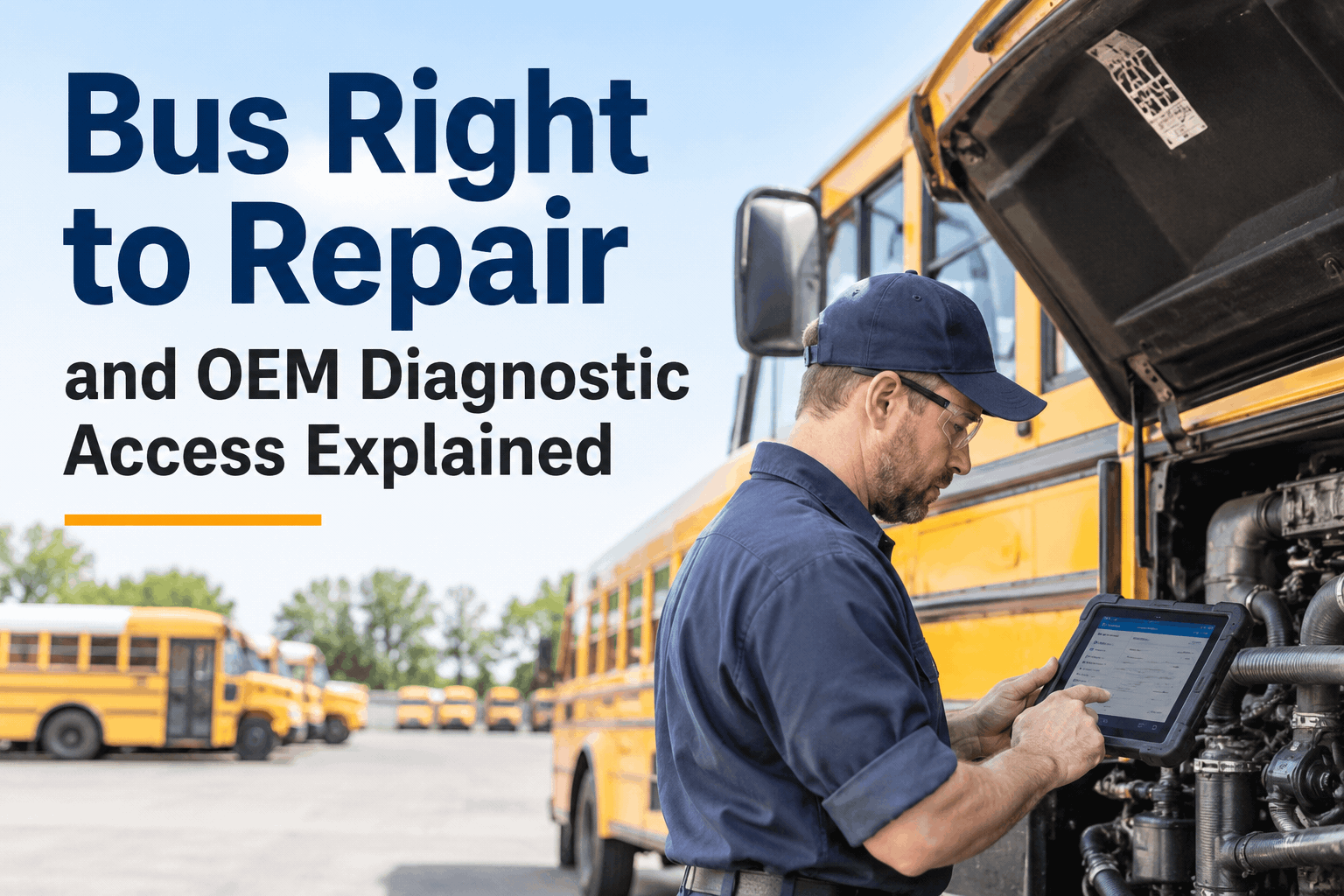
A check-engine light comes up on a bus mid-route, the code points at an after-treatment fault, and your independent shop plugs in — and gets locked out of the OEM software that would clear and calibrate it. Now it is a dealer trip, longer downtime, a bigger bill. Bus right to repair is the fight over exactly this: who can read, diagnose, and fix your bus. You can see how to keep every fault and repair on one record in a demo.
Bus Right to Repair and OEM Diagnostic Access Explained
Not all diagnostic access is the same. Some data on your bus is open to any tool, some the law already requires manufacturers to share, and some sits behind dealer-only software. Knowing which is which is the whole game.
The base layers are broadly available — a standard port reads basic codes, and emissions information already has to be shared. The contested tier is the one at the top: the full OEM software that clears and calibrates.
What OEM Diagnostic Access Actually Means
"Diagnostic access" is really three different things, and most of the frustration comes from treating them as one. Pulling a code is not the same as being able to clear it, and neither is the same as reprogramming a module. Here is how the layers break down for a heavy-duty bus.
Read basic codes
The standardized J1939 port on heavy-duty vehicles gives any capable scan tool the basic engine and fault-code data. This layer is broadly open.
Diagnose emissions systems
Under the Clean Air Act, manufacturers must make emissions diagnostic and repair information available for heavy-duty vehicles — a right that applies to buses today.
Clear, calibrate, reprogram
The deep functions — clearing certain faults, calibrations, module programming — often need OEM software that independent shops cannot always buy. This is the contested layer.
A fault you can see but not clear is still a dealer trip. The practical question is not "can I read it" but "can I finish the repair" — and that is where access gets gated.
Whatever access you have, the record of the work is yours to keep. You can sign up free and log every fault and repair in one place.
Where the Law Stands — and Where It Is Still Moving
Right to repair for commercial vehicles is partly settled and partly in motion, so it helps to separate what is already in force from what is being debated. This is general information, not legal advice, and the details are evolving — for the fuller legal picture, see our guide to right-to-repair laws for bus fleets.
Emissions diagnostic and repair access is already required for heavy-duty vehicles under the Clean Air Act, and a standardized data port gives basic code access. A 2015 heavy-duty memorandum of understanding between manufacturers and aftermarket groups covers buses over 10,000 pounds, though it is voluntary.
Federal bills such as the REPAIR Act would make the heavy-duty MOU enforceable with FTC oversight, but as of early 2026 that is advancing in committee, not settled, and versions differ on how they treat the heaviest vehicles. Some states, such as Maine, have passed their own rules, so coverage varies by where you operate.
The debate itself is balanced on real concerns. Fleets, independent shops, and aftermarket groups argue that broader access lowers repair cost, cuts downtime, and restores fair competition; manufacturers raise intellectual-property, cybersecurity, and safety concerns about who can reprogram a vehicle. Most proposals try to split the difference with secure, owner-authorized access rather than open public access.
One Record, Wherever the Repair Happens
Access rules decide who can touch the bus; they do not decide who keeps the history. That part is always yours to control — and a complete record is what protects your warranty claims, your resale value, and your next diagnosis, whoever did the last one.
The repair can happen wherever your access and your budget allow. The record of it should never be scattered across three shops' invoices and a glovebox.
That single history is the asset you keep no matter which way the rules go. You can sign up free and start one record for every bus.
Protect Your Repair-Data Rights: A Checklist
Whatever the law settles on, the fleets that fare best are the ones that document everything and keep their options open. Run this so you are never boxed into a single repair path by missing records. The CRITICAL items keep a bus legal and serviceable anywhere; the PROTECT items guard your leverage and your data.
- Log every fault code and what fixed itCapture the code, the diagnosis, and the repair on the bus's record — not just on a shop invoice.CRITICAL
- Know your emissions-access rightEmissions diagnostic and repair information must be shared for heavy-duty buses — use it rather than defaulting to the dealer.CRITICAL
- Keep warranty-grade documentationDated records of parts, labor, and procedures protect warranty claims no matter who did the work.CRITICAL
- Track which tools cover which modelsKnow where your scan tools and software stop, so a gated repair never surprises you mid-route.PROTECT
- Hold your own telematics and fault dataKeep the vehicle data you generate in a record you control, not only in a manufacturer's portal.PROTECT
- Build a repeat-failure history per busA pattern of the same fault is your evidence — for warranty, for a recall, or for a smarter next repair.PROTECT
None of this requires winning a policy fight — it is documentation you control today. You can book a demo and see how the fault history builds itself.
How BusCMMS Fits the Right-to-Repair Picture
BusCMMS does not read your engine or unlock OEM software — that is the job of a scan tool and the access rules around it. What it does is make sure every fault and fix becomes part of a record you own, so your leverage and your history never depend on a dealer's system.
Fault codes captured as work orders
A fault — entered by a tech or fed from telematics — opens a trackable work order, so nothing lives only on a handheld or a dealer screen.
Complete repair history you own
Parts, labor, procedures, and cost on one record per bus, independent of who performed the work or which tool they used.
Warranty and recall evidence
Dated, detailed records back a warranty claim or flag a repeat failure, whether the repair was in-house or at a dealer.
DVIRs and compliance records
Inspections and service history captured for FMCSA and state-DOT needs, so documentation is never the thing holding you up.
However the access question lands, your maintenance record stays yours — and that is the part you can lock in today. To set it up, book a demo and bring a bus's repair history.
A Shop Foreman's Take
Key Takeaways on Bus Right to Repair
Access is a moving target; your records are not. Four things to carry while the rest gets sorted out.
Access comes in layers
Basic codes are open, emissions data is required, deep OEM software is gated.
Some rights exist now
Emissions diagnostic access for heavy-duty buses is already the law today.
The rest is still moving
Federal and state rules are evolving — coverage can depend on where you operate.
Your record is your leverage
Document every fault and fix in a history you own, whoever does the work.
Understand the tiers of diagnostic access, use the rights you already have, and keep a complete repair record you control — and bus right to repair stops being a policy worry and becomes something you manage. The law will keep moving; the fleet that documents everything keeps its choices open no matter where it lands.