You cut from five routes to three to cover a driver shortage, parked two buses, and told the board you would save on maintenance. A few months in, the shop is busier, not quieter — faster brake wear, PMs due sooner, more road calls. That is the hidden effect of route consolidation on maintenance load: you did not remove the work, you concentrated it onto fewer buses. You can see how to re-baseline PM for a heavier duty cycle in a demo.
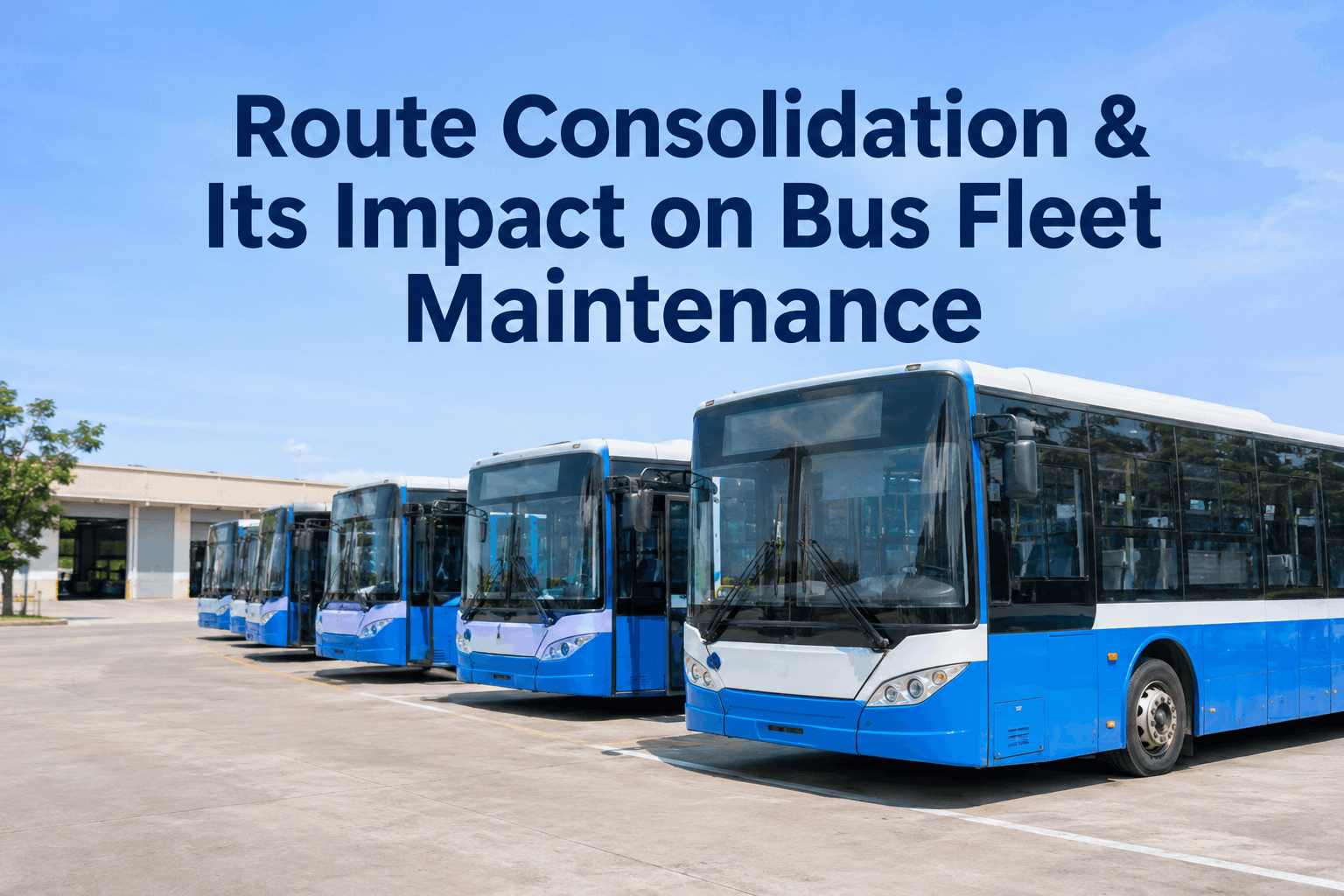
Route Consolidation & Its Impact on Bus Fleet Maintenance
Consolidating routes removes buses from the yard, not miles from the schedule. The same service rides on fewer units — so each remaining bus carries a heavier load, and your maintenance plan has to move with it.
Load figures are illustrative. The shape is what matters: the parked buses did not take their miles with them — those miles landed on the three that stayed.
The Hidden Effect: Fewer Buses, More Maintenance per Bus
Route consolidation looks like a maintenance win on the budget line — two fewer buses to service. The trap is assuming total maintenance scales with the number of buses. It scales with how hard each bus works, and consolidation makes the survivors work much harder.
Five buses became three, so maintenance should drop by roughly two buses' worth of PMs, parts, and shop hours. Fewer units, smaller bill.
The three remaining buses absorb the parked buses' miles and stops. Each hits PM intervals sooner, wears brakes faster, and logs more engine hours — so per-bus cost climbs even as the count drops.
The buses you kept are now your hardest-working assets. Maintained on their old, lighter-duty schedule, they are also the ones most likely to break down on a route.
The good news: the load is predictable, so the plan can get ahead of it. You can sign up free and set per-bus intervals that match the new load.
Wear Follows Duty Cycle, Not Headcount
A bus does not wear by how many siblings it has in the yard — it wears by miles driven, stops made, and hours run. After consolidation, all three climb on every remaining bus. That is why a mileage-only PM plan quietly falls behind.
Illustrative figures; each pair is scaled within its own metric. The direction is the real lesson — every wear driver rises together on the buses that stayed.
More miles
Longer daily blocks pull mileage-based PM — oil, filters, tires — forward on the calendar.
More stops
Each stop is a braking event. Denser blocks mean more brake cycles per mile, and brakes wear by cycles, not distance.
More engine hours
Idling and stop-and-go add engine hours a mileage-only schedule never sees — real wear that stays invisible.
This is exactly where duty-cycle-aware scheduling earns its keep. You can walk through mileage-and-engine-hour PM triggers in a demo and see the gap a mileage-only plan leaves.
Re-baseline Your Maintenance After Consolidation
The day the new route map goes live, your old PM assumptions expire. Run this list on every bus that absorbed extra service, before the heavier load shows up as an unplanned breakdown. The CRITICAL items keep a harder-working bus safe; the PLAN items keep the shop and budget from being blindsided.
- Recalculate PM intervals for the new daily mileageA bus now running 70% more miles hits its mileage PM far sooner — reset the trigger, do not keep the old one.CRITICAL
- Add an engine-hour trigger for stop-heavy blocksMileage alone misses idling and stop-and-go wear; let whichever threshold hits first set the PM date.CRITICAL
- Tighten brake inspection on denser routesMore stops per mile means more braking cycles — inspect brakes on a shorter cycle than the old route called for.CRITICAL
- Re-set per-bus cost and uptime baselinesCompare each bus to its new duty cycle, so rising cost reads as expected load, not a mystery.PLAN
- Protect a real spare for the busier scheduleWith fewer buses and higher use, one breakdown hits harder — keep a ready spare in the plan.PLAN
- Plan shop capacity for faster-arriving PMsThe same PMs now land closer together — make sure bay time and parts keep up with the compressed schedule.PLAN
Each item is a setting you change once and the system enforces every day. You can sign up free and re-baseline your PM in an afternoon.
How BusCMMS Keeps Up With a Heavier Duty Cycle
The reason consolidation surprises fleets is that mileage-only, calendar-only maintenance cannot feel the extra load. A bus-built CMMS can — it tracks the wear drivers that actually moved and adjusts the plan to them.
Dual-trigger PM scheduling
Mileage and engine hours tracked together, so the first threshold reached fires the PM — stop-heavy wear never slips past a mileage-only date.
Cost per bus, duty cycle aware
Real-time cost-per-mile and MTBF per unit, so a bus carrying more load reads as expected, and a true outlier stands out early.
Auto work orders from PM and defects
Compressed intervals and failed inspections generate work orders automatically, so the busier shop schedule never depends on memory.
Fleet availability you can prove
See which buses are current and which are due, so a leaner fleet still hits route coverage without a last-minute scramble.
That is maintenance that moves with your route map instead of lagging a season behind it — and it keeps your passenger transit operations covered as the fleet gets leaner. To set it up for your consolidated schedule, book a demo and bring your new route plan.
A Fleet Manager's Take
Key Takeaways on Route Consolidation & Maintenance
Consolidation is a sound move — as long as your maintenance plan moves with it. Four things to carry into the next route change.
Work concentrates, it does not vanish
Parked buses hand their miles and stops to the ones that stay.
Wear tracks duty cycle
Miles, stops, and engine hours per bus all rise — and so does wear.
Mileage-only PM falls behind
Add engine-hour triggers so stop-and-go wear cannot hide.
Re-baseline on day one
Reset intervals and cost baselines the moment the new map goes live.
Treat the maintenance load as something you move deliberately when you consolidate — shorter intervals, a second PM trigger, fresh per-bus baselines — and the hidden effect stops being hidden. Your leaner fleet stays reliable because its upkeep matches the harder work you are now asking of it, not the lighter schedule it used to run.