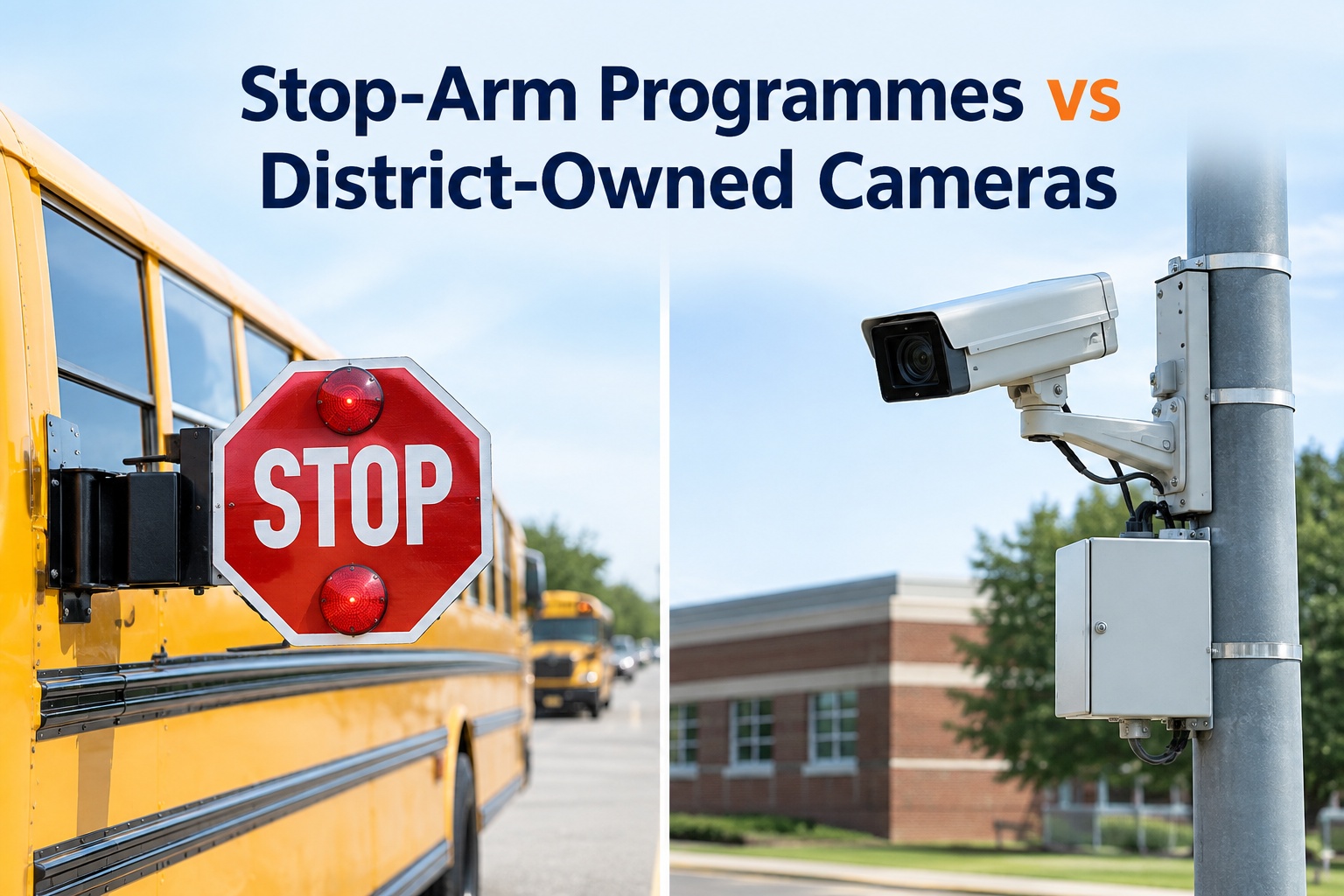
Choosing a stop-arm program versus district-owned cameras comes down to control versus convenience: a vendor-run program means a provider installs, operates, and maintains the cameras at little or no upfront cost and funds it from shared citation revenue, while district-owned means you buy the cameras, own the hardware and the footage, and run the program yourself. Neither is automatically right: vendor programmes trade control and revenue for a turnkey, low-capital start, and district-owned trades a large upfront spend for full ownership and data control — and the honest choice depends on your capital budget, your capacity, and whether your state even authorizes automated enforcement.
Stop-Arm Programmes vs District-Owned Cameras
One model costs almost nothing upfront but shares your revenue and holds your footage. The other costs capital but keeps you in control. Here is how to choose on more than the sales pitch.
Updated September 2026 · A practical buyer's guide, not legal advice; automated enforcement rules vary by state — verify your statute.Both models exist because they solve the problem differently, and both are legitimate. A vendor programme gets stop-arm enforcement running fast with no capital vote, while a district-owned system gives you complete control of the hardware, the footage, and any revenue. The wrong choice is not one model over the other — it is choosing either one without reading the fine print on ownership, contracts, and what happens to your evidence.
First: does your state even allow it?
Before comparing models, confirm the ground rules, because automated stop-arm enforcement is not legal everywhere and the details differ sharply by state.
All 50 states prohibit illegally passing a stopped school bus, but only about half currently authorize automated camera enforcement — issuing a citation without an officer witnessing the violation. Roughly 26 states explicitly authorize it per recent NCSL tracking, with vendor sources citing up to 30 as legislation expands. Some states still require an officer to witness the violation, in which case cameras can be installed for safety and deterrent value but not automated citations. Fine amounts and revenue rules vary widely by state and statute. Verify your own state's current law directly — this page is a practical buyer's guide, not legal advice, and does not establish what applies to your district.
This matters for the model choice, because the vendor-run, violator-funded model only works where automated citations are authorized — the revenue that funds it depends on it. In states that do not authorize automated enforcement, a district-owned system used for safety and deterrence may be the only route. Pilot on 10 buses to see the workflow either way
Where the two models actually differ
The headline is upfront cost, but the decision lives in the details below it — ownership, contracts, and control. Weigh all of these, not just the price of entry.
The two rows that surprise districts most are footage ownership and what happens when a contract ends. Under some vendor programmes the historical video is the vendor's, with access defined by contract — so read exactly who owns the evidence, who can export it, and what you keep if you leave. Start free and keep your evidence workflow in your control
The five-year view: small, medium, and large fleets
A one-year snapshot flatters the vendor model, because its cost is deferred into the revenue share. Look at five years, and factor fleet size, because scale changes which model wins — and never rely on a vendor's citation-revenue projection to make the case.
Limited capital and staff make the vendor model attractive — enforcement without a large purchase or new headcount. Just confirm the revenue share and footage terms are fair at low volume.
The math tightens. Over five years, a shared revenue stream and recurring vendor terms may rival what owning would cost — model both, including staff time, before deciding.
Scale can favor ownership: enough buses to justify capital and staffing, and enough citation volume that a revenue share becomes a large recurring giveaway. Owning keeps the revenue and the control.
Whichever way it leans, build your own five-year model — upfront, recurring, staffing, and a conservative, self-verified revenue estimate — rather than accepting the projection a vendor has every incentive to inflate. A programme that looks free can be the expensive one at scale. Pilot on 10 buses and build a real five-year model
Contract red flags to catch before you sign
Vendor programmes especially can hide their real terms in the contract. Read for these before a signature, because they are hard to unwind afterward.
A minimum bus count or term that locks in spend regardless of results.
Terms that renew on their own unless you cancel by a buried deadline.
No plain answer on who owns the video and what you keep if you leave.
Limits on exporting your own footage and records, or fees to do it.
Projections built on optimistic citation volume the vendor will not guarantee.
Unclear duties for equipment repair, replacement, and who pays.
Charges for storage, connectivity, or evidence retrieval on top of the share.
No clarity on what happens to historical footage when the contract ends.
Ask any vendor for a redacted sample contract during evaluation and read these clauses first. A confident, fair partner will answer all of them plainly; evasiveness on ownership or fees is itself the warning. Start free and avoid the fine-print traps
Pilot it on measurable criteria
Do not evaluate either model on brochures or revenue promises. Run a pilot and score it on measurable things, on your own buses and routes.
These numbers cut through the pitch: a programme with great citation projections but a high false-positive rate and slow retrieval buries your staff in review, while one that surfaces clean, usable events and connects to your maintenance workflow saves time on every incident. Measure, then decide. Pilot on 10 buses against these exact criteria
Vendor-run vs district-owned, side by side
Laid out directly, the trade-off is clear — and it is about far more than the price of entry. This is the comparison to bring to a board.
There is no green column here on purpose — neither model is universally better. The right one depends on your capital budget, your staffing capacity, your state's rules, and how much control of footage and revenue matters to you. Start free and evaluate the workflow behind either model
Four moments that test either model
Whatever model you lean toward, put it through the situations your district actually faces — because this is where a silo shows.
Review a suspected violation
A stop-arm event triggers — how clean is the evidence, and how fast can it be reviewed and acted on?
Retrieve after a complaint
A parent reports an incident — can you find, review, and export the footage quickly, or is it the vendor's to release?
Preserve for an investigation
Footage must be held for a case — who controls retention, and can you guarantee it is preserved?
Link an event to the bus
A camera event ties to a bus with a defect — does it connect to the vehicle and maintenance history, or stop at the clip?
The fourth is the one both models tend to fail, because stop-arm enforcement is usually run apart from fleet maintenance. Yet the same camera catching a violation is on a bus with inspections, defects, and a maintenance history — and connecting them is where a lot of hidden value sits. Pilot on 10 buses and connect events to the bus record
Why BusCMMS fits either model
BusCMMS does not pick the model for you — it makes sure that whichever you choose, the camera evidence does not end up stranded in its own system.
Model-agnostic
Works alongside a vendor programme or a district-owned system — it unifies the events either way.
One vehicle record
Camera events, inspections, defects, and maintenance on the same bus record, not a separate silo.
AI-native
AI surfaces high-risk buses and events first, so review time goes to what matters.
Hardware-agnostic
Works with the cameras you already run or a vendor deploys, so evaluating it costs no rip-and-replace.
So the real buying question is not just vendor versus owned, or which camera or which citation split. It is whether the complete evidence and maintenance workflow works for your district — which is exactly what a pilot is for. Start free and evaluate the whole workflow
Discuss a BusCMMS pilot on ten buses
Whether you run a vendor stop-arm programme or own your cameras, see how BusCMMS unifies camera events, inspections, defects, and maintenance on one vehicle record — with AI surfacing the high-risk buses first. Model-agnostic and hardware-agnostic, so evaluating it costs no rip-and-replace. Start with a pilot on ten buses and measure it against real criteria.
Model-agnostic · One vehicle record · AI prioritizes high-risk buses
Frequently asked questions
What is the difference between a vendor-run stop-arm programme and district-owned cameras?
In a vendor-run programme, a provider installs, operates, and maintains the stop-arm cameras at little or no upfront cost and funds the programme from citation revenue, sharing a portion with the district; the vendor typically owns the hardware and often the footage, sets equipment specs, and handles evidence review and citation processing. In a district-owned system, the district buys the cameras as a capital purchase, owns the hardware and the footage outright, keeps any revenue, and runs review, maintenance, and support with its own staff. The trade-off is control versus convenience: vendor programmes start fast with no capital and minimal labor but share revenue and hold your footage, while district-owned costs more upfront but keeps full ownership and data control. The right model depends on your capital budget, staffing capacity, and whether your state authorizes automated enforcement at all.
Is automated stop-arm camera enforcement legal everywhere?
No. All 50 states prohibit illegally passing a stopped school bus, but only about half currently authorize automated camera enforcement — issuing a citation without an officer witnessing the violation. Recent tracking puts roughly 26 states as explicitly authorizing it, with vendor sources citing up to 30 as legislation expands, and some states still require an officer to witness the violation, in which case cameras can be used for safety and deterrence but not automated citations. Fine amounts, revenue rules, and administrative requirements vary widely by state and statute. Because the vendor-run, violator-funded model depends on citation revenue, it only works where automated enforcement is authorized. Always verify your own state's current law directly rather than relying on a vendor summary; this is a practical guide and not legal advice.
Who owns the footage in a vendor stop-arm programme?
It depends entirely on the contract, and it is one of the most important clauses to check. Under many vendor programmes the historical video is the vendor's, with the district's access defined by the agreement, which affects how quickly you can retrieve evidence after a complaint, whether you can export your own footage, and what you keep if the contract ends. In a district-owned system the footage is fully yours. Before signing any vendor agreement, get a plain answer on who owns the video, who can access and export it, how long it is retained, whether there are fees for retrieval, and what happens to the historical footage at the end of the contract. Evasiveness on footage ownership is itself a warning sign, and clear ownership terms should be a firm requirement rather than a detail left to trust.
How should a district evaluate a stop-arm programme beyond revenue projections?
Never rely on a vendor's citation or revenue projection to make the decision, because the vendor has every incentive to inflate it and will rarely guarantee it. Instead, run a pilot on your own buses and routes and score it on measurable criteria: event detection accuracy, how usable the video evidence actually is, retrieval time, false-positive rate, the workload it places on staff, system uptime, and whether it integrates with your maintenance workflow. Build your own five-year cost model covering upfront, recurring, and staffing costs against a conservative, self-verified revenue estimate, and compare it across your fleet size. A programme with attractive revenue projections but a high false-positive rate and slow retrieval can quietly bury your staff in review work, so the measurable operational criteria matter more than the headline financial pitch.
How does BusCMMS fit with either stop-arm model?
BusCMMS is model-agnostic and hardware-agnostic, so it does not require you to choose vendor-run or district-owned, and it does not require replacing your cameras. Its role is to make sure that whichever model you run, the stop-arm and other camera evidence does not sit in a separate silo away from fleet operations. It unifies camera events with inspections, defects, and maintenance on one vehicle record, so a camera event on a bus connects to that bus's inspections and maintenance history rather than stopping at the clip, and AI surfaces the high-risk buses and events first so review time goes where it matters. Because it works alongside a vendor programme or a district-owned system and with your existing cameras, evaluating it does not require a rip-and-replace — the recommended starting point is a pilot on ten buses measured against real operational criteria.