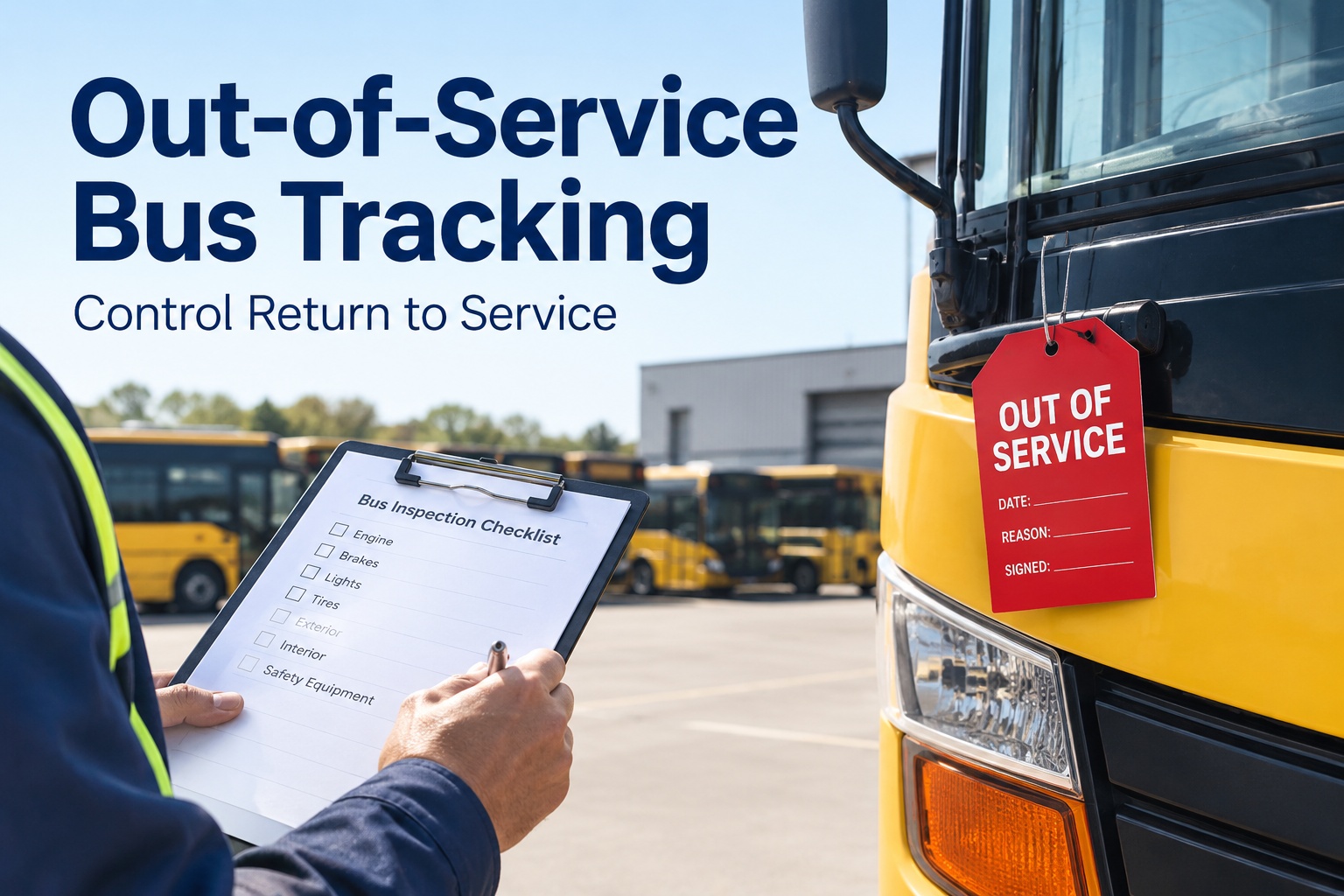
A bus fails a pre-trip. Driver red-tags it, parks it behind the shop. Three days later that same bus is on a route. Nobody can tell you who cleared it, what was actually fixed, or whether the failed item was re-inspected. That is a premature release — the quietest liability in a bus operation.
Out-of-Service Bus Tracking: Control Every Return to Service
Red-tag workflows, gated release checkpoints, and audit-ready OOS records for school, transit, and charter fleets.
- 5Release Gates
- 2Required Sign-Offs
- 100%Audit Traceable
What Out-of-Service Bus Tracking Actually Means
Out-of-service (OOS) tracking is the discipline of knowing — at any moment — which buses in your fleet are not authorized to run, why they are down, who is working on them, and who is authorized to release them. It is a process, not a sticker on a windshield. When it fails, buses get released early, defects get missed, and the paper trail that would protect you in an audit or a lawsuit does not exist.
Immediate Ground
Brake failure, steering, stop arm, wheelchair lift, emergency exit, warning lights. Bus is parked immediately, keys secured, WO opened same shift.
Scheduled Ground
Interior damage, non-safety electrical, HVAC issues in mild weather. Bus can finish the route but is grounded before next dispatch.
Regulatory Hold
Missed annual inspection, expired ADA lift certification, open safety recall, DOT violation. Bus cannot run until the compliance item is closed.
The category matters because release requirements differ. A safety-critical OOS needs a road test and a second signature before it goes back on route. A compliance OOS needs a document — not a repair — before release. Mixing those two workflows is where most premature releases happen. Book a demo to see OOS categorization and release gates configured for your fleet.
The Real Cost of a Premature Release
Every fleet manager reading this has seen a bus rolled back into service before it was ready. Sometimes it is route coverage pressure. Sometimes it is a communication gap between the shop and dispatch. Either way, the exposure is the same — and it stacks fast.
What Premature Release Actually Costs
The fix is not to work harder. It is to build the release gates into the system so a bus cannot be marked in-service without the signatures the process requires. Sign up free to lock down your release workflow this month.
The 5-Gate Return-to-Service Workflow
A defensible return-to-service process has five gates. Each gate is a stop — the bus does not advance until the gate is cleared and the clearance is recorded against the WO. Skip any gate and the release is premature.
-
Declaration & Red-Tag
OOS declared by driver DVIR, technician finding, or supervisor call. Physical red tag on steering wheel, keys pulled and secured. Bus status flipped in the system — dispatch cannot assign it.
PASSES WHEN WO opened with OOS reason code and defect description logged. -
Diagnosis & Scope
Technician confirms the defect, identifies root cause, scopes the repair, requests parts. Any related items found during diagnosis get added to the WO — no separate side jobs.
PASSES WHEN Diagnosis logged, parts sourced, ETA on file. -
Repair Complete
Technician performs the repair, logs labor hours, records part numbers and quantities, attaches before/after photos. WO advances to "ready for inspection" — not "ready for service."
PASSES WHEN Technician signs the WO with authenticated login. -
Post-Repair Inspection & Road Test
A second person — foreman, lead tech, or supervisor — inspects the completed work. For safety-critical systems a road test is required and its outcome logged. The failed DVIR item is specifically re-verified.
PASSES WHEN Inspector signs with an authenticated login different from the repairing tech. -
Release to Service
Supervisor authorizes return to service, red tag removed, keys returned to dispatch, bus status flipped back to "in service." Dispatch can now assign it. Full WO becomes a permanent record on that VIN.
PASSES WHEN Supervisor sign-off recorded with timestamp and user ID.
Notice the separation between Gate 03 and Gate 04. The technician who did the work cannot be the same person who inspects and releases it. That single rule — enforced by the system, not by memory — turns premature release from possible into impossible.
Who Signs What: The Release Authority Matrix
Not every OOS release needs the same authority. A blown headlight bulb does not need the shop foreman's signature; a brake job does. Building the authority tiers into your workflow — and letting the system enforce them — prevents the two common failures: over-escalation and under-authorization.
This matrix should live inside the CMMS as a rule set, not on a printed sheet in the shop office. When Gate 04 comes up on a brake job, the system knows who is authorized to sign — and refuses signatures from anyone else. That eliminates the "well, the foreman was off that day so I signed it" workaround.
What an Auditor Wants on an OOS Record
The audit test on any OOS event is simple: can you show, in one document, the full lifecycle from red tag to release? Here is the record structure that satisfies FMCSA, FTA triennial, and state DOT reviewers on the first request.
Declaration Record
Date, time, VIN, who declared OOS, source (DVIR, inspection, driver report), defect description, category tag.
Diagnostic Notes
Technician who diagnosed, root cause identified, scope of repair, parts required with OEM numbers, ETA.
Repair Log
Labor hours by technician, parts consumed with quantities, torque specs where applicable, photos of completed work.
Inspection Sign-Off
Inspector name and ID, timestamp, confirmation the originally failed item was re-verified, road test result if applicable.
Release Authorization
Supervisor name and ID, timestamp of release, total OOS duration (declaration to release), notes if any.
Chain of Custody
Who had authority over the bus at each stage — driver, shop, inspector, dispatch — with timestamps at every handoff.
Every one of those six pieces must be traceable back to a specific person with a specific timestamp. Handwritten notes and detached inspection forms cannot produce that chain on demand. Book a demo to see a complete OOS record generated in one click.
How BusCMMS Enforces OOS Discipline
BusCMMS treats out-of-service status as a locked state on the asset record. Once a bus is OOS, dispatch cannot assign it, the driver app will not show it as available, and the WO controlling it will not close without every required signature. That is the point of the software — not to track OOS status, but to make premature release mechanically impossible.
-
Locked Asset States
OOS status blocks dispatch assignment automatically. No manual override without a supervisor login.
-
Auto-Generated WO from DVIR
Failed DVIR items with safety-critical codes auto-create an OOS work order — no manual routing.
-
Two-Person Sign-Off
Repair tech and inspector must be different authenticated users. The system rejects same-user signatures on safety-critical WOs.
-
OOS Duration Tracking
Every second from red tag to release is timestamped. Reports show average OOS duration by defect type, technician, and bus.
-
Live OOS Dashboard
Real-time view of every bus currently OOS, which gate it is at, and who owns the next step. Dispatch and shop see the same picture.
-
One-Click Audit Export
Full OOS record — declaration through release — exports as a single PDF per WO. Ready for FMCSA, FTA, or state DOT review.
Because BusCMMS is built for bus fleets specifically, the OOS workflow understands the difference between a stop-arm failure (safety-critical, two-signature release) and an interior seat tear (non-safety, single technician close). Generic CMMS platforms treat every WO the same — which is why they cannot enforce the release discipline this process actually needs.
The Practitioner View: Why Gated Release Changes the Shop
That is the real value of gated OOS tracking. Audit records matter, but the operational value shows up daily — in arguments that do not happen, releases that do not get rushed, and second pairs of eyes catching what the first missed. Sign up free and put gates around every OOS bus in your fleet.
The Bottom Line on Out-of-Service Bus Tracking
Every fleet has OOS buses. The question is not whether — it is whether your system can prove, on any given bus on any given day, exactly where it sits in the release cycle and who is authorized to move it forward. That control is the difference between a maintenance program and a compliance liability. Build the gates into the software, enforce them mechanically, and premature release stops being a possibility.
What is out-of-service bus tracking?
Out-of-service bus tracking is the process of documenting every bus in the fleet that is not authorized to run — recording why it is down, what work is being done, who is authorized to release it, and preserving that full lifecycle as an audit record. It covers safety-critical defects that ground a bus immediately, non-critical defects grounded before next dispatch, and compliance holds like expired inspections or open recalls. Effective tracking uses a gated workflow so no bus is released until every required signature is in place.
What causes premature release of an out-of-service bus?
The most common causes are route coverage pressure combined with unclear handoffs between shop and dispatch, single-person sign-off (the technician who did the work also declares it fixed), release based on verbal confirmation rather than a documented inspection, and paper-based tracking that lets a bus be marked in-service without the full release record being complete. A CMMS that enforces multi-signature gates and locks asset status until release is authorized eliminates most of these failure modes.
Who is authorized to release a bus back to service?
Authority depends on defect category. Safety-critical items — brakes, steering, wheelchair lifts, stop arms, warning lights — typically require the shop foreman or a designated supervisor to authorize release, with the inspecting person different from the repairing technician. Non-critical items may only need a lead technician sign-off. Compliance holds like open recalls or expired inspections require the compliance officer, not the shop, since release depends on documentation rather than repair. Every fleet should have an authority matrix built into the workflow and enforced by the CMMS.
What records do FMCSA and state DOT auditors want for OOS buses?
Auditors want a complete lifecycle record per OOS event: the declaration (date, time, VIN, who declared, defect), the diagnosis and scope, the repair log (labor, parts, photos), the post-repair inspection signed by someone other than the repairing technician, the road test outcome for safety-critical systems, and the supervisor's release authorization with timestamp. They also want to see the OOS duration and any patterns — repeat defects on the same bus, long dwell times, or unusual release patterns that suggest process weakness.
How does BusCMMS enforce the return-to-service workflow?
BusCMMS locks the bus's asset status when OOS is declared — dispatch cannot assign the bus until release is authorized. Each gate in the workflow requires an authenticated user action, and safety-critical WOs enforce two-person sign-off (the repairing technician cannot also be the releasing inspector). The full OOS record — declaration, diagnosis, repair, inspection, release — exports as a single audit-ready document per work order. Because the platform is built for bus fleets, it understands the difference between safety-critical and non-critical release requirements out of the box.