The right parts supplier can transform fleet operations. A supplier offering reliable delivery, competitive pricing, and quality parts reduces downtime and costs. A poor supplier with inconsistent availability, high prices, or quality issues creates constant operational headaches. Yet many fleets default to whatever supplier they've always used without evaluating alternatives or negotiating better terms. The cost of poor vendor relationships is hidden but significant: emergency expedite fees for urgent parts ($50-$200 premiums), downtime waiting for parts ($1,000+ per day), preventive maintenance delayed because needed parts aren't available, and repair quality issues from substandard parts. Effective vendor management—evaluating suppliers, negotiating terms, monitoring performance, and developing relationships—directly improves fleet economics. Here's a comprehensive guide to vendor management for bus parts procurement.
Vendor Management for Bus Parts Suppliers
The right vendors lower cost and downtime. Learn how to evaluate, negotiate with, and manage bus parts suppliers for better terms and fill rates.
Introduction to Vendor Management: Effective vendor relationships require systematic evaluation, clear performance metrics, and ongoing communication. This guide covers vendor selection, contract negotiation, performance monitoring, and relationship development for bus fleet parts procurement. Implementing these practices within your CMMS safeguards your operation against unexpected stockouts and volatile market pricing.
1. Evaluating and Selecting Parts Vendors
Vendor evaluation should be systematic and comprehensive. Create a scorecard evaluating vendors on key criteria: pricing competitiveness, product availability, delivery speed, and customer service responsiveness. Weight criteria by importance to your operation—if you value reliability over price, weight availability and delivery higher than cost.
On-Site Capability Audits
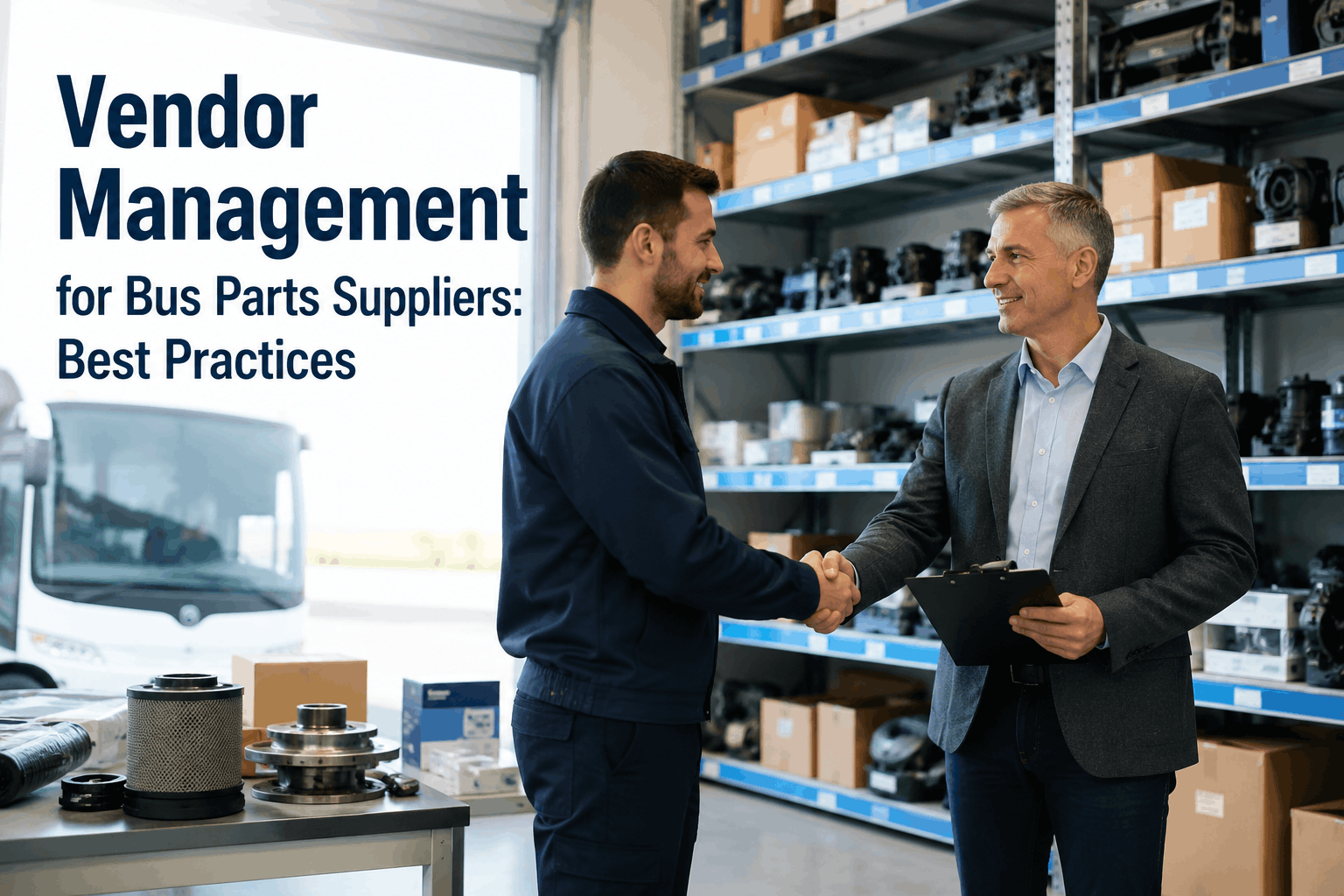
Visit potential vendors in person. Tour their facilities and meet key staff to verify inventory depth. A well-organized facility with digital barcode tracking and strong inventory controls consistently delivers better service and long-term partnership reliability.
Total Cost Comparison
Request detailed pricing for a sample parts list. Compare the total procurement cost rather than just the standalone unit price, making sure to fully unmask hidden minimum order requirements, unexpected delivery surcharges, fuel adjustments, or restocking fees.
Technical Specialization
Evaluate vehicle domain expertise. A vendor deeply knowledgeable about your specific bus types (Gillig, New Flyer, Thomas) can quickly recommend correct cross-references, verify transit-grade durability, and streamline system troubleshooting.
Do not overlook a supplier's logistics infrastructure. Evaluate their shipping carrier networks and localized delivery routes. A vendor with their own dedicated hot-shot delivery fleet will always outperform a vendor relying entirely on standard third-party LTL (Less-Than-Truckload) shipping during emergency breakdown situations.
Assess financial stability before routing large contract volumes. A vendor experiencing financial distress might struggle with parts availability or slow deliveries months before a public failure. Request audited financials or credit profiles for high-volume contract lines.
Vendor Tier & Sourcing Architecture
To build a resilient supply chain, segment your vendors into distinct functional tiers. Balancing large national distributors with local jobbers allows you to preserve volume-based discounts while protecting your operational speed when a bus is stuck on a shop lift.
| Vendor Sourcing Tier | Target Fill Rate | Standard Delivery Window | Average Cost Profile |
|---|---|---|---|
| Primary OEM Supplier | 98% or Higher | 24 - 48 Hours | Premium Baseline |
| Secondary Aftermarket | 95% Baseline | 48 - 72 Hours | Competitive (10-15% Savings) |
| Local Jobber / Parts Finder | 90% Variable | Same-Day Courier (Hot-Shot) | Standard Fleet Rates |
2. Negotiating Vendor Contracts and Terms
Negotiation should be a balanced, win-win framework. You need competitive pricing and reliable service; the vendor needs stable volume and predictable business operations. A structured contract locks in mutual protection across key operational baselines:
Critical SLA Guardrails & Contract Baselines:
- On-Time Delivery Target: Maintain a strict baseline of 95% or greater on-time performance.
- Order Fill Accuracy: Require a 99% or greater error-free parts delivery rate to prevent shop disruptions.
- Emergency Turnaround: Secure a contractually guaranteed 24-48 hour rush delivery window for critical breakdown parts.
- Price Lock Protection: Lock in core maintenance item pricing for 12–24 months to insulate against inflation.
- Flexible Returns: Waive or minimize standard restocking fees for unused items returned within 30 days.
Leverage your volume metrics during discussions. Committing to larger purchasing volumes can unlock 10-15% discount tiers, giving you immediate savings while giving the vendor a predictable baseline of business. Be transparent with your fleet's volume projections to maintain trust.
Finally, address technology integrations. Look for vendors who can push structured order data directly into your CMMS via API or EDI protocols. Automated invoicing and real-time electronic parts updates reduce manual data entry mistakes, match purchase orders instantly, and significantly speed up your procurement cycle.
3. Managing Vendor Performance and Relationships
Track vendor performance systematically using monthly data scorecards generated straight from your fleet software. Sharing these scorecards creates objective accountability, helping suppliers see exactly where they are meeting targets and where process adjustments are needed. Continuous failure to meet established scores should trigger formal Corrective Action Plans (CAPs).
First-Pick Fill Rate
The percentage of requested parts supplied on the initial inventory order without requiring backorders. Aim for a target above 90%.
Lead Time Deviation
Tracking the exact variance in days between the contractually promised delivery date and the actual physical receipt date at the shop dock.
Warranty Defect Rate
The percentage of delivered replacement components that fail prematurely within the vendor's specified coverage window. Maintain under 1.5%.
Establish a consistent communications schedule. Use structured quarterly business reviews to go over performance data, share upcoming maintenance schedules, and discuss inventory needs well before introducing new bus models to your lanes.
"Transitioning our maintenance operation to a structured vendor management framework dropped our average parts-related vehicle downtime from 4.2 days down to under 18 hours, saving our transit lines over $45,000 in Q1 alone."
4. Diversification and Risk Management
Over-relying on a single vendor exposes your fleet to significant operational risk. If that supplier experiences supply chain blockages, labor shortages, or inventory outages, your vehicle uptime drops immediately.
To safeguard your operations, keep a safety stock of high-wear, critical safety parts (like brake linings, air valves, belts, and cooling system elements) directly in your local shop. While keeping inventory on hand carries a carrying cost, it is a small investment compared to losing over $1,000 a day on a sidelined bus.
Regularly benchmark your pricing against the broader market. Every 6 to 12 months, request competitive quotes for your high-volume parts categories. This ensures your active agreements stay aligned with current market rates and helps you identify alternative sourcing options early.
Optimize Your Vendor Relationships
Effective vendor management reduces parts costs, improves availability, and strengthens supplier relationships. Systematic evaluation, clear contracts, and ongoing performance management create partnerships delivering value for your fleet.