A transit authority received an audit notice: "Prepare vendor management documentation for all subcontracted maintenance, parts suppliers, and repair services from the past 24 months." The fleet director panicked. Vendor contracts were scattered across email, some vendors weren't formally approved, payment records were in accounting (separate from service records), and nobody could prove whether contracted work met specifications. Compiling the audit response took 180 hours of staff time and cost $12,000 in labor. A proper vendor management system would have generated the audit response in one day with searchable documentation showing every vendor interaction, cost, delivery performance, and compliance. Vendor management isn't just about finding the cheapest repair shop — it's about audit-ready documentation, performance tracking, and compliance verification. Auditors check: Are vendors approved? Is work documented? Are costs tracked to the vendor? Is quality verified? Does the fleet have backup vendors (supply chain risk)? This guide explains vendor management best practices and how to prepare for audits.
Vendor documentation, performance tracking, and compliance verification. Be ready for audits anytime.
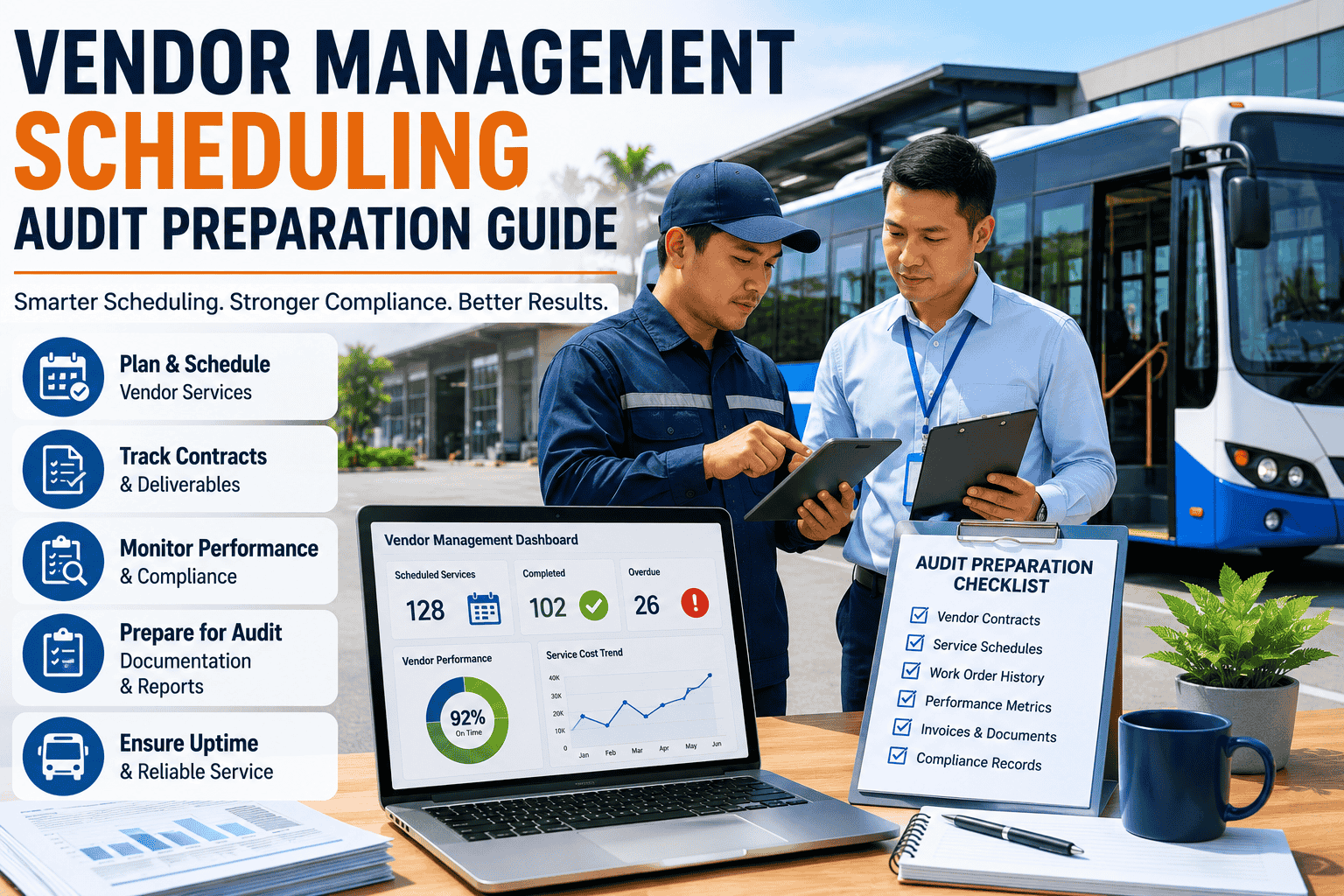
Auditors first ask: "Are all vendors approved?" An approved vendor has a signed contract defining scope, costs, delivery timeline, quality standards, and insurance requirements. Without a contract, you have no documentation that you verified the vendor's qualifications, insurance, or safety record. A fleet using an unapproved repair shop without documentation faces audit citations and liability exposure if work is substandard. Fix: (1) Maintain vendor master list with all vendors, (2) Every vendor must have signed contract defining scope and standards, (3) Insurance verification (liability, workers comp) documented and current, (4) Contract indexed by vendor and service type (brakes, transmission, electrical, etc.), (5) Annual contract review to ensure terms and insurance remain valid. CMMS systems should store vendor records and contracts as searchable documents. When auditor asks "show me all brake service vendors," the system should return three vendors with contracts, insurance verification, and service history in 10 seconds.
Every work order assigned to a vendor must be documented. Auditor asks: "Show me all transmission work performed by ABC Transmission Services in the past 12 months." Without linking, you manually search emails and invoices. With proper linking, CMMS returns: 23 jobs, total cost $47,500, average turnaround 3.2 days, defect-free completion rate 100%. That shows a well-managed vendor relationship. Linking also enables performance trending: Is this vendor getting slower? Are costs increasing? Is defect rate rising? These trends trigger action (renegotiate contract, find backup vendor, investigate quality issues). Performance audits should happen quarterly: (1) Review metrics for each vendor, (2) Identify underperformers (slow, expensive, defects), (3) Provide feedback and improvement plan, (4) Consider termination or replacement for chronic problems. Vendors improve when they know they're being measured. Most respond positively to transparent metrics.
Audits can be announced or unannounced. You have 24 hours to provide vendor documentation. Without system, you scramble. With system, you generate in 10 minutes. Audit-ready documentation includes: (1) Vendor master file (all vendors, contracts, insurance), (2) Work orders assigned to each vendor (past 24 months), (3) Performance metrics (on-time, costs, defects), (4) Contract renewals and terminations, (5) Complaints or quality issues and resolutions, (6) Supply chain continuity plan (what if XYZ vendor goes out of business?). CMMS must make this retrieval instant. A report button that generates "Vendor Audit Report — Past 24 Months" in PDF format. No manual compilation. No searching. The more efficient your audit response, the better auditor impression. Some fleets get reputation for being audit-efficient because their systems are clean. That reputation saves them in close calls.
Vendor management is both operational and compliance. Operationally, you need reliable vendors with good performance. Compliance-wise, you need documented approval, work linking, performance tracking, and audit-ready retrieval. Auditors examine vendor programs carefully because they're a common control failure point. A well-documented vendor program with performance metrics demonstrates strong internal controls. A CMMS with vendor tracking capabilities is practically mandatory for audit efficiency.
Vendor management requires approved vendors with contracts, documented work orders, tracked performance metrics, and audit-ready retrieval. Without this, audits take 180+ hours and still lack completeness. With proper system, audit response takes hours. Implement vendor master file, work order-to-vendor linking, performance metrics tracking, and monthly performance reviews. CMMS should support instant audit report generation. A well-managed vendor program demonstrates strong controls and saves time during audits.