A pre-trip inspection takes 10 minutes when you know the routine and 30 minutes when you don't. Skip it entirely and you find the broken stop arm the hard way -- on Route 14 with 40 students already on board. This guide gives you the exact 10-minute pre-trip routine, organized by 5 zones around the bus, plus the checklist items every driver should hit before pulling out of the yard.
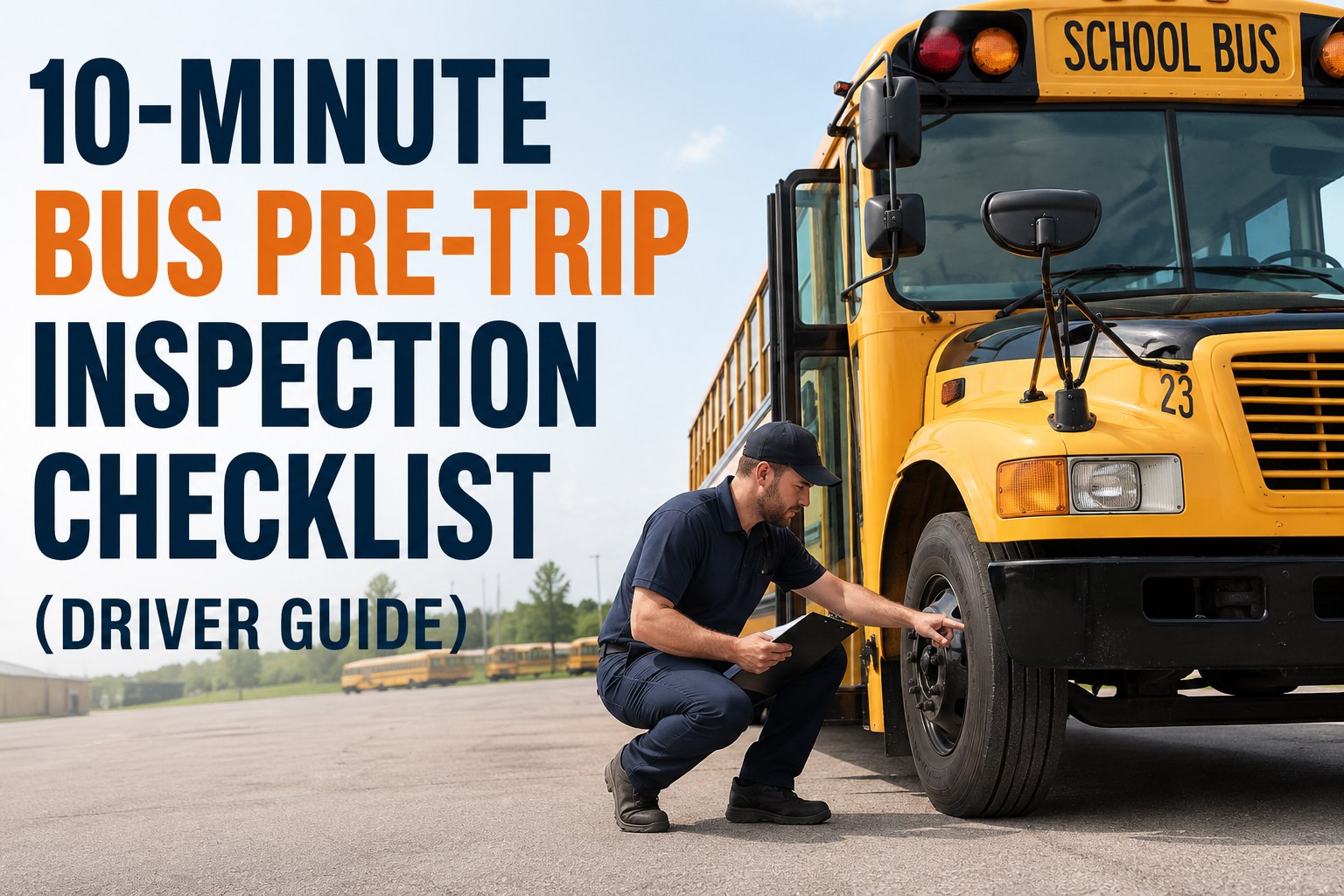
10-Minute Bus Pre-Trip Inspection Checklist
The exact 5-zone walk-around routine every bus driver can run before the first route of the day
- 5Zones
- 30+Check items
- 10 minTotal time
- Z1Front Exterior2:00
- Z2Right Side2:00
- Z3Rear1:30
- Z4Left Side1:30
- Z5Interior + Under-Hood3:00
Why 10 Minutes Is the Sweet Spot
The DOT full pre-trip that CDL exams test on takes 25-40 minutes,and covers every regulatory checkpoint. Nobody runs that daily. The reality of school and transit route schedules is you have 10 minutes between logging in and pulling out. Skip pre-trip entirely and you find safety-critical failures on the road. Rush it in 3 minutes and you miss the same failures. Ten minutes is the point where a trained driver can hit every meaningful safety check without falling behind schedule.
Full DOT Pre-Trip
25-40 minComplete regulatory inspection. Required for CDL exam and full audit compliance. Not realistic for daily route prep.
Daily 10-Min Pre-Trip
10 minAll safety-critical checks covered. Fits between clock-in and route start. What this guide teaches.
Rushed 3-Min Pre-Trip
3 minEnough to fake the paperwork. Misses roughly 60% of safety-critical items. This is what happens when the routine is not scripted.
No Pre-Trip
0 minFMCSA violation. Failed DOT audits. Discovered safety issues become roadside incidents with kids on board.
The trick is scripting the routine so you never have to think about what comes next. That is what the 5-zone walk-around does. Book a demo to see digital pre-trip checklists that keep drivers on the 10-minute routine.
The 5-Zone Walk-Around Method
The 5-zone method is a physical walking pattern around and through the bus. You start at the front, walk clockwise around the exterior, then finish inside. Same route every day, same items at each stop. No decisions to make, no items forgotten. When your body knows the route, the checklist fills itself in.
The walk direction (clockwise from the front) matters less than the consistency. Pick one direction and never change it. Muscle memory does more of the work than most drivers realize -- and that is what keeps you on the 10-minute timer even on a cold Monday morning. Book a demo to see the 5-zone digital DVIR your drivers can run from a tablet.
The Complete Zone-by-Zone Checklist
Print this section. Hand it to every driver. This is the daily 10-minute checklist that hits every safety-critical item. Times per zone are targets, not stopwatch requirements -- a driver who finds a problem in Zone 2 legitimately spends longer there.
Z1 Front Exterior
2:00- Windshield: cracks, chips, wiper condition
- Headlights, marker lights, turn signals functional
- Stop arm deploys, retracts, warning lights work
- 8-light warning system (amber and red) cycles correctly
- Front mirrors adjusted, cross-view mirror present and clean
- License plate present, visible, illumination working
- Front bumper, grille condition, hood latches secure
- No visible fluid leaks under front of bus
Z2 Right Side
2:00- Passenger service door opens, closes, seals correctly
- Right side marker lights, turn signals, brake lights
- Tires: pressure look, tread depth, no sidewall damage or cuts
- Wheel lug nuts: visual check for missing, loose, or rust trails
- Fuel and DEF caps sealed, no fuel odor
- Side reflectors present and clean
- Emergency exit windows and door on right side sealed
Z3 Rear
1:30- Brake lights, turn signals, reverse lights all work
- Emergency door: opens, closes, alarm functional
- Rear reflectors present and visible
- License plate light working, plate visible
- Rear bumper condition, mud flaps intact
- Under-body visual: fuel tank, DEF tank, air tanks, no leaks
Z4 Left Side
1:30- Driver door operates smoothly, seals correctly
- Left side marker lights, turn signals, brake lights
- Tires: pressure look, tread depth, sidewall inspection
- Wheel lug nuts: visual check for missing or loose
- Side reflectors and emergency exits on left side
- No fluid leaks or hardware issues under left side
Z5 Interior + Under-Hood
3:00- Under-hood: oil level, coolant level, belts intact, no cracked hoses
- Battery terminals clean, no corrosion, cables tight
- Instrument panel: all warning lights out after start, gauges reading normal
- Air brake test if applicable (buildup, low-air warning, emergency brake)
- Mirror positions set, seatbelt functional, seat adjustment locked
- Emergency equipment: fire extinguisher charged, first-aid kit sealed, body-fluid kit present, triangle warnings present
- Interior lights, emergency exit signs, aisle clear
- Student seat integrity, floor condition, no loose items
Any failed item on any zone becomes a written note the driver takes to dispatch before pulling out. Zero exceptions. A bus with a failed pre-trip does not run the route -- period. That is the rule that makes pre-trip a real safety system rather than a paperwork exercise. Sign up free to load this exact 5-zone checklist as a digital DVIR.
6 Most Commonly Missed Pre-Trip Items
Even experienced drivers develop blind spots. Certain items get skipped so often that they show up on nearly every post-incident review. Watching for these six specifically is a simple habit that closes most of the safety gaps drivers create for themselves.
01Missed 45% of the time Cross-View Mirror Adjustment
Drivers check that the mirror is present but do not verify the actual view. A misadjusted cross-view mirror is functionally the same as a missing one when a child steps in front of the bus.
02Missed 40% of the time Under-Bus Fluid Check
Requires actually looking under the vehicle. Drivers skip it in cold, wet, or dark conditions. Slow leaks announce themselves here first -- before the temperature gauge climbs on route.
03Missed 35% of the time Emergency Equipment Verification
Fire extinguisher gauge, first-aid kit seal, triangle warnings, body-fluid kit. Presence gets checked; condition and expiration dates get skipped. Discovered empty on the day it is needed.
04Missed 30% of the time Wheel Lug Nut Visual
Rust trails and missing lug nuts are visible from 6 feet away. Drivers walk past. Loose wheel incidents almost always show visual warning signs the driver could have caught days earlier.
05Missed 25% of the time Stop Arm + 8-Light Full Cycle
Drivers verify the stop arm deploys but not that it retracts cleanly. 8-light warnings get glanced at, not cycled. Failures here are visible to state inspectors -- and to parents at bus stops.
06Missed 20% of the time Air Brake System Test
Applies to air-brake buses only. Full test (buildup, low-air warning, emergency brake application) gets shortened to a single pedal press. FMCSA violation and a mechanical risk on longer routes.
Every one of these items is on the standard checklist. The problem is not knowing what to check -- it is remembering to check it under time pressure. A digital pre-trip that requires an actual response (tap, photo, note) for each item closes this gap more effectively than any amount of driver training. Book a demo to see digital DVIRs that prevent skipped items.
Faster Pre-Trips With Digital DVIRs
A paper pre-trip checklist works. A digital pre-trip on a tablet works better -- not because it is fancier, but because it enforces the routine and passes failed items straight to the shop without a hand-off delay. Book a demo to see the digital DVIR workflow built for buses. Here is what changes when your drivers move from paper to a digital DVIR built for buses.
Same 10-Minute Total
Digital does not make pre-trip faster. It makes it more reliable. Drivers still walk the 5 zones on the same routine.
Every Item Requires a Tap
No skipping. No handwriting shortcuts. Each check must be marked PASS or FAIL before submission, eliminating the 20-45% skip rates from the previous section.
Photo Evidence Built In
Tap a fail, snap a photo, submit. Shop team sees the actual damage without waiting for the driver to explain it in person.
Failed Item Becomes Work Order
The moment a driver flags a fail, the maintenance team has a work order open on the bus. Zero paperwork handoff, zero delay.
FMCSA Audit-Ready History
Every completed DVIR stored per bus, per driver, per date. State inspectors get one-click export instead of a filing cabinet dig.
The single biggest difference is not the technology. It is the fact that a driver cannot fake a digital DVIR the way they can fake a paper one. The tap-through requirement forces attention, and the resulting audit trail forces accountability. Both of those close the safety gap that shortcuts create. Book a demo to see how tap-through DVIRs eliminate skipped items.
How BusCMMS Runs the 10-Minute Pre-Trip
BusCMMS ships with pre-loaded bus-specific DVIRs covering every item in the 5-zone checklist above. Drivers open the app, tap through the 5 zones, and submit. Everything downstream -- work order creation, compliance recording, historical audit trail -- runs in the background. Here is what the platform does specifically for pre-trip.
Pre-Loaded 5-Zone DVIRs
Full checklist for school bus, transit, and charter configurations. Stop arms, crossing gates, wheelchair lifts, all covered.
Photo Capture per Item
Failed check items require a photo before submission. Shop team sees the actual condition, not a driver's description of it.
Auto Work Order Creation
Failed items open work orders on the specific bus immediately. Maintenance queue updates in real time.
Historical DVIR Records
Every completed pre-trip stored per bus, per driver, per date. Search by any dimension. FMCSA audit-ready.
Driver + CDL Tracking
Driver certifications, endorsements, and CDL expiration dates track alongside DVIR history for full compliance picture.
Compliance Dashboard
Real-time completion rates per driver, per bus, per week. Overdue or missing pre-trips surface immediately.
The whole system runs on the same 10-minute walk-around this guide teaches. The digital version simply guarantees it actually happens -- which is what turns a good checklist into a safety program that holds up under a real DOT audit. Book a demo to see the 5-zone DVIR running from a driver tablet.
The Bottom Line on the 10-Minute Pre-Trip
A 10-minute pre-trip is not a shortcut. It is the routine that fits between clock-in and route start while still catching every safety-critical item. The 5-zone walk-around is what makes it possible. Print the checklist. Practice the pattern. Move the paperwork to a tablet. That is the entire path from a rushed 3-minute inspection to a professional pre-trip that holds up in a DOT audit -- without adding a single minute to the driver's morning schedule.
How long should a daily bus pre-trip inspection take?
A daily pre-trip inspection should take approximately 10 minutes when the driver follows a scripted routine like the 5-zone walk-around. The full DOT pre-trip that CDL exams test on takes 25-40 minutes and covers every regulatory checkpoint, but is not realistic for daily route prep. A 10-minute pre-trip covers all safety-critical items when organized by physical zones around the bus, without the driver having to think about what comes next. Rushing pre-trip in 3 minutes or less typically misses roughly 60% of safety-critical items.
What is the 5-zone walk-around method for bus pre-trip inspection?
The 5-zone walk-around is a scripted physical routine covering five sequential inspection zones. Zone 1 (2 min) is the front exterior: windshield, headlights, stop arm, 8-light warning system, mirrors. Zone 2 (2 min) covers the right side: passenger door, side lights, tires, wheel lug nuts, fuel caps. Zone 3 (1:30) is the rear: brake and turn lights, emergency door, under-body visual. Zone 4 (1:30) covers the left side: driver door, side lights, tires, wheel checks. Zone 5 (3 min) is the interior and under-hood: fluid levels, belts, hoses, emergency equipment, instrument panel, air brake test. Total: 10 minutes.
What items are most commonly missed in a bus pre-trip inspection?
Six items are commonly missed even by experienced drivers. Cross-view mirror adjustment gets skipped roughly 45% of the time (drivers verify presence, not actual view). Under-bus fluid checks get missed roughly 40% of the time (skipped in cold, wet, or dark conditions). Emergency equipment verification (fire extinguisher gauge, first-aid kit seal, triangle warnings) is missed roughly 35% of the time. Wheel lug nut visual checks are skipped roughly 30% of the time despite visible warning signs. Full stop arm and 8-light warning system cycling is missed 25% of the time. Air brake system tests get shortened to a single pedal press roughly 20% of the time.
Is a digital DVIR better than paper for pre-trip inspections?
Digital DVIRs are meaningfully more reliable than paper for three specific reasons. First, every check item requires a tap or response before submission, eliminating the skipped items that paper allows. Second, photo capture is built in, so failed items include actual visual evidence rather than a driver's written description. Third, failed items automatically create work orders in the maintenance system, eliminating the paper hand-off delay between driver and shop. Digital does not make pre-trip faster -- both should take about 10 minutes -- but it makes the inspection auditable, actionable, and harder to shortcut.
How does BusCMMS support the 10-minute pre-trip routine?
BusCMMS ships with pre-loaded 5-zone DVIRs covering the exact items in this guide for school bus, transit, and charter configurations. Drivers open the app on a tablet, tap through the 5 zones, capture photos for any failed items, and submit. Failed items automatically create work orders on the specific bus in real time. Historical DVIR records store per bus, per driver, per date for FMCSA audit compliance. Driver CDL and certification tracking runs alongside DVIR history. A real-time compliance dashboard shows completion rates per driver, per bus, per week, with overdue or missing pre-trips surfacing immediately.