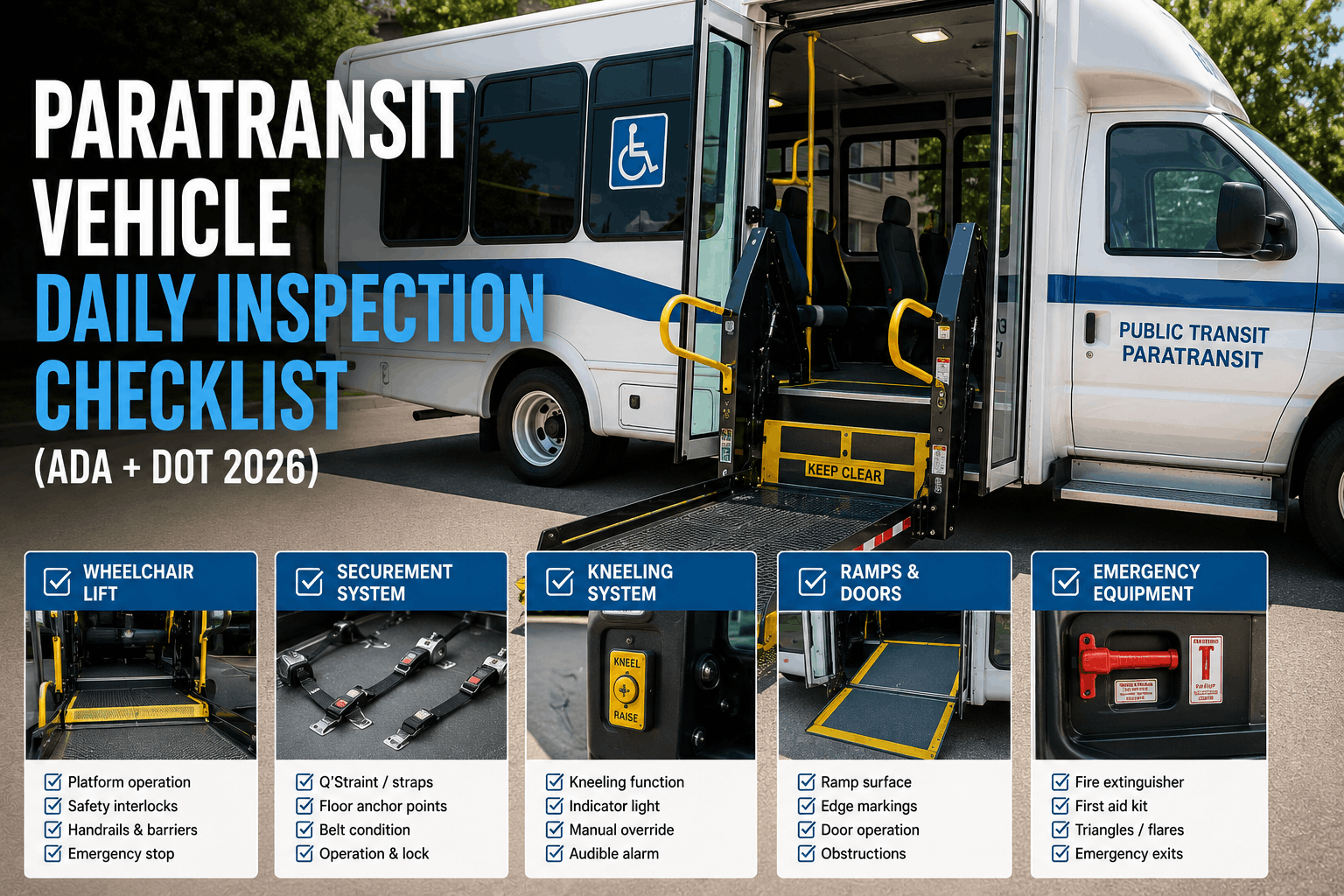
Paratransit vehicles — cutaway vans, low-floor minibuses, and accessible transit vans providing ADA demand-response service across the United States — carry some of the most vulnerable passengers in the public transit system: elderly riders, wheelchair users, passengers with cognitive and physical disabilities, and individuals whose mobility depends entirely on the reliability of every piece of equipment on that vehicle. A failed wheelchair lift, an improperly secured mobility device, or a kneeling system that cannot deploy is not just a mechanical defect — it is a federal ADA Title II compliance violation, an FTA safety finding, and a direct harm to a passenger who has no alternative transportation. The paratransit inspection checklist requirements under 49 CFR Part 37 (DOT ADA regulations), FTA Circular 4710.1 (ADA guidance for transit agencies), and FMCSA 49 CFR 396 collectively require that every ADA paratransit vehicle be maintained in a state of good repair, with accessibility features — lifts, ramps, securements, kneeling systems — functioning at every departure. This checklist provides a complete daily pre-trip inspection framework for paratransit drivers and technicians covering every ADA and DOT compliance item, structured for digital DVIR capture in BusCMMS. Start your free trial to run this as a pre-loaded digital DVIR in BusCMMS with automatic defect-to-work-order conversion and FTA-compliant record retention.
ADA Paratransit Compliance Starts with Every Pre-Trip — Make It Digital
BusCMMS pre-loads all paratransit lift, securement, ramp, kneeling, and emergency exit inspection items in every driver DVIR. Defects create assigned shop work orders in under two minutes — keeping your fleet ADA-compliant and FTA audit-ready at all times.
ADA & DOT Regulatory Requirements for Paratransit Vehicle Inspection
Paratransit operators receiving FTA funding are subject to overlapping federal requirements that together mandate daily inspection, systematic maintenance, and documented repair of all accessibility features. Under 49 CFR 37.161, transit agencies must maintain accessibility features in operative condition and repair them promptly when they fail. A wheelchair lift that is out of service is not a discretionary maintenance deferral — it is a federal compliance violation that requires the agency to provide equivalent service to the affected passenger and document the corrective action. FTA Circular 4710.1 reinforces that ADA accessibility features must be operational at all times, not just during scheduled inspection periods. FMCSA 49 CFR 396.3 requires systematic inspection records retained 12 months. The 2026 FMCSA eDVIR rule (effective March 23, 2026) authorizes electronic DVIRs for all applicable vehicles, including paratransit DVIR completion on mobile devices.
49 CFR 37.163 requires lift cycle test before each day of service. Full deployment and retraction with load test at rated capacity. Any lift malfunction triggers immediate service substitution requirement and defect documentation.
All four-point wheelchair securement anchor points, retractors, and lap/shoulder belt connections must be functionally verified before each shift. A failed retractor or missing anchor point is an immediate ADA compliance defect under 49 CFR 37.165.
Air or electric kneeling system must lower and raise smoothly through full travel range. A kneeling system that sticks or fails to return to full ride height before movement is a safety defect requiring immediate correction. Deploy and stow ramp fully each pre-trip.
Weekly lubrication of all lift pivot points and slides using manufacturer-specified lubricant. Inspect platform anti-slip surface, platform edge barriers, and structural welds at high-stress points. Inner barrier must deploy when platform is raised.
Paratransit Vehicle Daily Inspection Checklist
Complete all sections before every revenue departure. Sections A through D cover ADA-mandated accessibility features. Sections E and F cover standard DOT vehicle safety items required by FMCSA 49 CFR 396. Any defect in Sections A–D requires immediate service substitution notification to dispatch and a corrective work order before the vehicle re-enters paratransit PM service.
Paratransit ADA Compliance Reference: Lift & Accessibility Specifications
| ADA / DOT Item | Minimum Standard | Regulatory Reference | Inspection Frequency | Defect Action |
|---|---|---|---|---|
| Lift Cycle Time | Max 12 seconds platform-to-ground | 49 CFR 37.163 | Daily pre-trip | Service substitution + WO |
| Lift Platform Width | Min 28.5 inches clear width | 49 CFR Part 38 Appendix | Monthly measurement | Repair or remove from ADA service |
| Boarding Door Width | Min 32 inches clear opening | 49 CFR Part 37 App. D | Monthly check | Repair before ADA use |
| Securement Anchor Points | 4-point system, all anchors functional | 49 CFR 37.165 | Daily pre-trip | Immediate repair + WO |
| Grab Rail Diameter | 1.25–2.0 inches graspable | ADA Standards 505 | Weekly visual check | Replace non-compliant hardware |
| Kneeling System Travel | Full range, audible warning during kneel | 49 CFR 37.163(e) | Daily pre-trip | Repair before service |
| DVIR Record Retention | 12 months per FMCSA 49 CFR 396.3 | FMCSA 49 CFR 396.3 | Every departure | Digital retention in BusCMMS |
How BusCMMS Supports Paratransit ADA Compliance Documentation
FTA compliance reviews of paratransit operators consistently identify two documentation failure modes: lift defects that were identified by drivers but not formally documented in a DVIR, and corrective work orders that were opened but closed without confirming the accessibility feature was fully restored to compliance. BusCMMS closes both gaps simultaneously. Every NEMT inspection and paratransit DVIR completed in BusCMMS creates a timestamped, driver-signed record. Any defect flagged in sections A through D automatically generates an assigned corrective work order with the specific accessibility item, vehicle number, and driver report. The work order cannot be closed without a technician sign-off confirming the feature is restored to full function — creating the documentation chain that satisfies both FTA Circular 4710.1 and FMCSA 49 CFR 396.3 in a single workflow. Book a demo to see the paratransit compliance documentation workflow in a live fleet environment.
We had an FTA compliance review and they specifically asked for lift maintenance records going back 14 months. With our old paper DVIR system we could only produce three months of legible records. Since moving to BusCMMS we have every lift cycle test, every defect, every corrective work order timestamped and searchable by vehicle. The reviewer said our documentation was the most complete they had seen from an agency our size — 34 accessible vehicles across three counties.
Frequently Asked Questions: Paratransit Vehicle Inspection & ADA Compliance
What does 49 CFR 37.161 require for paratransit vehicle accessibility maintenance?
49 CFR 37.161 requires transit agencies to maintain accessibility features — lifts, ramps, securements, kneeling systems — in operative condition and to repair them promptly when they fail. The regulation also requires agencies to provide alternative accessible service when an accessible vehicle is temporarily out of service due to an accessibility feature failure — it does not permit simply removing the vehicle from accessible service without a substitute.
How often must wheelchair lifts be tested on paratransit vehicles?
49 CFR 37.163 requires that wheelchair lifts be cycled through a complete deployment and retraction before each day's service. This means every paratransit vehicle with a lift must complete a full lift test before the first revenue trip of the AM run — with the result documented in the vehicle's DVIR. BusCMMS captures the lift cycle test result as a timestamped pre-trip item with driver signature.
What is the ADA minimum clear width for a paratransit boarding door?
ADA accessibility standards and 49 CFR Part 38 require a minimum 32-inch clear opening at the accessible boarding door for paratransit vehicles. This must be the clear unobstructed width when the door is fully open — not the door panel width. Weatherstripping, hinges, or door stops that reduce the clear opening below 32 inches must be corrected before the vehicle provides accessible service.
What securement system requirements apply to paratransit vehicles under ADA?
49 CFR 37.165 requires that paratransit vehicles be equipped with a securement system that can secure the common wheelchairs and scooters used by ADA paratransit passengers. Agencies must provide and use a four-point tie-down system and an occupant restraint system. All four anchor points, belt retractors, and lap/shoulder belt hardware must be verified functional during each daily pre-trip inspection before passenger service begins.
Can a paratransit vehicle operate if the lift is broken?
A paratransit vehicle with a non-functional lift may not carry passengers who require the lift — but under 49 CFR 37.161, the agency must provide an accessible substitute vehicle promptly. The broken vehicle must have a corrective work order opened and documented. Operating a paratransit vehicle and declining to serve passengers who need the lift is an ADA Title II violation regardless of whether the equipment failure was known or recently discovered.
How long must paratransit inspection records be retained?
FMCSA 49 CFR 396.3 requires vehicle inspection records to be retained for a minimum of 12 months. Annual inspection documentation must be held for 14 months. FTA compliance reviews may request records going back further for pattern analysis — BusCMMS retains all DVIR and work order records indefinitely, making multi-year lift maintenance history available for any FTA compliance inquiry without manual document retrieval.
What is the maximum slope allowed for a paratransit vehicle ramp?
The ADA Standards for Accessible Design specify a maximum ramp slope of 1:4 (25%) when deployed to a 6-inch curb height for paratransit vehicles. The ADA recommends a maximum of 1:6 (approximately 17%) where ramp length permits. Folding ramps must also have a minimum 30-inch clear ramp width and non-slip surface — any ramp with a compromised anti-slip surface must be repaired before accessible passenger service.
How does BusCMMS track paratransit lift defects and corrective work orders?
When a driver flags a lift, securement, kneeling, or ramp defect during a BusCMMS mobile DVIR, the system automatically creates an assigned corrective work order with the specific defect item, vehicle number, and driver report timestamp. The work order requires technician sign-off confirming full restoration before the vehicle can be cleared to accessible service status — creating the complete documentation trail required by FTA Circular 4710.1 and FMCSA 49 CFR 396.3.
ADA Compliance Requires Perfect Documentation — BusCMMS Makes It Automatic
BusCMMS pre-loads all paratransit lift, securement, ramp, and kneeling inspection items, captures driver DVIR digitally, auto-generates corrective work orders for any ADA defect, and retains FTA-ready documentation without paper filing.