The tire invoices stack up fast on a bus fleet — mounting, balancing, service calls, the truck that rolls out every time a bus needs rubber. At some point every director runs the mental math: we turn so many tires, could we just run our own shop and stop paying someone else's markup? Sometimes it's a clear yes. Sometimes it's an expensive mistake. An in-house bus tire shop pays off only when your tire volume, the real costs, and your downtime picture all line up — and the way to know is to run the numbers, not the frustration.
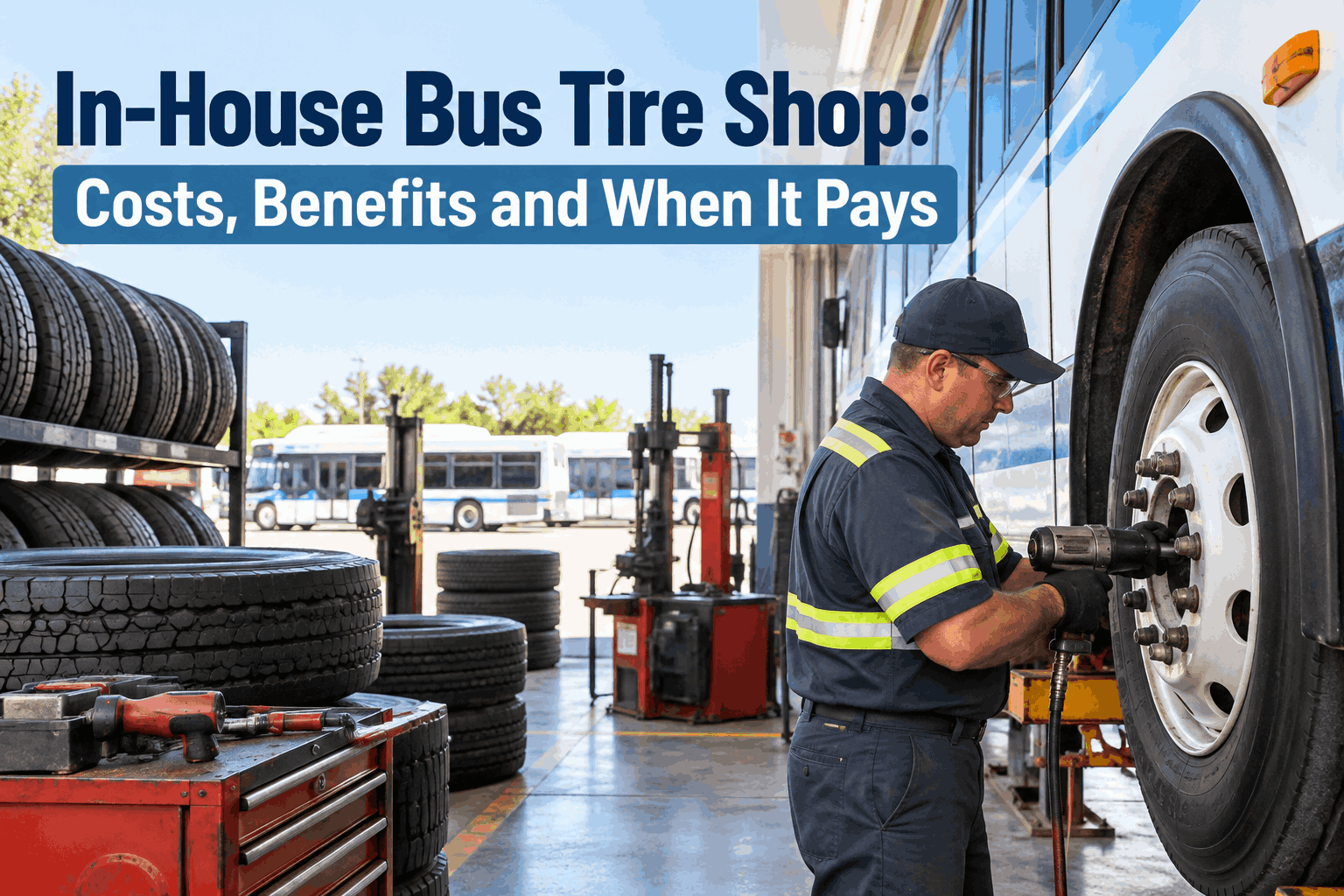
In-House Bus Tire Shop: Costs, Benefits & When It Pays
Running your own tire shop can cut cost and downtime — or sink money into equipment you don't run enough. Tire volume is the tipping point. Here's the math, the true costs, and the middle path.
Why Fleets Consider Their Own Tire Shop
The pull toward an in-house tire operation comes from a handful of real frustrations with outsourcing. Every one is legitimate — sending tire work out genuinely costs money, time, and control — but each has to be weighed honestly against what running a shop actually takes, or you swap one problem for a pricier one.
Per-Job Markup Adds Up
Every outsourced mount, balance, and service call carries the vendor's labor, overhead, and margin. On a fleet turning hundreds of tires a year, that markup starts to look like the cost of your own equipment and a tech.
Downtime & Road Calls
A bus waiting on a mobile service or sitting at a vendor is a bus off its route. Tire road calls especially can strand a bus mid-service — and you're on the vendor's clock, not yours.
Scheduling Around a Vendor
Rotations and replacements bend to the vendor's calendar instead of your PM plan. An in-house shop means tire work slots around your routes and your schedule, not someone else's.
Control Over Quality & Casings
In-house means you control mounting quality, rotation timing, and how casings are handled for retreading — where real tire savings live. Outsourced, you trust someone else with all of it.
The honest counterweight is that a tire shop isn't free control — it's a real investment in mounting and balancing equipment, a trained tech, dedicated space, and the safety and disposal responsibilities that come with it. That's why the in-house bus tire shop question is a strategy decision, not a gut call. It's a specific case of the broader maintenance insource-versus-outsource decision, sharpened by tires' unique economics: very high recurring volume on one hand, valuable casings and road-call urgency on the other. The way to settle it is to put real numbers against each factor. Book a demo to see your annual tire volume and cost in one view.
The True Cost of an In-House Tire Shop
The classic mistake is comparing the vendor invoice to just the tire and a bit of labor. The real comparison includes everything a tire shop carries — the up-front capital and the ongoing overhead. Get it all on the table first, or the savings you projected quietly disappear into costs you didn't count.
Mounting & Balancing Equipment
Heavy-duty tire changer, balancer, cages, jacks, and torque tools rated for bus wheels. The fixed capital the whole break-even turns on — it doesn't shrink if you run few tires.
Labor & Training
A tech's time per tire plus training to do commercial tire work safely. Bus tire service carries real hazards — this cost includes building genuine competence, not learning on the job.
Space & Tire Storage
A dedicated bay plus racked storage for new tires, spares, and casings awaiting retread. Space you commit to tires is space not doing other maintenance work.
Disposal & Compliance
Scrap-tire disposal, safety practices for a high-hazard task, and the documentation a passenger fleet needs — real recurring costs the vendor's price quietly absorbs for you today.
Once all four are on the table, the shape is clear: an in-house tire shop front-loads a large fixed cost (equipment, training, space) in exchange for a much lower cost per tire afterward. Outsourcing has almost no fixed cost but a higher price on every job. That's the fixed-versus-variable tradeoff the chart above draws — and it means the answer depends entirely on how many tires you turn a year. One tire-specific twist works in your favor: controlling your own casings for retreading adds savings an outside vendor often captures instead, since a good casing retreaded in-house runs again at a fraction of new-tire cost. Sign up free and pull your true per-tire service cost.
The Break-Even: When Volume Justifies an In-House Bus Tire Shop
The whole decision reduces to one calculation: at your annual tire volume, does the per-tire savings of doing it yourself ever repay the fixed investment? Work it in four steps with your own numbers.
Count Your Annual Tire Volume
Pull how many tire jobs your fleet does per year — mounts, rotations, replacements, road calls — from your records. The single biggest driver, and the one most fleets guess instead of measure.
Nail Down Both Per-Job Costs
Get the true outsourced cost per tire job (invoice plus the downtime it causes) and the projected in-house cost per job (labor plus consumables, without fixed costs). The gap is your per-job savings.
Total the Fixed Investment
Add up equipment, training, and setup — the one-time and annual fixed costs of standing up the shop. This is what the per-job savings (plus any retread gains) must pay back before in-house is truly cheaper.
Find the Break-Even Volume
Divide the fixed investment by the per-job savings to get the tire volume needed to break even each year. Clear it comfortably and a shop wins; land close to or below it and you keep outsourcing.
Two inputs get fudged most, and both distort the answer. Annual volume gets guessed rather than counted — and tire volume is easy to underestimate because rotations and road calls hide between the obvious replacements. And the true outsourced cost gets understated because the invoice is remembered while the downtime of a bus waiting on a tire service is left out. Fix both by pulling actuals from your records. A fleet turning high, steady volume usually finds the equipment pays back fast; one with sporadic, low volume rarely does. The math doesn't care how annoying the vendor is — only about the numbers. Book a walkthrough to build your tire-shop break-even on real data.
The Middle Path: Hybrid and Mobile Service
Here's what the all-or-nothing framing misses: tire service isn't one decision. It's several kinds of work — routine mounts and rotations, emergency road calls, specialty jobs — and the smart answer often splits them. Most fleets that get this right don't go fully in-house or fully outsourced; they sort each type of work to whichever model is cheaper and faster for it.
Bring In-House
Scheduled mounts, rotations, and replacements — where your fixed shop stays busy and the low per-job cost pays off. The bulk of tire work and the core of the break-even case.
Keep Mobile / Vendor
Emergency road calls and after-hours blowouts, where a mobile service reaching the stranded bus beats hauling it back. Paying variable for the rare urgent job beats staffing for it around the clock.
Outsource Specialty
Unusual sizes, alignment beyond your gear, retreading if you don't run it — where the volume never justifies owning the capability. Send it out and keep your shop focused.
This hybrid model is where a lot of fleets land, because it captures the fixed-cost efficiency of in-house on the routine bulk while keeping the flexibility of a vendor for the urgent and the rare. It also lowers the break-even bar: you don't need enough volume to justify handling every tire scenario, just enough routine work to keep an in-house bay busy. The break-even math still decides it — it just tells you which slice of tire work belongs in your shop and which belongs on someone else's truck, rather than forcing one answer for everything. Sign up free and see which tire work your volume justifies insourcing.
The Tire Data That Makes and Monitors the Decision
Every input to this decision — volume, cost per job, downtime, and post-decision tire life — is data your fleet either has or should be capturing. That's why tire management and reporting is what turns an in-house tire shop from a hunch into a business case you can defend and then verify. BusCMMS supplies the numbers going in and watches the results coming out.
-
Tire-Job Volume Reporting
See how many tire jobs your fleet does per year — mounts, rotations, replacements, road calls — the single biggest break-even input, measured instead of guessed.
-
True Cost Per Tire Job
Roll up labor, materials, and downtime into a real cost per tire job — so the outsourced-versus-in-house comparison uses actuals, not the sticker price alone.
-
Downtime Tracking
Capture how long buses sit waiting on tire work, in-house or out — the hidden cost of outsourcing that a fair break-even has to include.
-
Tread & Rotation Tracking
Track tread depth by position and keep rotations on schedule — so once you're in-house, tire life is managed and you can prove the program is extending it.
-
Cost Per Mile by Tire
Compare tire cost per mile before and after the decision, so you can prove an in-house shop delivered the savings the break-even promised — or catch it if it didn't.
-
Casing & Retread Tracking
Track casings through retread cycles, so the retread savings that tip many in-house decisions are captured and counted, not lost.
The pattern is that this decision is bracketed by data on both ends: you need numbers to make the call, and numbers to confirm it worked. Skip the first and you're guessing; skip the second and you'll never know whether the shop actually paid off or quietly cost you. Because BusCMMS is purpose-built for buses, it tracks tire work against specific positions, casings, and duty types out of the box — the same data that powers ongoing tire lifecycle tracking — so the volume and cost picture is accurate rather than buried in generic repair categories. That turns an in-house bus tire shop from a leap of faith into a measured, reversible decision, typically live in two to four weeks.
A Director's Take
That's the decision done right: the frustration was real, but the numbers justified the investment — and, just as important, drew the line between what to insource and what to leave on the vendor's truck. Enthusiasm got them looking; the data got them to the right shape.
The Bottom Line on an In-House Bus Tire Shop
An in-house bus tire shop is a make-versus-buy decision that pays off for the right fleet and backfires for the wrong one — and only the numbers tell them apart. Count your true annual tire volume (including the rotations and road calls that hide between replacements), nail down both the real outsourced cost with downtime and the projected in-house cost, total the fixed investment in equipment, training, and space, and find the break-even volume it requires — remembering that controlling casings for retreading can tip the math in your favor. If your steady volume clears the bar, a shop cuts cost and gives you back control of turnaround and quality. But the smartest fleets rarely go all-or-nothing: they insource the high-volume routine work where the fixed shop stays busy, keep a mobile vendor for the rare emergency road call, and outsource specialty jobs whose volume never justifies owning the capability. That hybrid lowers the break-even bar and matches each kind of tire work to the model that serves it best. Run it on data, decide with confidence, and keep measuring tire cost per mile so you know it worked. The tire invoices got you asking; the numbers should get you the answer. Book a walkthrough to build your in-house tire case on real numbers.