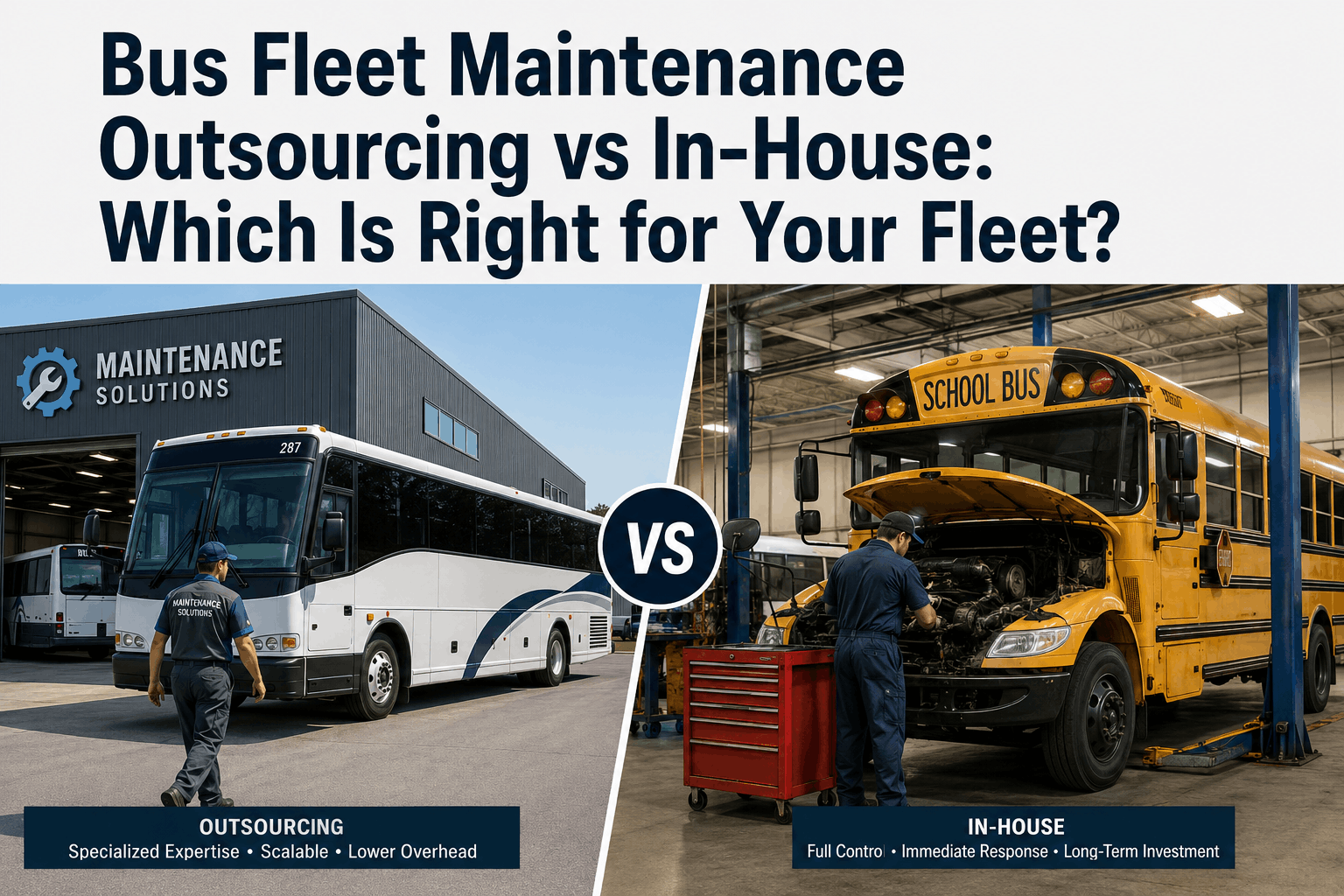
The decision to outsource bus fleet maintenance or manage it in-house is one of the most consequential operational choices fleet managers make. This choice affects labor costs, control over quality, capital investment, expertise access, and long-term financial performance. Large fleets (1,000+ vehicles) handle 62.4% of maintenance in-house and achieve lower cost per mile. Small fleets (5-25 vehicles) handle only 48.2% in-house and often struggle with shop utilization. The correct answer is not universal—it depends on fleet size, complexity, geographic distribution, capital availability, and your organization's ability to sustain disciplined preventive maintenance planning. This comprehensive analysis from 500 fleet operators reveals the true cost-benefit tradeoffs and hybrid models that optimize economics for different fleet profiles.
Bus Maintenance Outsourcing vs In-House: Complete Cost-Benefit Analysis
Data-driven comparison from 500 fleet operators. Analyze labor costs, facility expenses, quality control, warranty implications, and hybrid models. Discover which maintenance model optimizes economics and operational efficiency for your specific fleet profile.
In-House Maintenance: Upfront Costs, Long-Term Advantages, and Hidden Expenses
Capital Investment Requirements: In-house maintenance requires substantial upfront capital investment. Facility costs include securing an appropriate maintenance space (leased or owned), equipment installation, diagnostic tools, and parts storage infrastructure. For a 50-bus fleet, typical facility costs range $150,000-$400,000 depending on whether you lease or purchase, condition of existing space, and equipment needs. Diagnostic equipment (computer systems, lifts, brake testers, tire machines) costs $50,000-$100,000. Parts inventory management systems and storage infrastructure cost $20,000-$50,000. Total initial capital investment for in-house operations typically ranges $220,000-$550,000 for modest-sized fleets.
Labor Costs and Staffing: In-house operations require hiring and managing maintenance technicians. Experienced diesel bus technicians earn $45,000-$65,000 annually plus benefits (health insurance, retirement contributions, payroll taxes), bringing fully-loaded cost to $60,000-$85,000 per technician annually. A 50-bus fleet typically requires 4-6 full-time technicians. At five technicians, annual labor cost reaches $300,000-$425,000. Entry-level technicians cost less but require training and supervision. Most in-house operations employ a mix of experienced and developing technicians.
Facility and Operating Expenses: Facilities require ongoing maintenance, utilities, insurance, and compliance. Annual facility operating costs (rent/mortgage, utilities, insurance, maintenance) range $30,000-$80,000 depending on location and space size. Equipment maintenance and replacement reserves should allocate $10,000-$20,000 annually. Parts inventory carrying costs and obsolescence typically consume $15,000-$30,000 annually.
Long-Term Cost Advantages: Despite high upfront investment, in-house operations achieve lower per-mile maintenance costs in the long term. Industry data shows fleets with 50+ vehicles handling maintenance in-house achieve maintenance costs of $3,500-$5,000 per bus annually compared to $5,500-$7,000 for fleets outsourcing heavily. For a 50-bus fleet, this difference amounts to $75,000-$100,000 in annual savings. Over 10 years, cumulative savings exceed $750,000-$1,000,000.
Control, Quality, and Warranty Implications: In-house operations provide complete control over maintenance schedules, repair quality, and parts selection. You can prioritize preventive maintenance, ensure consistent work quality, and maintain detailed documentation. Parts procurement directly affects warranty coverage—using OEM parts protects manufacturer warranties while aftermarket parts can create coverage gaps. In-house operations allow strategic parts decisions that optimize cost and warranty coverage simultaneously.
Hidden In-House Costs Often Overlooked: Administrative overhead for payroll, HR, compliance, and vendor management typically consumes 15-20% of visible labor costs. Facility opportunity costs—land or building depreciation, alternative uses for capital tied up in facilities and equipment. Technician turnover creates training costs and productivity loss: 40-50% of new technicians leave within two years, requiring constant recruitment and training investment. Seasonal workforce demands create scheduling challenges: winter peaks for heating system repairs, summer peaks for brake work. Most in-house operations accept 15-25% labor underutilization during slow periods, paying staff to wait for work.
Outsourced Maintenance: Lower Capital Requirements, Higher Per-Service Costs, Less Control
Service Model Overview: Outsourced maintenance transfers vehicle maintenance responsibility to third-party specialized providers. A service provider handles routine inspections, preventive maintenance, repairs, and emergency roadside assistance. Your fleet pays per-service charges based on work completed. This model eliminates capital investment in facilities and equipment while providing access to specialized expertise.
Cost Structure and Pricing Models: Outsourced maintenance typically uses one of three pricing models: per-hour labor rates (typically $75-$125 per technician hour for commercial fleet work), per-service contracts (fixed price for specific maintenance items), or monthly retainer agreements (fixed monthly cost with included services). Large commercial service providers charge $80-$110 per hour. Specialized work (transmission service, electrical diagnostics) commands premium rates of $120-$150 per hour. A typical bus brake service requiring 6 hours at $90 per hour costs $540 in labor alone.
Capital Reduction Benefits: Outsourcing eliminates facility investment ($150,000-$400,000), diagnostic equipment ($50,000-$100,000), and parts storage infrastructure ($20,000-$50,000). For a fleet operator with limited capital, avoiding $220,000-$550,000 in upfront investment provides significant financial flexibility. Capital can be directed to vehicle acquisition, driver training, or technology investments instead.
Cost Per Repair Event Reality: While hourly rates appear reasonable, actual repair costs reveal outsourcing expenses. Industry analysis of cost per repair event (including parts, labor, scheduling inefficiency, parts delivery delays, and return visits) shows outsourced maintenance costs approximately 1.5x more than in-house per repair event. For a fleet paying $3,500 per bus annually in-house, outsourced equivalent might cost $5,250 annually. For a 50-bus fleet, this amounts to $87,500 in additional annual cost—nearly double the savings from avoided capital investment.
Control and Quality Challenges: Outsourcing transfers maintenance control to third-party providers. Quality consistency varies across locations and service providers. Accountability for work quality becomes complicated: disputes over whether repair was performed correctly or whether problem was pre-existing often result in billing disagreements. Warranty coverage depends on outsourced provider's parts and procedures—using non-OEM parts can void manufacturer warranties.
Emergency Repair Costs and Disruption: When breakdowns occur unexpectedly, outsourced providers charge emergency premiums (typically 50-100% above standard rates). If a bus breaks down on route, emergency roadside service can cost $200-$400. If the bus must be towed to a shop, towing costs add $150-$300. Emergency repair turnaround is unpredictable—shops prioritize their own customers. Your fleet may experience extended downtime waiting for capacity.
Service Level Variability: Large outsourced service providers balance competing customer priorities. Your fleet's maintenance may be deprioritized if other customers pay higher service premiums. Scheduling becomes difficult: getting service appointments requires coordinating schedules, and rush requests encounter capacity constraints. Preventive maintenance often gets deferred due to schedule conflicts, pushing you toward emergency reactive maintenance.
Cost Comparison: Total Fully-Loaded Cost Per Bus, In-House vs. Outsourced
In-House Maintenance Annual Cost Breakdown (50-Bus Fleet): Labor (5 technicians at $70,000 fully-loaded each): $350,000 divided by 50 buses = $7,000 per bus. Facility and overhead ($50,000 annually): $1,000 per bus. Diagnostic equipment and tools maintenance ($15,000 annually): $300 per bus. Parts inventory and management ($25,000 annually): $500 per bus. Total in-house fully-loaded cost: approximately $8,800 per bus annually. But this includes overhead costs. Direct maintenance cost (labor and parts for actual work) typically runs $4,500-$5,500 per bus, with remaining costs representing facility, tools, and management infrastructure.
Outsourced Maintenance Annual Cost Breakdown (50-Bus Fleet): Assuming average outsource rates of $95 per hour and 60-70 maintenance hours per bus annually (typical for preventive maintenance program): labor cost approximately $5,700-$6,650 per bus. Parts and service charges (typically 30-40% of labor): $1,700-$2,600 per bus. Emergency service premiums and rush charges (estimated 10-15% additional): $700-$1,200 per bus. Total outsourced cost: approximately $8,100-$10,450 per bus annually. This typically exceeds in-house fully-loaded cost, particularly for proactive, well-planned maintenance.
The Critical Variable: Planning Discipline: Most cost analyses miss the critical insight: maintenance planning matters more than in-house vs. outsource choice. Well-planned outsourced maintenance (scheduled, preventive-focused, integrated planning) can cost less than poorly-managed in-house operations. Conversely, well-managed in-house programs outperform poorly-planned outsourced models. Research shows: planned maintenance costs approximately 1/7 the cost of emergency maintenance. A fleet spending on emergency repairs faces dramatically higher costs regardless of in-house vs. outsourced choice. The best model combines discipline with appropriate structure.
Hybrid Maintenance Models: Combining In-House and Outsourced for Optimal Economics
Strategic Hybrid Model: Leading fleet operators use hybrid models combining in-house and outsourced maintenance strategically. The hybrid approach performs routine preventive maintenance in-house (oil changes, fluid checks, tire service, filter replacements) while outsourcing specialized work requiring expertise or equipment the fleet doesn't have (transmission service, electrical diagnostics, welding, body work). This model captures cost advantages of both approaches while managing capital investment and expertise constraints.
How Strategic Hybrids Operate: A 50-bus fleet with 2-3 in-house technicians focuses on preventive maintenance consuming 40-60% of work hours. Complex repairs and specialized work (15-20% of work) are outsourced to specialists. Emergency work is managed with preferred vendors negotiating priority scheduling. The fleet avoids capital investment in specialized equipment (transmission service equipment, welding stations, electrical diagnostic systems) that sees limited utilization, while maintaining control of most maintenance work. In-house technicians focus on high-value preventive work. Outsource partners handle expensive specialized work infrequently.
Cost Advantages of Hybrid Approach: Hybrid models typically achieve annual costs of $8,500-$9,500 per bus—lower than pure outsourced ($10,000+) and similar to or slightly higher than optimal in-house operations ($8,000-$8,500), but without the capital investment. The model reduces capital requirements to $50,000-$100,000 (minimal in-house staff facility) compared to $220,000-$550,000 for full in-house. Hybrid flexibility accommodates workforce variability: if in-house staff turnover occurs, outsourcing capacity absorbs work temporarily without disrupting service.
Workforce Benefits of Hybrid Model: In-house technicians in hybrid models engage in high-value preventive work and fleet planning rather than being consumed by emergency repairs. This appeals to quality technicians: preventive work is more satisfying and intellectually engaging than reactive emergency repairs. Turnover risk decreases. The hybrid model also accommodates technician cross-training: your best in-house technician can develop expertise in specialized areas through outsourced partner relationships.
Decision Framework: In-House, Outsourced, or Hybrid for Your Fleet
Choose In-House If: Your fleet exceeds 50 vehicles, providing sufficient volume for technician utilization. Your routes are predictable and geographically concentrated, allowing efficient in-house scheduling. You have capital available for facility and equipment investment ($200,000-$500,000). You can commit to disciplined preventive maintenance planning. You want control over quality and warranty coverage. Your team includes experienced leadership capable of managing technician teams and vendor relationships.
Choose Outsourced If: Your fleet is small (under 30 vehicles), making in-house technician utilization inefficient. Your routes are geographically dispersed across multiple locations. Capital is constrained and should be directed to core business investments. You lack in-house expertise managing technician teams. You prefer predictable fixed costs over variable maintenance investments. You're willing to accept higher per-service costs for operational simplicity and flexibility.
Choose Hybrid If: Your fleet is 30-100 vehicles—large enough for some in-house work but too small for full in-house efficiency. You want to balance capital investment with cost optimization. You need flexibility accommodating variable workload. You want to retain control over preventive maintenance (highest-value activities) while outsourcing specialized work. You're building a capability roadmap toward in-house over time as fleet grows.
Geographic Distribution Impact: Geographically dispersed fleets (multiple locations in different cities) naturally favor outsourcing due to coordination complexity. Geographically concentrated fleets (single location or region) favor in-house. Multi-location fleets should consider franchise in-house operations at largest location with outsourcing at smaller locations.
Implementation: Transitioning Models and Avoiding Common Mistakes
Transitioning to In-House: If currently outsourcing and planning to build in-house capability, implement gradually over 12-18 months. Phase 1: Hire experienced lead technician to assess operations and identify in-house candidates. Phase 2: Invest in facility and basic equipment. Phase 3: Hire initial technicians and begin with simple preventive maintenance work. Phase 4: Gradually transfer more complex work in-house as team develops expertise. Avoid recruiting all technicians immediately—this creates training overload and quality issues. Building in-house culture requires time.
Transitioning to Outsourced: If currently in-house and considering outsourcing, this transition is more complex due to workforce changes. Phase 1: Identify redundant/inefficient operations. Phase 2: Negotiate outsource vendor agreements with overlap period maintaining some in-house staff. Phase 3: Phase out in-house operations gradually as vendor quality proves reliable. Avoid abrupt termination of in-house teams—this creates knowledge loss and creates perception of neglecting employees, damaging organizational culture.
Common Mistakes to Avoid: Choosing based on current year costs alone without considering 5-10 year trajectory. Assuming outsourcing eliminates your maintenance responsibility—you must still manage vendor quality. Failing to implement preventive maintenance discipline in any model—model choice matters less than planning discipline. Underestimating technician turnover costs in in-house models. Failing to negotiate volume discounts and service level agreements with outsource vendors.
Maintenance Model Comparison Matrix
In-House: Best for 50+ buses | Capital $200-500K | Annual Cost $8,000-9,000/bus | Control High | Flexibility Low | Expertise Full | Suitable for concentrated operations with capital availability
Outsourced: Best for under 30 buses | Capital $10-50K | Annual Cost $10,000-11,000/bus | Control Medium | Flexibility High | Expertise Variable | Suitable for small dispersed fleets with capital constraints
Hybrid: Best for 30-100 buses | Capital $50-150K | Annual Cost $8,500-9,500/bus | Control Medium-High | Flexibility Medium | Expertise Mixed | Suitable for growing fleets balancing control and capital efficiency
Maintenance Outsourcing Decision Questions
If in-house is cheaper, why do many fleets outsource maintenance?
Capital constraints. In-house requires $200-500K upfront investment many small fleets cannot afford. Complexity. Managing technician teams requires expertise some fleet operators lack. Flexibility. Outsourcing allows cost variability matching seasonal demand without staff overhead.
What's the break-even point where in-house becomes cheaper than outsourced?
Approximately 40-50 vehicles. Below this threshold, in-house technicians lack utilization to justify fixed costs. Above 50 vehicles, in-house cost per mile typically becomes lower despite higher absolute costs.
How do CMMS systems impact outsourced vs. in-house maintenance decisions?
CMMS enables superior cost control in both models. With outsourcing, CMMS tracks vendor performance and work quality objectively. With in-house, CMMS improves scheduling efficiency and reduces emergency repairs. CMMS discipline matters more than model choice.
Does outsourcing give you less warranty coverage than in-house maintenance?
Potentially. Warranty coverage depends on parts used and procedures followed, not whether work is in-house or outsourced. Reputable outsourced vendors understand warranty requirements. Ensure contracts specify OEM parts and procedures to protect warranty coverage.
How do hybrid models manage coordination between in-house and outsourced work?
Via CMMS scheduling and work order systems. In-house technicians perform scheduled preventive work. Complex jobs are scheduled with outsource vendors. CMMS provides visibility into all work across both models, preventing duplication and gaps.
What happens if an outsourced vendor fails to complete quality work on my buses?
This is a significant risk. Contracts should specify quality standards, warranty guarantees, and remedies for substandard work. Maintain detailed documentation of issues. Many disputes result in billing disagreements—strong contracts with clear performance standards reduce disputes.
USA Based - Are there specific regulations about outsourced bus maintenance compliance?
Yes. Under 49 CFR Part 396, carriers must maintain maintenance records regardless of whether work is in-house or outsourced. You remain responsible for compliance documentation. Outsource contracts must require vendors to provide documentation meeting regulatory requirements.
Can I use a hybrid model for just some buses in my fleet while keeping others fully outsourced?
Yes. Many fleets allocate newer/higher-value buses to in-house maintenance to protect warranty and performance. Older buses nearing retirement are outsourced to minimize capital. This segmented approach optimizes economics across fleet lifecycle.
We tried pure outsourcing for years and watched maintenance costs climb 10-15% annually. When we shifted to a hybrid model—our best technician handling preventive work and outsourcing complex repairs—we cut costs 18% while improving control and quality. The hybrid approach gave us the stability of in-house without the capital burden.
Optimize Your Maintenance Model With Data-Driven Analysis
Your actual maintenance costs reveal whether in-house, outsourced, or hybrid is optimal for your fleet. BusCMMS provides cost visibility by work type, technician, and vendor. Analyze actual data to determine which maintenance model—or hybrid combination—minimizes total cost while maintaining quality. Schedule a consultation to analyze your fleet's unique economics.