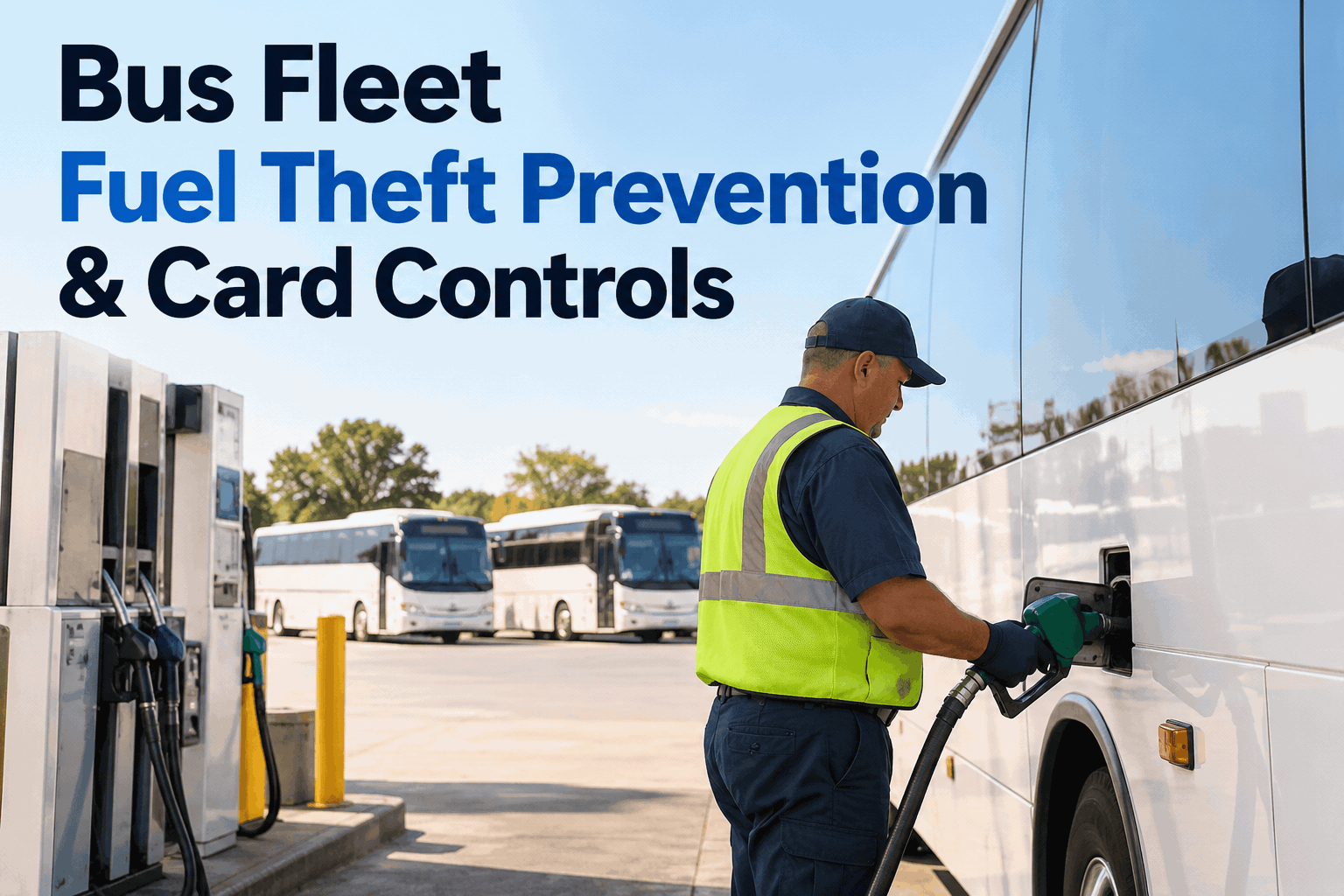
Bus fleet fuel theft prevention rarely starts with a stakeout — it starts with a fuel line that keeps climbing while your routes and mileage stay flat. The gallons are leaking somewhere between the pump and the tank. You can see how fuel-card reconciliation catches that gap in a demo before the next budget review.
Bus Fleet Fuel Theft Prevention and Fuel Card Controls
When buses run fixed routes, the fuel they should burn is a known number. The gap between that and what the cards paid for is where the theft hides — and it's measurable.
Why Fuel Theft Hits Bus Fleets Harder Than Most
Fuel is one of the biggest lines in any transportation budget, and on a bus fleet every gallon is traceable to a known route and a known bus — which is exactly why losses that slip through feel so avoidable after the fact. A few common leaks drain the budget quietly.
The card fills the wrong tank
A fuel card meant for a 65-passenger diesel ends up filling a personal pickup or a lawn-care can. One driver, a few gallons a week, and it never shows until someone adds up the year.
Phantom gallons that never hit a bus
A fill-up is logged for more than the tank holds, or logged with no fuel dispensed at all. On a fixed route that burns a predictable amount, the overage stands out — if anyone is checking.
The statement nobody reconciles
The fuel-card bill arrives as one lump sum. Without matching each transaction back to a bus, a route, and the miles it ran, there's no way to see which charges don't belong.
For a school district, that leak is public money. The advantage you have over a long-haul fleet: your buses run the same routes every day, so the expected fuel number is knowable — and anything above it is a question.
The Fuel Card Fraud Red Flags Worth Watching
Most fuel-card fraud shows up as a handful of transaction patterns. None of them prove theft on their own, but each one is a transaction that deserves a second look — and together they're the shortlist any fuel monitoring should flag automatically.
Swipe sideways to see all three columns.
Catching these by hand means reading a statement line by line. Catching them automatically means the exceptions come to you. You can start a free account and watch these flags surface on your own fuel data.
How a Suspicious Fill-Up Gets Flagged
A fuel-card transaction isn't suspicious in isolation — it's suspicious against what that specific bus should have done. Scoring each fill against the tank it went into, the route it runs, and the miles on the odometer turns a lump-sum statement into a short list of exceptions.
The 78-gallon charge clears the route check but fails on tank capacity — so it's held, not paid blind. One failed check is enough to put a transaction in front of a human.
Fuel Card Controls That Close the Gap
Detection catches theft after the charge; controls stop a lot of it before the pump even dispenses. Tightening how the cards themselves work is the cheapest prevention you have.
Loose card, open to misuse
- One shared card anyone can grab
- No gallon or dollar limit per fill
- Fuel grade not restricted
- No driver PIN at the pump
- Any station, any hour
- Statement reviewed once, in a lump
Controlled card, hard to abuse
- Card tied to a specific bus or driver
- Per-transaction gallon cap near tank size
- Locked to the right fuel grade
- Driver PIN required at the pump
- Limited to service hours and areas
- Every charge reconciled automatically
A gallon cap set near each bus's real tank size alone kills the over-capacity fill. Book a demo to see card controls mapped to your fleet.
How Fuel Card Reconciliation Actually Works
Reconciliation is the step that turns a fuel-card feed into something you can act on. Each charge is matched to the bus, its route, and the odometer reading, then it either clears or becomes an exception waiting for review — no statement-reading required.
The clean charges never need your attention. Your time goes only to the handful of exceptions — which is the whole point. You can book a demo to see reconciliation run on your own fuel-card feed.
Your Fuel Theft Prevention Checklist
If you're starting from a lump-sum statement and a shared card, here's the order that closes the most leakage for the least effort. Work down the list — the first three stop the easy theft.
- Tie each card to a bus or driverEnd the shared-card free-for-all. When a charge is attached to a specific bus, every other check becomes possible.FIRST
- Set a gallon cap near each tank's sizeA per-fill limit just above real tank capacity makes the over-capacity fill impossible at the pump.FIRST
- Require a driver PIN at the pumpTies every transaction to a person, not just a card, so an off-hours or off-route charge has a name on it.FIRST
- Reconcile every charge to miles and routeMatch each fill to the bus's odometer and route so gallons that don't fit the miles surface on their own.THEN
- Review exceptions, not whole statementsLet the system surface the handful of flagged charges each period, and track repeat offenders by card.THEN
The first three are card settings you can ask your fuel provider for today. The last two are where a bus-built system does the work for you — start a free account and set up reconciliation on your fleet.
How BusCMMS Handles Bus Fleet Fuel Management
BusCMMS tracks fuel per bus, per driver, and per route, reconciles the card feed automatically, and flags the charges that don't fit — so fuel theft prevention becomes a weekly five-minute review instead of a year-end surprise.
Fuel tracked per bus and route
Consumption by bus, driver, and route, with MPG-drop alerts that catch a leak or a developing mechanical problem early.
Automatic card reconciliation
Every fuel-card charge matched to the bus, route, and odometer, with the exceptions surfaced for you to review.
The fuel number you can show
Cost-per-mile and fuel-spend trends on one dashboard — a defensible number for the board instead of a lump-sum guess.
BusCMMS reports bus fleets cutting maintenance and operating costs by 25–35% within a year once fuel and maintenance run on one system — company-reported figures from its own customer base, not independently audited, but a fair picture of what tightening the leaks is worth. See where fuel fits in the complete guide to what a bus CMMS does.
A Transportation Director's Take
Key Takeaways on Bus Fleet Fuel Theft Prevention
The leak is measurable because your buses run known routes. Close the gap with a mix of tighter card controls and automatic reconciliation. Four things to carry out of this.
The gap is knowable
Fuel bought minus fuel the routes should burn is your leak — and it's a number.
A short list of red flags
Over-capacity fills, gallons that don't match miles, off-route and off-hours charges.
Controls stop it at the pump
Card-to-bus, gallon caps, driver PINs — the cheapest prevention you have.
Reconcile, don't read
Let the system match every charge and hand you only the exceptions.
Done right, bus fleet fuel theft prevention isn't a witch hunt — it's a quiet system that matches every gallon to a bus and a route, so the charges that don't belong rise to the top on their own. Tighten the cards, reconcile the feed, and the gap closes before it reaches the budget.