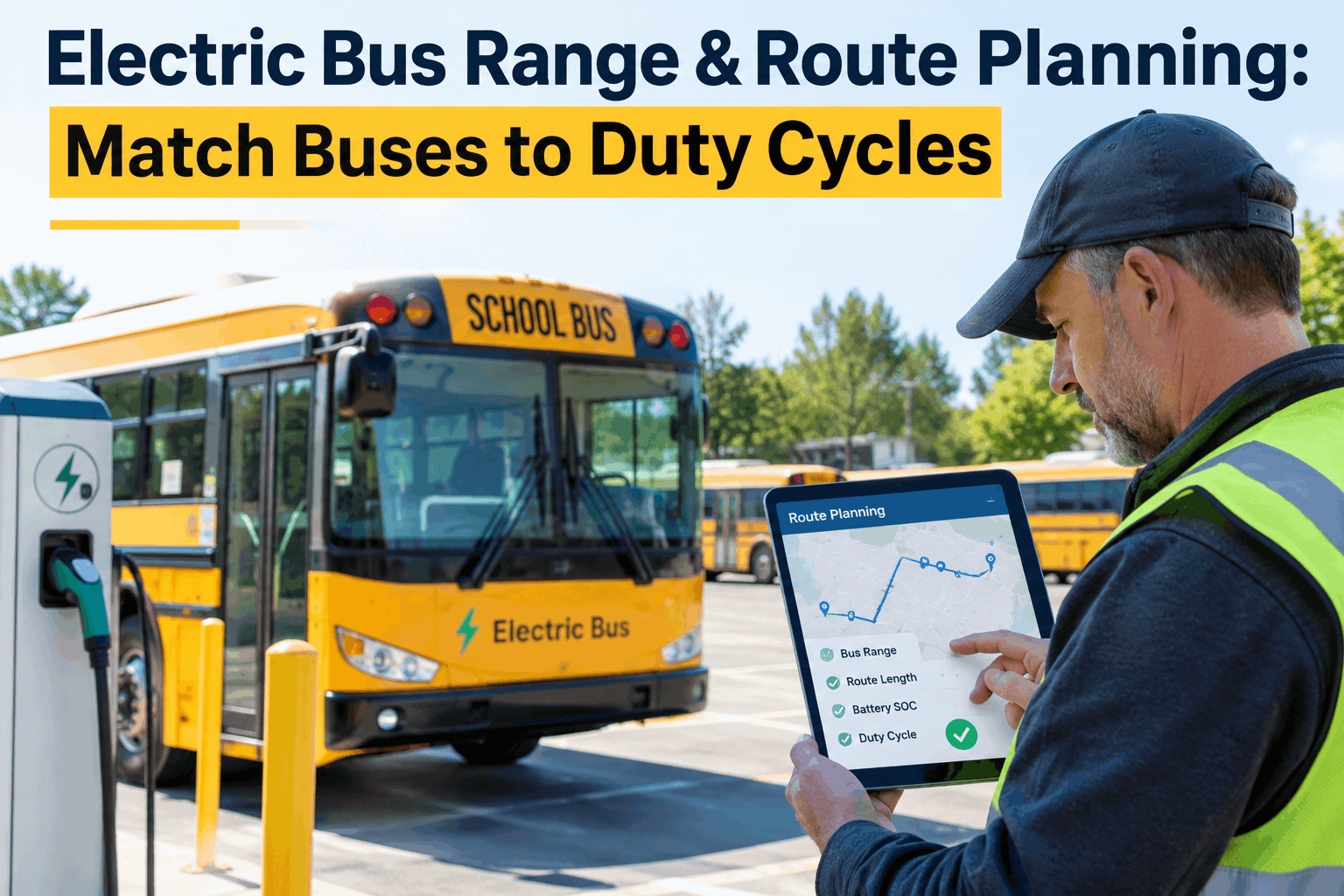
On paper, Route 22 is an easy 92-mile run for a 135-mile electric school bus—until a 6% hill climb, full cabin heat, and a 79% State of Health pack force a tow truck before the afternoon bell. Smart electric bus range and route planning matches every bus to its real duty cycle and maintenance status. You can see how BusCMMS aligns kWh/mile health with dispatch in a live demo.
Electric Bus Range & Route Planning: Match Buses to Duty Cycles
Sticker range assumes flat roads and mild weather. Real-world electric bus route planning accounts for kWh/mile efficiency, HVAC draw, terrain, battery SOH, and active maintenance holds.
4 Real-World Variables That Shrink Electric Bus Range
According to the U.S. Department of Energy's Alternative Fuels Data Center, a 100-mile school bus route averages roughly 150 kWh in traction energy, while HVAC load is the single biggest range variable in transit service:
Type C school buses average ~1.5 kWh/mi; 40-ft transit coaches run higher under stop-and-go duty.
Resistive cabin heat and A/C draw continuous kilowatts that slash usable route miles.
An aging pack at 78% SOH holds 22% less energy than its day-one spec sheet.
Dispatching below a 20% SOC buffer risks winter limp-mode derates on steep grades.
Route-to-Bus Matching Matrix for School & Transit Fleets
Pair each route profile with the right bus health tier inside your transit and school bus CMMS so degraded units stay on shorter runs:
| Route Profile | Daily Mileage | Required Pack Health | Dispatch & CMMS Rule |
|---|---|---|---|
| Tier A · Express / Rural | 90–120 mi | 88%+ SOH · Zero active faults | Assign newest packs; block units with BMS/thermal codes |
| Tier B · Standard Split | 55–89 mi | 80%–87% SOH · Normal kWh/mi | Midday AC top-off optional in winter; log daily SOC return |
| Tier C · Short Urban / Spare | Under 55 mi | 72%–79% SOH · Healthy brakes | Ideal home for older packs approaching OEM warranty audit |
| Tier D · Steep Grade / Mountain | 40–75 mi | 85%+ SOH · Chiller PM current | Monitor regen recovery, and battery thermal derate limits |
| Tier E · Activity / Field Trip | Variable | 90%+ SOH · Verified destination EVSE | Confirm public/partner charger access before dispatch release |
Static Dispatch Sheets vs. Maintenance-Synced Route Planning
When route planners and mechanics work off disconnected spreadsheets, a bus with a sticking brake caliper or thermal fault gets dispatched onto your longest run:
Blind Bus Assignments
- Treats every electric bus as having identical day-one sticker range
- Ignores active BMS isolation, chiller, or drag-induced kWh/mile spikes
- Forces emergency bus swaps when afternoon SOC drops below 15%
Verified Duty-Cycle Fit
- Pairs per-VIN SOH and seasonal kWh/mile with route length
- Holds buses with open thermal or brake-drag work orders automatically
- Extends fleet life by rotating 75%–80% SOH units to short urban loops
4-Step Electric Bus Range & Route Planning Workflow
Replacing static spreadsheets with live maintenance telemetry keeps routes predictable year-round. Connect telematics to BusCMMS to automate these four checks:
Track Route kWh/Mile
Log actual energy consumed per route by season and driver style rather than relying on OEM brochures.
Flag Efficiency Spikes
Trigger a shop inspection if a bus's kWh/mile jumps 15%+ due to dragging calipers or low tire pressure.
Sync Fault Holds
Automatically mark buses with thermal, chiller, or isolation faults unavailable on the morning dispatch board.
Rotate Older Packs
Shift 75%–80% SOH buses onto short urban loops to extend useful life past year 12 without pack swaps.
How Maintenance Directly Controls Electric Bus Range
Route planners often blame battery aging when a bus misses range targets, yet four everyday maintenance items quietly drain 10% to 25% of usable pack energy:
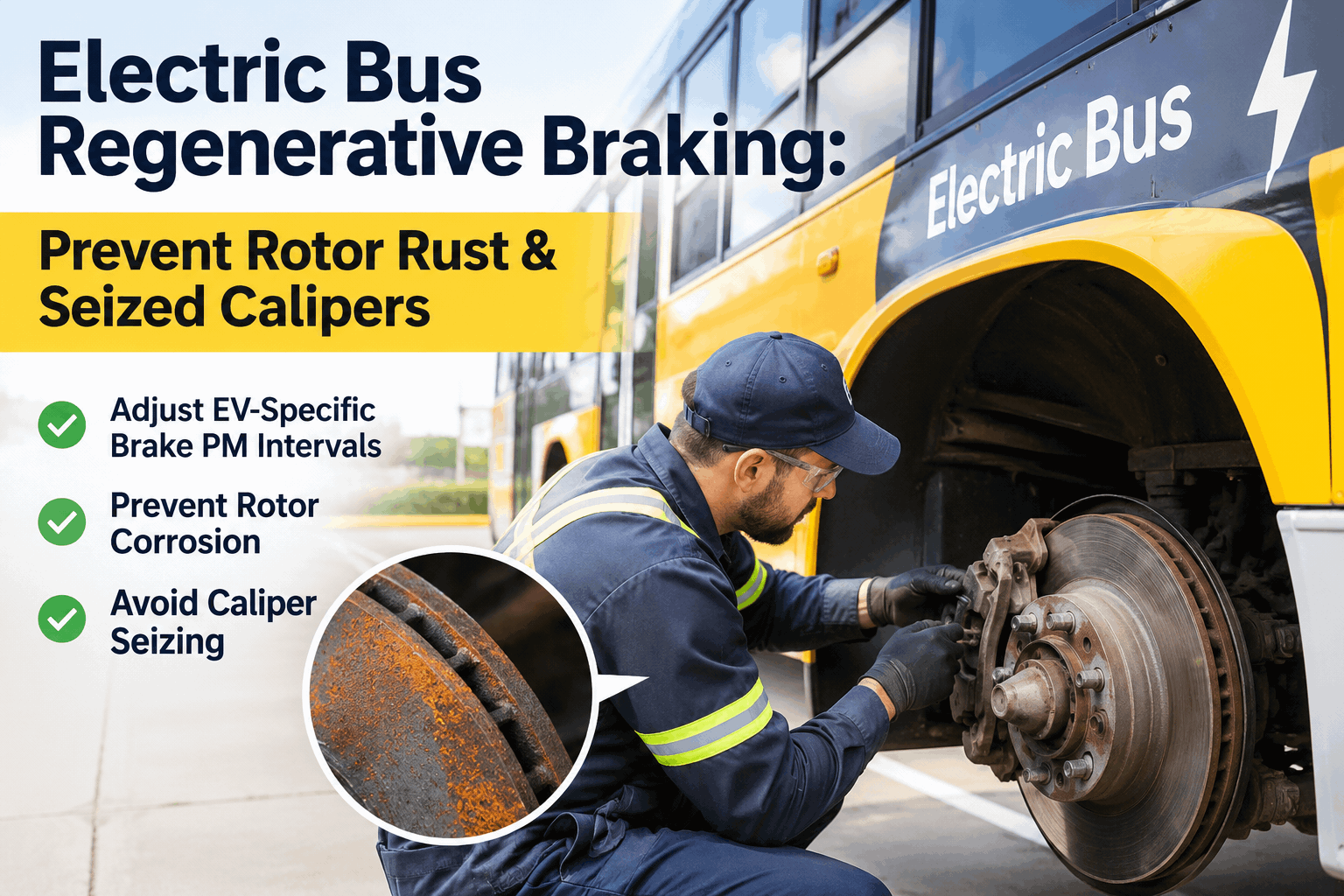
Seized Caliper Slide Pins
A single dragging rear caliper forces the traction motor to work harder on every acceleration, spiking kWh/mile by 15%–20% before pads ever smell hot.
Underinflated Steer & Drive Tires
Heavy EV battery packs punish underinflated tires. Checking cold tire pressures weekly cuts rolling resistance and preserves 4–7 miles of daily route buffer.
Failed Auxiliary Fuel Heaters
When a diesel-fired cabin heater fails to ignite, buses fall back on electric resistance heaters that pull 3–5 kW continuously from the main battery.
Axle Alignment & Hub Drag
Curb strikes knock heavy EV front ends out of spec, scrubbing tires and stealing kilowatt-hours on highway deadheads between school runs.
Using Historical kWh/Mile Data for Smarter Fleet Expansion
As your district or agency adds its second or third batch of electric buses, real route energy logs outperform OEM spec sheets every time. Tracking seasonal kWh/mile, winter HVAC draw, and per-VIN SOH inside BusCMMS gives planners defensible data for right-sizing battery packs, midday top-off chargers, and route assignments.
Baseline Efficiency Window
Measure mild-weather kWh/mile across flat and hilly routes to establish a clean mechanical baseline for every bus VIN.
Peak HVAC Stress Window
Compare peak heating and A/C route draw against your 20% SOC reserve floor so dispatchers adjust long runs before weather hits.
Midday Top-Off Charging vs. Direct Route Reassignment
When winter temperatures cut usable range on an 85-mile split run, dispatchers face two choices: schedule a 30-minute midday DC top-off between bell times or swap the bus with a higher-SOH unit from a shorter urban loop. Comparing charger availability, utility peak tariffs, and per-VIN SOH inside BusCMMS makes that call instant every morning.
Midday Depot Opportunity Charge
Adds 25–40 miles of buffer between AM and PM school bells when off-peak DC dispensers are open and healthy.
Health-Matched Bus Rotation
Assigns 88%+ SOH coaches to long rural runs while moving 75%–80% SOH buses onto 45-mile neighborhood routes.
By combining real route telemetry with active shop holds, transportation directors protect morning pull-out reliability, extend pack lifespans past 12 years, and avoid mid-route charging emergencies across every season.
A Route Planner's Take
Key Takeaways for Electric Bus Range & Route Planning
1. Budget HVAC & reserve
Always include cabin heating loads and a 20% SOC reserve in daily route energy math.
2. Watch kWh/mile drift
Catch dragging brakes and low tire pressure early through efficiency alerts.
3. Sync shop holds
Prevent dispatch from assigning buses with active thermal or BMS faults.
4. Rotate aging packs
Assign 75%–80% SOH units to short urban routes to maximize total bus lifespan.
Reliable electric bus range and route planning comes down to matching real pack capacity and shop status to daily duty cycles—book a BusCMMS demo to see live availability and kWh/mile tracking.