Four months before your first ten electric school buses arrive, the grant consultant asks if your garage bays have 1,000V insulated tooling, Class 0 dielectric gloves, and floor-lift capacity for 4,000-pound battery packs. Without a structured electric bus maintenance shop checklist, critical safety gear, and bay upgrades get missed until a technician needs to pull a high-voltage cover. You can see how BusCMMS tracks shop readiness and tool calibration dates in a live demo.
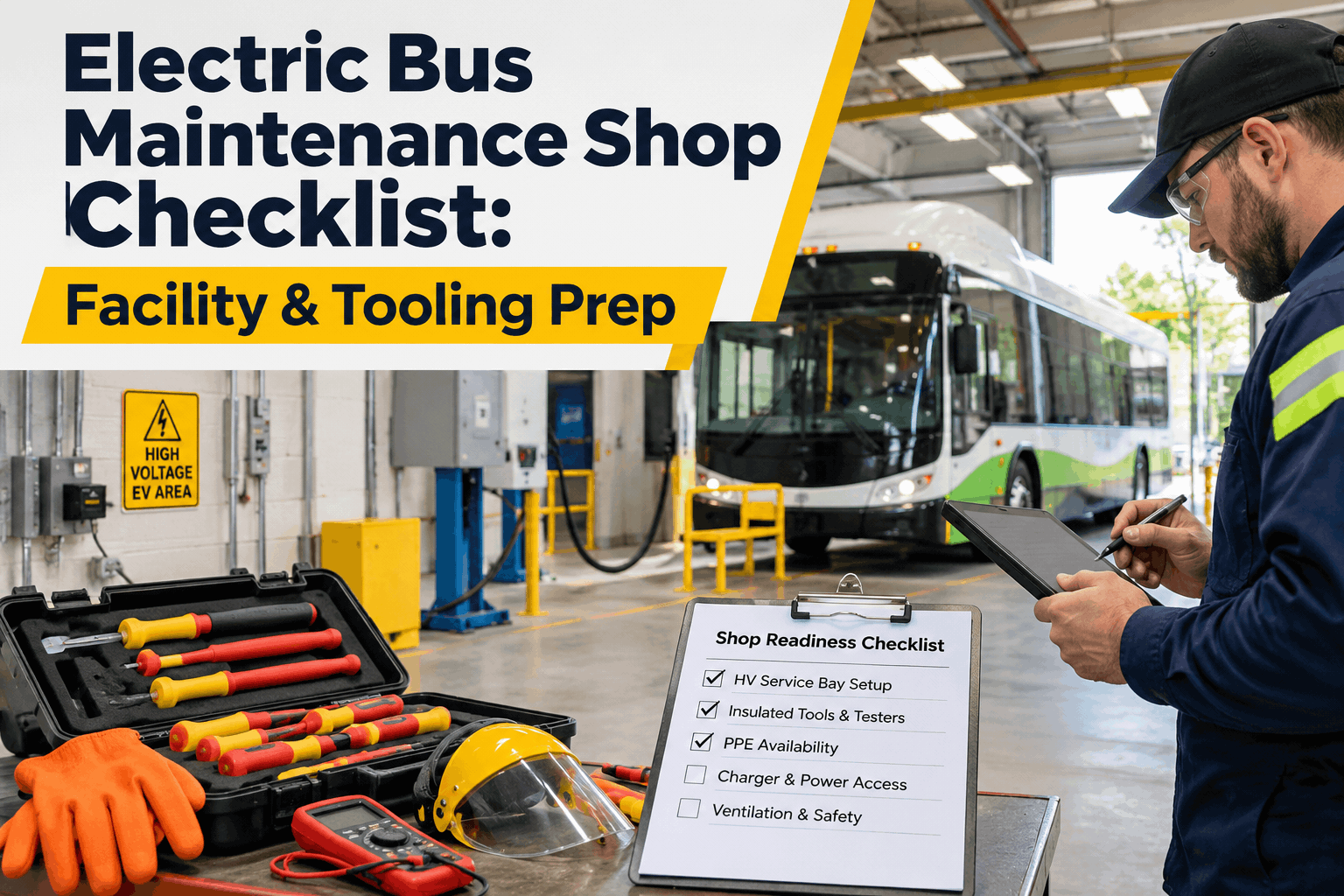
Electric Bus Maintenance Shop Checklist: Facility & Tooling Prep
Transitioning a diesel bus garage for zero-emission coaches requires more than parking chargers outside. Prepare your high-voltage service bays, NFPA 70E PPE, insulated tools, lift adapters and calibration logs before delivery day.
What Changes in the Garage: Diesel Bay vs. High-Voltage EV Bay
You do not need to rebuild an entire bus barn, but at least one dedicated service bay must be isolated and equipped for 400V–800V DC architectures before your first bus arrives.
Standard Mechanical Setup
- Exhaust extraction reels and DEF/coolant overhead drops
- Uninsulated chrome hand tools and 12V/24V test lights
- Open bay access with standard shop safety glasses
- Standard frame-contact lift pads without pack clearance
Dedicated Zero-Emission Setup
- Retractable high-voltage safety cones, chains, and live-work signage
- 1000V insulated torque tools, Class 0 gloves, and fiberglass rescue hook
- CAT III/IV 1000V multimeter and calibrated insulation megohmmeter
- Heavy-duty mobile column lifts with battery-rail clearance adapters
Every socket, torque wrench, and driver used near HV busbars must carry double-insulated 1000V certification.
OSHA and NFPA 70E require certified lab dielectric testing of Class 0 rubber gloves every 6 months.
Maintain a barricaded limited-approach perimeter around energized EV coaches during HV diagnostics.
Fleets using BusCMMS report 95%+ availability and ~$2,800/bus annual savings across mixed garages.
6-Part Electric Bus Maintenance Shop Checklist for Tooling & PPE
Every item below carries strict inspection or dielectric testing intervals under NFPA 70E and OSHA rules. Log tool calibration and glove test dates in BusCMMS so expired gear is flagged before a tech picks it up:
Class 0 Rubber Insulating Gloves
Rated to 1,000V AC / 1,500V DC with leather protectors; requires daily air-inflation checks and lab testing every 6 months.
1000V Insulated Hand Tool Kit
Double-insulated sockets, torque wrenches, and drivers stored in a locked EV-only shadow board so chrome tools never mix in.
Arc-Flash Face Shield & Suit
Calibrated arc-rated balaclava, face shield, and FR coveralls matched to the incident energy rating of your bus battery packs.
CAT III/IV 1000V Meter & Megger
True-RMS multimeter for Live-Dead-Live zero-energy checks plus insulation megohmmeter for HV cable testing.
Insulated Rescue Hook & Mat
6-foot fiberglass shepherd's hook and Class 0 dielectric floor matting staged beside the bay for emergency extraction.
EV Lift & Dielectric Coolant Rig
Mobile column lifts rated for EV curb weight plus a dedicated low-conductivity coolant vacuum-fill cart.
Facility Infrastructure & Bay Prep Standards
Review these bay specifications with your facility manager and transit fleet maintenance software team 90 days prior to bus commissioning:
| Facility Area | Key Readiness Requirement | Shop Verification Step |
|---|---|---|
| Mobile Column Lifts | Verify 18,000+ lb/column capacity for heavier EV battery axles | Inspect lift pads so underbody battery pack rails are never pinched |
| Overhead Clearance | Account for roof-mounted battery packs on 40-ft transit coaches | Check bay door height, fall-protection anchors, and gantry clearance |
| LOTO & Perimeter Kit | Dedicated high-voltage lockout locks, tags, and stanchion chains | Stage LOTO station at bay entrance; log key custody in CMMS |
| Fire & Thermal Protocol | Coordinate lithium-ion thermal runaway plan with local fire marshal | Post emergency disconnect map and outdoor quarantine parking zone |
| Shop Charging Drop | Install one Level 2 or portable DC service charger inside the EV bay | Test GFCI breaker and cable reach for post-repair HV wake-up checks |
| Diagnostic Software | OEM HV diagnostic laptops, CAN-bus cables, and firmware licenses | Log software renewal dates and assign bay laptop custody in CMMS |
90-Day Pre-Delivery Readiness Timeline
Working backward from your OEM delivery date keeps commissioning smooth—schedule a 20-minute walkthrough with BusCMMS to load pre-delivery PM templates:
Order Tooling & PPE
Procure 1000V tool kits, Class 0 gloves, arc-flash shields, and HV bay stanchions before supply lead times slip.
Certify Technicians
Complete NFPA 70E and OEM EV familiarization training and log tech qualification tiers in BusCMMS.
Test Lifts & Chargers
Verify bay lift adapters, shop charger breakers, and low-conductivity coolant flush carts.
Log Baseline SOH
Record pack serial numbers, delivery SOH, and launch automated PM schedules per VIN.
Common EV Shop Transition Mistakes to Avoid
Districts and transit agencies upgrading diesel garages often run into these four avoidable bottlenecks during their first six months of electric bus service:
Mixing 12V Chrome & 1000V Tools
Allowing uninsulated sockets into EV toolboxes risks accidental busbar shorts. Lock IEC 60900 tools in a dedicated high-voltage cabinet with sign-out tracking.
Skipping Lift Adapter Checks
Standard diesel axle forks can crush underbody battery rails or orange conduit. Verify OEM-approved lift points and post diagrams in every service bay.
Missing 6-Month Glove Re-Tests
Rubber insulating gloves lose dielectric protection with ozone exposure and pinholes. Set automated 6-month lab-test reminders in BusCMMS so expired pairs are pulled.
No Quarantine Parking Plan
Damaged or flood-exposed EV buses need an outdoor isolation zone 50 feet from buildings. Coordinate staging markers and emergency disconnects with local fire officials.
Budgeting Your EV Shop Transition Without Surprise Spend
Most school districts and transit agencies phase shop upgrades over two budget cycles—starting with one isolated high-voltage bay, IEC 60900 insulated hand tools, Class 0 gloves, and CAT III/IV meters. Tracking tool calibration dates and bay readiness tasks inside BusCMMS ensures grant auditors and safety officers see complete documentation before the first coach enters service.
A Transportation Director's Take
Key Takeaways from This Electric Bus Maintenance Shop Checklist
1. Isolate one HV bay
Set up 10-foot safety perimeters, signage, and dielectric matting before buses arrive.
2. Stock 1000V tools & PPE
Equip techs with IEC 60900 tools, Class 0 gloves, and CAT III/IV meters.
3. Automate 6-month tests
Track rubber glove dielectric recertification and meter calibration in your CMMS.
4. Verify lifts & clearance
Confirm axle weights, battery-rail lift points, and roof-pack overhead clearance.
Working through this electric bus maintenance shop checklist early keeps your depot compliant on day one—book a BusCMMS demo to load your EV shop templates.