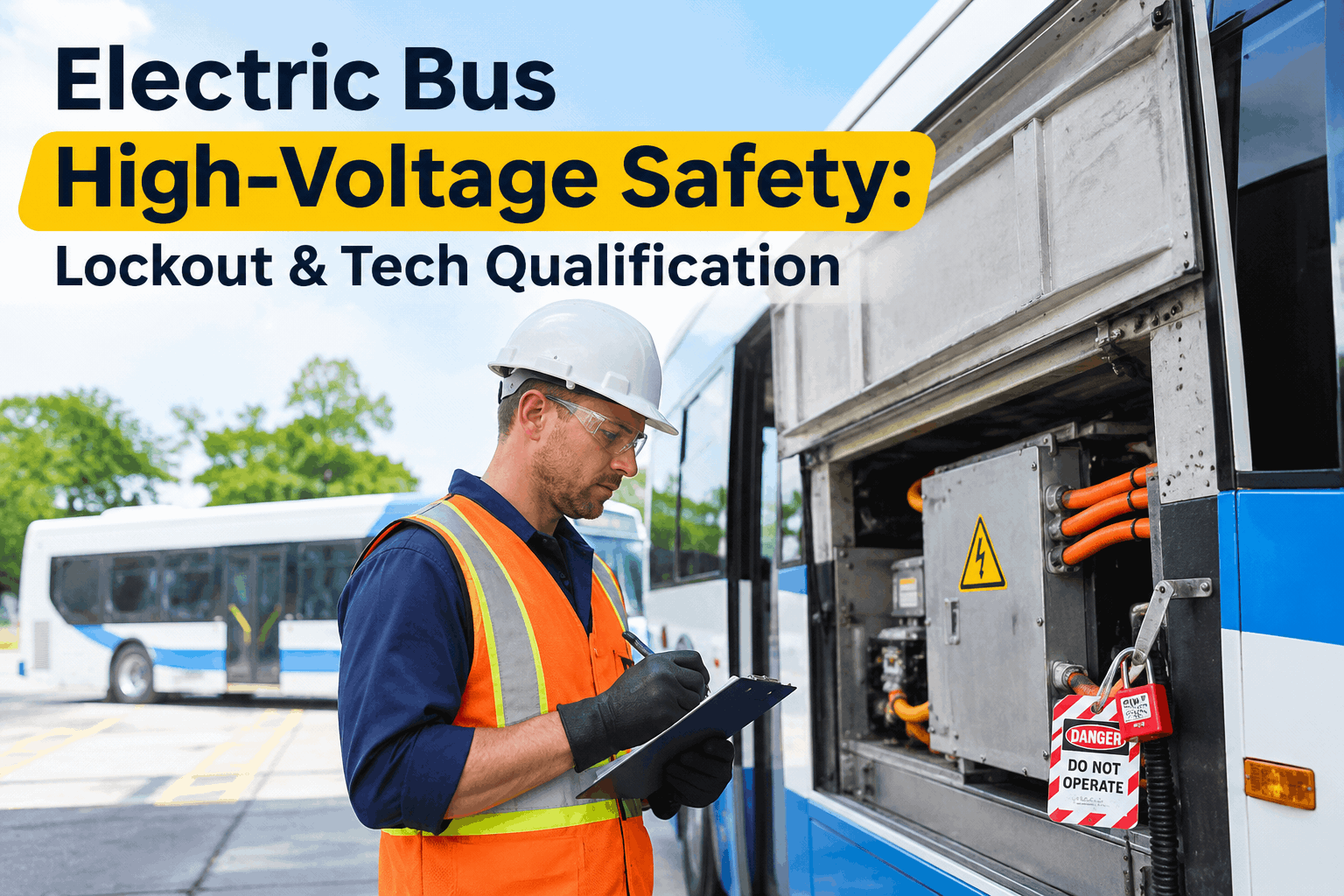
An overnight brake job on a battery-electric transit coach turns urgent when the technician spots a chafed orange high-voltage conduit rubbing the frame rail—yet the afternoon shift mechanic on duty has never completed NFPA 70E lockout training. Enforcing electric bus high-voltage safety procedures ensures only qualified techs touch energized systems while every LOTO step is logged. You can see skill-gated HV work orders in a live BusCMMS demo.
Electric Bus High-Voltage Safety: Lockout & Tech Qualification
400V–800V DC bus systems leave zero margin for shortcuts. Restrict high-voltage work orders to certified technicians and enforce digital Lockout/Tagout (LOTO) sign-offs before any orange cable is disconnected.
5-Step Digital Lockout/Tagout (LOTO) for Electric Bus Repairs
Following a repeatable de-energizing sequence under OSHA 1910.147 and NFPA 70E prevents arc-flash injuries and shock hazards. Require digital LOTO sign-offs in BusCMMS before a technician can advance an HV work order:
Isolate & Barricade Bay
Park bus, set wheel chocks, unplug depot charger, remove ignition key, and place 10-foot HV perimeter cones and warning signage.
Don Class 0 PPE & Pull MSD
Put on air-tested 1000V Class 0 gloves and arc-rated face shield, then remove the Manual Service Disconnect (MSD) plug.
Apply Personal Lock & Tag
Lock the MSD receptacle or HV disconnect box with the technician's personal padlock and signed LOTO tag—never share locks.
Wait 5–10 Min Discharge
Allow inverter and DC-bus capacitors to bleed down per OEM manual before loosening any orange high-voltage junction cover.
Live-Dead-Live Zero Check
Test CAT III/IV 1000V meter on a known live source, verify 0V across bus terminals, then re-verify the meter on the live source.
Paper LOTO Clipboards vs. Skill-Gated CMMS Safety Controls
In busy municipal and school garages, verbal shift handoffs are where high-voltage accidents happen. Comparing manual safety logs against automated work-order controls shows why safety coordinators digitize LOTO:
Unverified Shift Handoffs
- Any available night-shift mechanic can grab an open HV fault ticket
- Expired NFPA 70E or OEM EV certifications go unnoticed for months
- Paper LOTO tags get lost before OSHA or FTA safety audits
Enforced Digital Safety
- HV work orders only assign to Level 3 Qualified techs with active certs
- Mandatory digital LOTO checkboxes unlock repair steps in order
- Timestamped sign-offs, meter readings and tech IDs stay archived per VIN
Electric Bus High-Voltage Safety Procedures: Compliance & Training Matrix
Safety coordinators need clear boundaries between routine mechanical work and high-voltage diagnostics inside their transit and school bus CMMS:
| Repair / Inspection Task | Required Tier | PPE & LOTO Rule | CMMS Enforcement |
|---|---|---|---|
| Tires, Wipers & Body Panels | Level 1 / 2 | Standard shop PPE; zero orange conduit contact | Open to all technicians |
| 12V/24V Low-Voltage Batteries | Level 2 | Verify HV isolation if adjacent to pack rails | Standard mechanical sign-off |
| HV Coolant Flush & Chiller | Level 3 | Full LOTO + Class 0 gloves for sensor/valve work | Requires active EV cert on profile |
| A/C Compressor (HV Electric) | Level 3 | Full LOTO, Live-Dead-Live check, 1000V tools | Mandatory 5-step digital LOTO log |
| Traction Motor & Inverter | Level 3 | Full LOTO, 10-min bleed, arc-flash face shield | Locked to Level 3 Qualified techs |
| Battery Pack Module Swap | Level 3 | Full LOTO, dual-tech buddy rule, rescue hook staged | Supervisor sign-off + LOTO archive |
Want to audit technician certifications before your next OSHA review? See certification tracking in a live BusCMMS demo.
6-Point NFPA 70E & OSHA Shop Safety Audit
Verify your electric bus shop enforces these six compliance controls every shift:
Personal Padlock & Key Control
Each Qualified tech holds their own keyed LOTO lock—never use a shared shop lock on an MSD.
6-Month Glove Dielectric Log
Track Class 0 rubber glove lab test dates in BusCMMS and pull expired pairs immediately.
Annual Meter Calibration
Verify CAT III/IV 1000V multimeters and megohmmeters carry current calibration certificates.
10-Foot HV Perimeter Cones
Keep non-qualified mechanics and drivers outside the barricaded bay during energized testing.
Annual NFPA 70E Refresher
Automate 12-month renewal reminders for electrical safety and OEM high-voltage certifications.
Two-Person Buddy Rule
Require a second trained observer with a rescue hook staged whenever working inside open HV enclosures.
High-Voltage Emergency & Incident Prevention Protocols
Beyond routine LOTO, every EV bus garage must maintain clear emergency procedures for collision-damaged coaches, water intrusion, and unexpected HV isolation faults:
Post-Crash HV Inspection
Any bus involved in a rear or side impact must undergo Qualified Tech MSD isolation and insulation resistance testing before entering an indoor garage bay.
Active Chassis-Fault Lockout
If telematics reports an HV isolation fault, block dispatch immediately and require Class 0 PPE before opening junction boxes or testing coolant conductivity.
Multi-Shift LOTO Transfers
Never leave an MSD unlocked between day and night shifts. Log personal lock handoffs inside the BusCMMS work order so the incoming Qualified tech re-verifies 0V.
FTA & PTASP Safety Records
Archive technician NFPA 70E certificates, glove test logs, and signed LOTO checklists together to satisfy FTA Public Transportation Agency Safety Plan reviews.
Building a High-Voltage Safety Culture Across Shifts
Safety policies fail when they sit in a binder instead of inside the technician's daily workflow. By tying NFPA 70E qualification tiers, 6-month glove test alerts, and 5-step digital LOTO sign-offs directly to BusCMMS work orders, every shift mechanic follows the exact same de-energizing discipline on every 400V–800V bus.
Pre-Work MSD Photo Proof
Technicians snap a quick photo of the locked MSD receptacle directly inside the mobile work order before starting repairs.
Post-Repair HV Re-Energizing
Verify all orange conduit clips are torqued, bay perimeter is clear, and BMS isolation checks pass before releasing to dispatch.
Supervisor Sign-Off & Annual Audit Checklist
Safety directors should review LOTO logs quarterly to confirm every Qualified tech maintains active NFPA 70E credentials, personal lock custody, and calibrated 1000V meters—preventing compliance gaps before state DOT or OSHA inspections.
A Shop Foreman's Take
Key Takeaways on Electric Bus High-Voltage Safety Procedures
1. Gate HV work orders
Restrict high-voltage repairs exclusively to Level 3 Qualified technicians.
2. Enforce Live-Dead-Live
Never skip capacitor discharge wait times or 0V meter verification.
3. Track cert expirations
Log NFPA 70E and OEM EV training renewals so lapses trigger alerts.
4. Keep digital LOTO proof
Store timestamped lockout sign-offs directly on every HV work order.
Enforcing electric bus high-voltage safety procedures protects your crew and your agency—book a BusCMMS demo to configure skill-gated HV workflows.