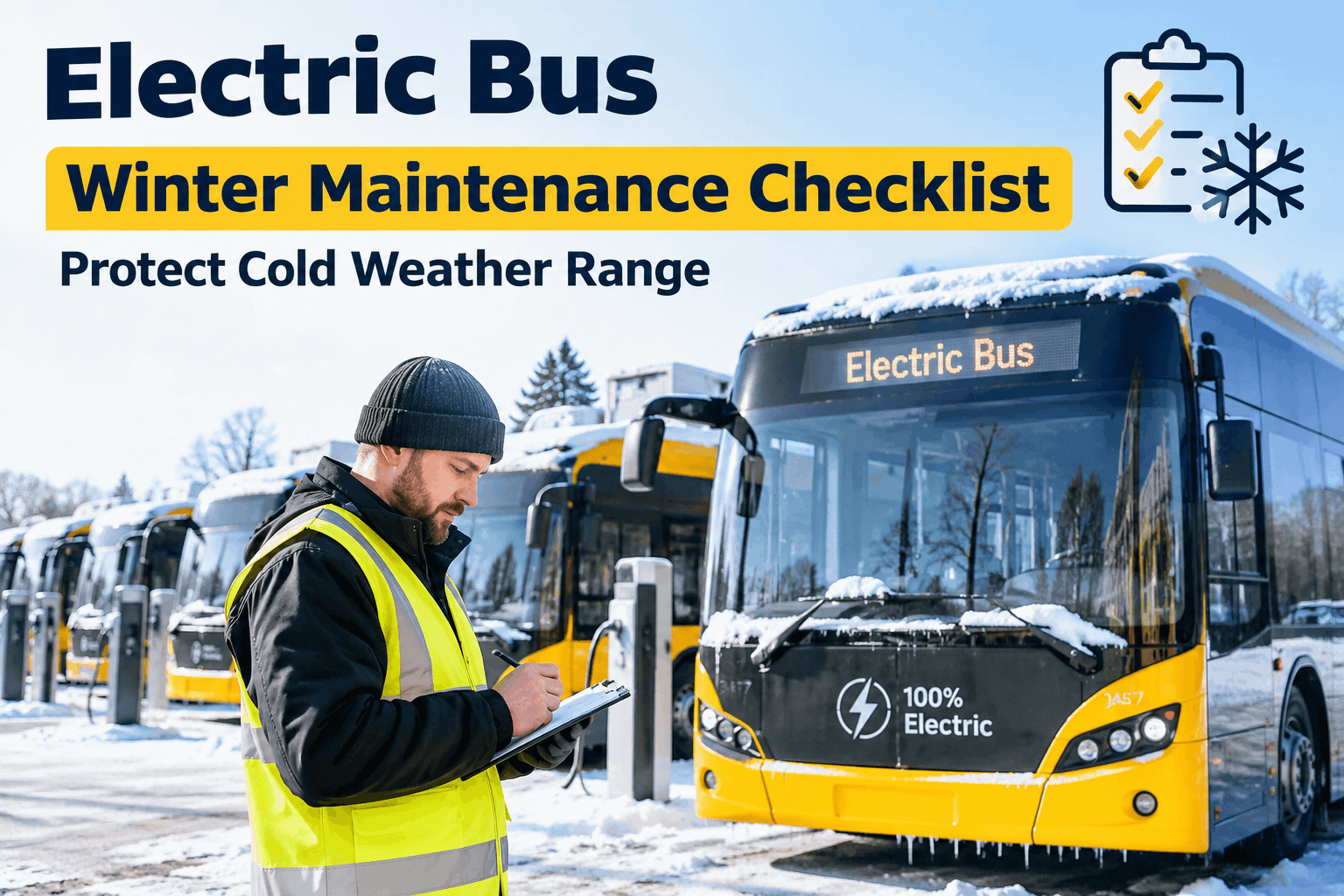
On the first 8°F morning of January, your electric school buses lose 35% of their summer range because resistive cabin heaters pull continuous kilowatts while cold packs limit regeneration. Following a structured electric bus winter maintenance checklist keeps heaters, thermal blankets and air dryers ready before frost hits. You can see bulk seasonal EV winter PMs in a live BusCMMS demo.
Electric Bus Winter Maintenance Checklist: Protect Cold Weather Range
Sub-freezing temperatures can cut EV bus range by 20% to 40%. Launch seasonal inspections across heat pumps, fuel-fired auxiliary heaters, air dryers and shore-power preconditioning.
Why Cold Weather Cuts Electric Bus Range—and What to Check
Resistive cabin heaters can draw 3 to 5 kW continuously—consuming 15% to 20% of pack energy on a 40-minute route—while cold lithium-ion cells limit regenerative braking. Preconditioning while plugged in recovers roughly 40% of cold-weather range loss:
Cold battery resistance plus cabin heat loads shrink usable miles below summer baselines.
Faulty heat pumps or unserviced auxiliary diesel heaters force heavy battery drain.
Pre-warming the pack and cabin on depot shore power restores lost cold-weather range.
Assign seasonal winter-prep checklists across every EV VIN simultaneously in BusCMMS.
6-Item Electric Bus Winter Maintenance Checklist
Run this seasonal inspection across your entire EV fleet every October inside your school and transit bus CMMS:
Heat Pump & PTC Heaters
Test electric cabin heat pumps, defroster blowers, and coolant circulation pumps under full cold load.
Fuel-Fired Auxiliary Heaters
Service Webasto/Espar glow pins, fuel filters, and exhausts so cabin heat doesn't drain traction packs.
Battery Thermal Blankets
Verify pack heaters and preconditioning timers fire cleanly while buses sit plugged into shore power.
Air Dryer & Tank Moisture
Replace desiccant cartridges and drain air tanks before freezing temps lock brake relay valves.
Door Seals & Stepwell Heat
Adjust entry-door weatherstripping and inspect stepwell heaters to keep warm air inside.
Winter Tires & 12V Batteries
Load-test 12V/24V accessory batteries (a dead 12V blocks HV contactors) and check winter tread.
Winter Fault Symptoms & Shop Remediation Matrix
When sub-zero temperatures hit, small deferred defects turn into morning no-starts or mid-route range alarms:
| Winter Symptom | Root Cause | CMMS Work Order Action |
|---|---|---|
| Bus Won't Close HV Contactors | Weak 12V/24V accessory battery below 11.8V | Load-test 12V bank; replace before sub-zero cold snaps |
| 30%–40% Sudden Range Drop | Dead auxiliary fuel heater forcing full PTC heat | Clean aux heater burner, swap fuel filter, verify ignition |
| Regen Braking Disabled at Start | Cold battery pack below 5°C without preheating | Enable 4:30 AM shore-power preconditioning timer |
| Frozen Brake Valves / Slow Air | Saturated air-dryer desiccant cartridge | Swap air-dryer cartridge & purge wet tanks in October |
Winter Preconditioning & Cold-Weather Dispatch Rules
Preparing the hardware in October is half the battle; running disciplined morning preconditioning and route-buffer rules from November through March locks in reliable winter service:
Preheat Before Unplugging
Schedule battery pack heaters and cabin preconditioning 45–60 minutes before pull-out while plugged into the depot charger so grid power heats the bus, not the battery.
Run Aux Heaters Monthly
Cycle fuel-fired auxiliary heaters for 15 minutes monthly year-round to keep fuel lines primed and prevent gummed nozzles on the first 10°F morning.
Raise Winter SOC Reserve
Increase minimum return-to-depot SOC buffers from 15% to 25% during sub-zero weeks and shift older 78% SOH buses onto shorter urban loops.
Wash Salt Off HV Conduit
Schedule undercarriage washes every two weeks during road-salt season to protect orange HV conduit clamps, chiller fins, and brake caliper slides.
Unprepped EV Fleet vs. Winter-Ready BusCMMS Fleet
Cold-Snap Range Anxiety
- Dead aux heaters force 5 kW electric heat drain on routes
- Unchecked 12V batteries lock out HV contactors at 5:00 AM
- Cold packs disable regen braking for the first 30 minutes
Predictable Sub-Zero Pull-Outs
- Bulk October winter PMs verify every aux heater & air dryer
- 12V load tests and preconditioning timers eliminate morning no-starts
- Shore-power preheating recovers ~40% of cold-weather range loss
4-Week October Countdown for Winter EV Bus Readiness
Launching winter prep in October gives your parts room time to stock auxiliary heater nozzles, air-dryer cartridges, and replacement 12V batteries before the first hard freeze:
Audit Winter Consumables
Check min/max stock for desiccant cartridges, aux heater glow pins, fuel filters, and low-conductivity coolant.
Test Aux & PTC Systems
Trigger bulk BusCMMS work orders to fire-test every fuel-fired auxiliary heater and electric cabin heat pump.
Load-Test 12V & Drain Tanks
Replace weak 12V/24V accessory batteries and swap air-dryer cartridges across the entire electric fleet.
Verify Depot Preconditioning
Confirm morning shore-power preheating schedules align with off-peak utility windows before November pull-outs.
Driver Habits That Preserve Winter Electric Bus Range
Shop prep and shore-power preconditioning work best when paired with simple winter driving and depot plug-in habits. Training drivers to keep doors closed during student staging, report sluggish aux heaters on DVIRs, and plug buses in immediately after afternoon runs protects usable range across the coldest weeks of January and February.
Flag Cold-Air Drafts Early
Ask drivers to note worn door seals or weak defroster airflow on daily DVIRs so mechanics fix leaks before sub-zero snaps.
Verify Green Charge Indicator
Confirm the dash charge light activates before walking away—cold packs need active shore power for morning preheating.
Minimize Yard Idle With Doors Open
Keep entry doors shut during morning staging so resistive heaters do not burn 5%–8% SOC before the first stop.
Compare Winter kWh/Mile
Review seasonal energy logs in BusCMMS to spot units with failing heat pumps or dragging brakes right away.
Combining October bulk winter PMs, reliable auxiliary heaters, load-tested 12V banks, and morning shore-power preconditioning keeps cold-weather range predictable and prevents sub-zero pull-out delays.
With bulk October inspections, healthy auxiliary heaters, and morning shore-power preheating, your electric buses deliver reliable winter service without mid-route range anxiety.
A School Transportation Director's Take
Key Takeaways from This Electric Bus Winter Maintenance Checklist
1. Service aux heaters
Keep diesel-fired cabin heaters healthy so electric heat doesn't drain packs.
2. Precondition plugged in
Warm packs and cabins on shore power to recover ~40% of lost winter range.
3. Load-test 12V banks
Prevent morning HV contactor lockouts caused by weak 12V/24V batteries.
4. Launch bulk October PMs
Trigger one seasonal checklist across all EV VINs before the first freeze.
Running this electric bus winter maintenance checklist every fall protects cold-weather range and morning pull-outs—book a BusCMMS demo or start your seasonal EV checklists free.