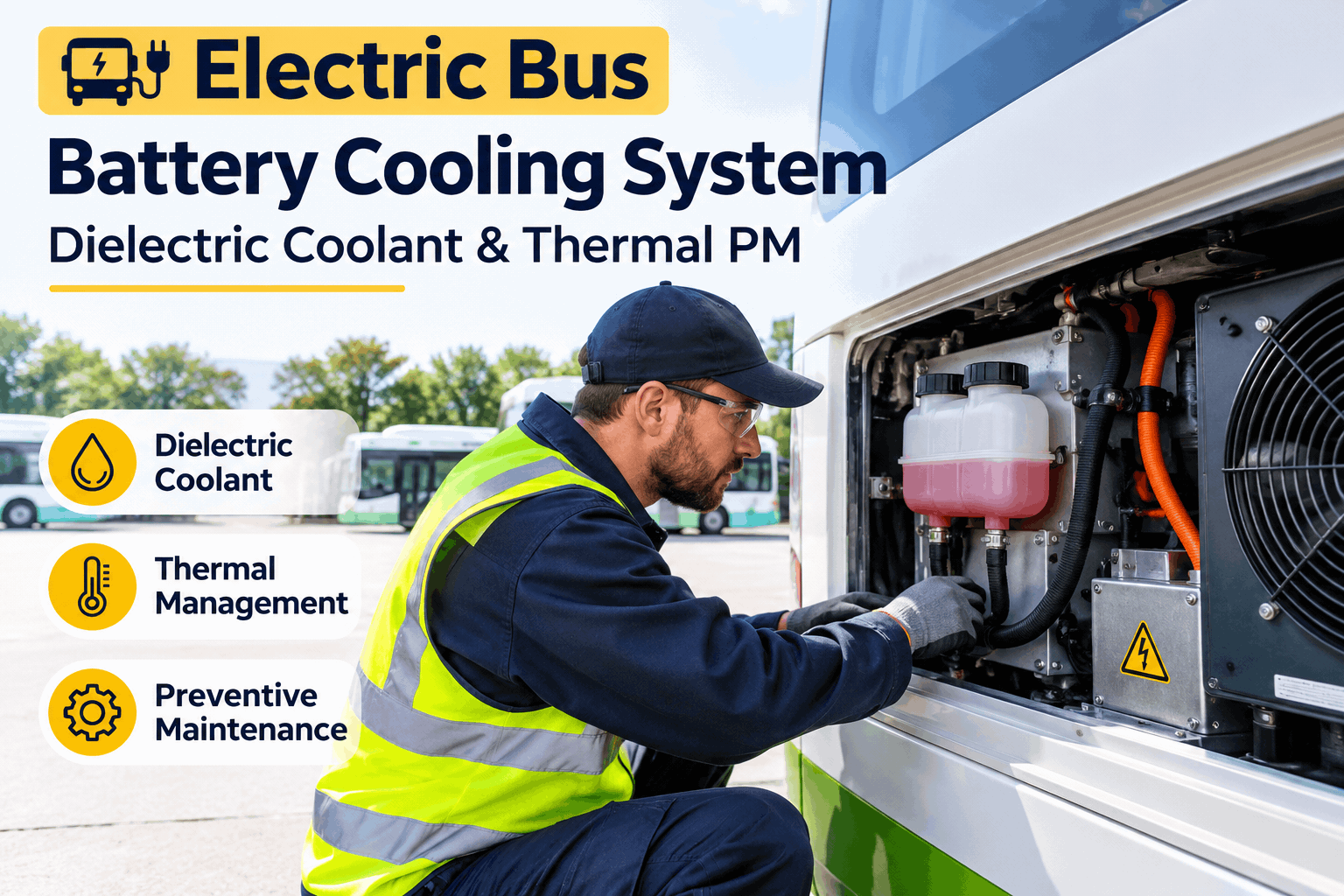
On a 95°F July afternoon, Bus 17 throttles down to 35 kW during DC fast charging and throws a thermal derate fault on the afternoon route—all because a leaf-clogged chiller radiator and degraded dielectric coolant went unchecked. Proactive electric bus battery cooling system maintenance protects cell longevity and charging speeds. You can see thermal PM and coolant tracking in a live BusCMMS demo.
Electric Bus Battery Cooling System: Dielectric Coolant & Thermal PM
Liquid-cooled battery packs depend on low-conductivity dielectric coolant, clean chiller heat exchangers, and working three-way valves. One missed cooling PM triggers thermal derating, and voids OEM battery warranties.
Why Electric Bus Battery Cooling System Maintenance Protects Pack Life
When battery thermal management systems (BTMS) fall behind on service, heat accelerates chemical fade and slows DC fast charging. Track these four thermal health indicators inside your transit and school bus CMMS:
WRI India data shows LFP packs lose half their cycle life when operated at 45°C vs. 25°C.
High-conductivity coolant inside HV cold plates triggers isolation faults and pack lockouts.
Pollen, road grit, and bugs choke condenser fins and force thermal derates on hot days.
Deploy fluid-specific EV cooling PM templates alongside diesel coolant checks.
BTMS Components, Failure Modes & Shop PM Actions
Never top off an EV battery loop with standard diesel ethylene-glycol coolant. Configure fluid-specific PM checklists in BusCMMS for each cooling circuit:
| Thermal Component | Common Failure Mode | CMMS PM Inspection & Interval |
|---|---|---|
| Dielectric / Low-Conductivity Coolant | Deionized additives deplete; conductivity rises | Test conductivity & freeze point every 6 months; flush per OEM spec |
| Chiller & Condenser Coils | Debris blockage or refrigerant low charge | Blow out fins quarterly; verify delta-T across chiller loop |
| Electric Coolant Pumps | Impeller wear or cavitation from air pockets | Log pump RPM telemetry; vacuum-bleed after any loop service |
| 3-Way Thermal Valves | Stuck bypass valve prevents chiller routing | Cycle valve via diagnostics and clear thermal fault codes early |
| De-Ionizer Cartridges | Saturated resin beads allow ions to build up | Replace inline de-ionizer filter on OEM 12-to-24-month schedule |
4-Step Thermal Fault Escalation Workflow
Catching a clogged condenser or failing coolant pump before summer peak keeps fast chargers running at full speed:
Auto-Ingest BTMS Faults
Pull chiller, coolant-temp, and isolation fault codes from telematics into BusCMMS automatically.
Test Coolant Conductivity
Check fluid with a calibrated conductivity meter before blaming an expensive battery module.
Clean Radiators & Bleed
Clear chiller fins and vacuum-fill approved low-conductivity coolant to remove trapped airlocks.
Archive Warranty Proof
Attach fluid test readings to the bus VIN to protect OEM battery warranty coverage.
5-Point Dielectric Coolant & Chiller Audit Checklist
Verify your EV shop follows these five thermal maintenance safeguards on every zero-emission bus:
Dedicated EV Coolant Cart
Never share funnels or vacuum-fill hoses with diesel glycol systems—cross-contamination ruins conductivity.
6-Month Conductivity Log
Record microsiemens readings per VIN in BusCMMS so OEM warranty engineers see compliant upkeep.
Quarterly Condenser Blow-Out
Clear leaves, cottonwood, and road salt from roof or side-mounted battery chiller cores.
Pump & Fan Amp-Draw Check
Confirm electric coolant pumps and radiator fans pull normal amps without bearing drag.
OEM Coolant Min/Max Stock
Keep sealed jugs of OEM-approved dielectric coolant and de-ionizer cartridges stocked in parts.
Seasonal Thermal Demands: Summer Fast-Charging vs. Winter Heating
Electric bus thermal loops work year-round—rejecting heat during summer DC fast charging and warming cold cells before winter pull-out:
Preventing Fast-Charge Derates
- Clear pollen and road grit from chiller condensers every 90 days
- Verify refrigerant pressures and chiller fan amp draw before June
- Log pack temperature delta during 150 kW DC fast-charge sessions
Protecting Cold-Soak Cells
- Test coolant freeze-point and conductivity before October frost
- Inspect 3-way thermal valves and PTC pack heaters for fault codes
- Verify shore-power preconditioning warms packs above 10°C before routes
Why Dielectric Coolant Records Protect OEM Warranties
Battery manufacturers treat thermal neglect as a primary warranty exclusion. Keeping timestamped conductivity readings, vacuum-bleed work orders, and chiller filter logs attached to each VIN in BusCMMS proves your shop maintained cooling loops to spec—eliminating costly warranty disputes if a pack degrades prematurely.
4-Point Technician Guide to Safe EV Cooling Loop Service
Servicing an electric bus thermal loop requires strict fluid isolation and high-voltage awareness so coolant work never triggers BMS lockouts:
De-Energize Before Valve Work
Follow full MSD lockout procedures whenever disconnecting coolant sensors or electric chiller pumps mounted near HV rails.
Measure Microsiemens First
Sample coolant conductivity every 6 months with a clean, dedicated meter; replace fluid immediately if readings climb toward OEM limits.
Vacuum-Fill to Prevent Airlocks
Use a dedicated EV vacuum-fill rig so trapped air pockets never cavitate coolant pumps or create hot spots inside battery cold plates.
Run Chiller Load Check
Confirm 3-way thermal valves cycle smoothly and condenser fans hit full RPM during a post-service DC fast-charge test.
Preventing Costly Pack Derates With Proactive Fluid Logs
A single unserviced chiller fan or contaminated coolant loop can force an electric bus into limp mode mid-route or double depot charging times during July heatwaves. By tracking microsiemens conductivity tests, de-ionizer cartridge swaps, and 90-day radiator cleanings inside BusCMMS, maintenance teams catch thermal drift early, keep DC fast-charging curves flat, and maintain complete OEM warranty compliance across every vehicle in the fleet.
Watch Pack Delta-T
Flag buses showing >5°C spread between battery modules—often an early sign of a clogged cold plate or failing valve.
Track Batch & Lot Numbers
Record OEM dielectric coolant part numbers on every work order to prove approved fluid use during warranty reviews.
Pressure-Test Underbody Lines
Inspect orange-adjacent coolant hoses and quick-disconnect fittings for road-debris chafing during semi-annual PMs.
Maintaining clean chiller condensers, verified low-conductivity dielectric coolant, and responsive 3-way thermal valves ensures your electric bus battery packs stay within optimal operating temperatures year-round—protecting fast-charging speeds and full OEM warranty coverage.
Tracking every conductivity test, de-ionizer cartridge swap, and radiator clean-out in one CMMS keeps thermal loops healthy across 12+ years of transit and school bus operation.
Routine chiller and dielectric fluid logs eliminate thermal derating, protect fast-charging speeds, and preserve full OEM battery warranty coverage.
An EV Fleet Engineer's Take
Key Takeaways for Electric Bus Battery Cooling System Maintenance
1. Isolate EV coolants
Use dedicated low-conductivity coolant carts and never mix with diesel glycol.
2. Clean chillers quarterly
Blow out condenser fins every 90 days to stop summer fast-charge derating.
3. Log conductivity
Record 6-month dielectric fluid tests per VIN to protect OEM warranties.
4. Escalate BTMS codes
Route pump and valve fault codes straight into shop work orders.
Consistent electric bus battery cooling system maintenance prevents thermal derating and preserves fast-charging speeds—book a BusCMMS demo to configure your BTMS PM templates.