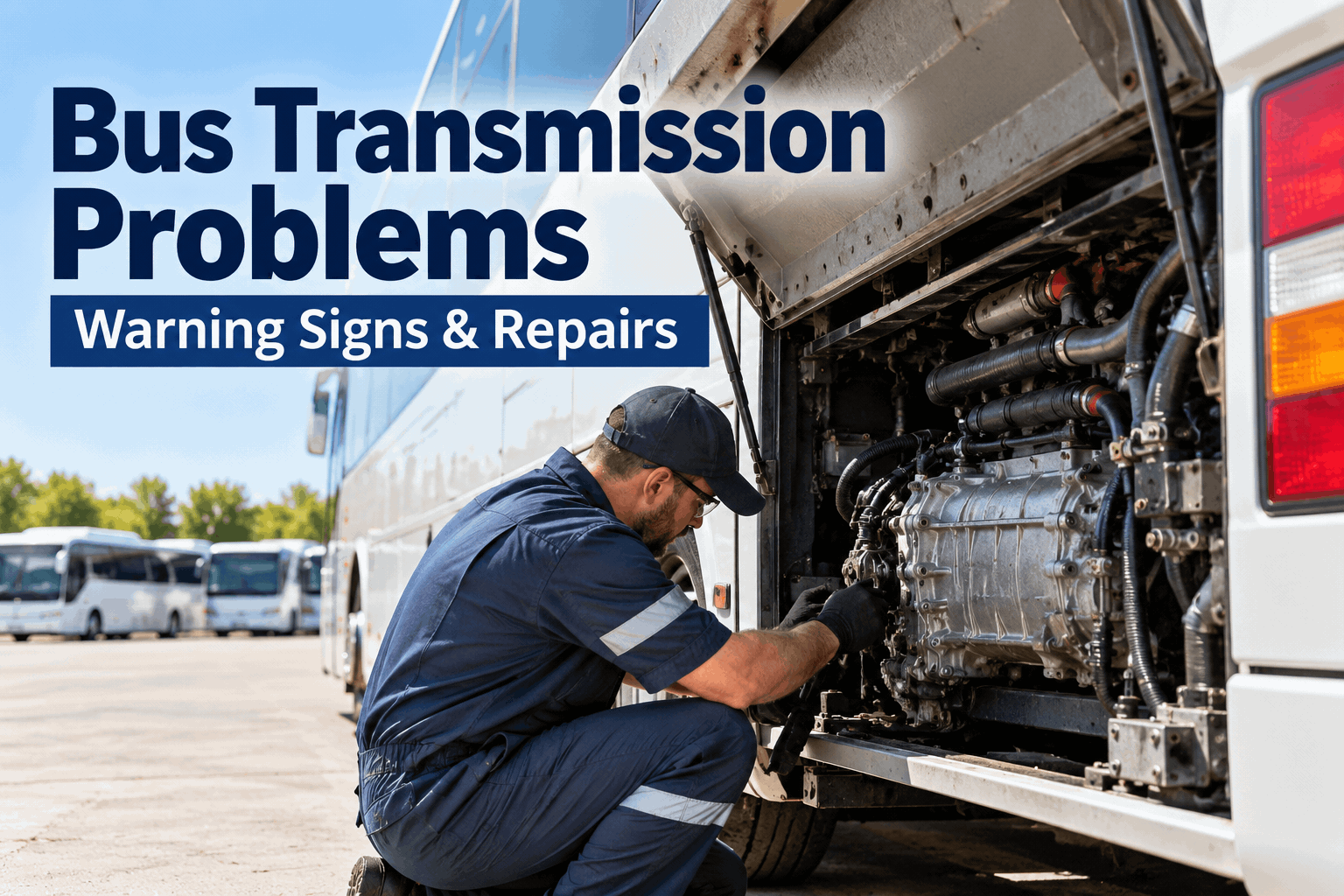
Bus transmission repair vs. rebuild is a decision no fleet manager wants to make on a Monday morning. A bus hesitates leaving a stop, the driver reports a harsh shift, and the shop needs an answer before tomorrow's routes. The mistake is treating every warning as proof of internal failure. A useful decision starts with the symptom, follows the manufacturer's diagnostic procedure, and compares repair scope, downtime, and remaining bus life. Book a demo to see how BusCMMS keeps transmission complaints and repair history together.
Bus Transmission Repair vs. Rebuild: Know When Each Makes Sense
One rough shift is a symptom, not a rebuild order. Follow the evidence from driver report to diagnosis to the right repair scope.
Six Warning Signs That Deserve a Proper Transmission Diagnosis
The driver sees the symptom; the technician establishes the cause. Record the exact condition and follow your fleet's safety and out-of-service procedures. Severe drivability issues are not something to test during passenger service.
Loss of drive or unexpected disengagement
A bus that cannot reliably transmit power may be unsafe to operate. Stop safely, secure the vehicle, and arrange qualified evaluation.
Severe slipping, overheating warning, or abnormal movement
Follow the model-specific warning instructions and your fleet's safety policy. Do not assume driving farther will clear the condition.
Delayed engagement into Drive or Reverse
Record whether the delay occurs cold, warm, intermittently, or after a specific maneuver. Control, pressure, fluid, and internal faults require different remedies.
Harsh, erratic, or missed shifts
Preserve fault codes and operating conditions. A shift-quality complaint alone cannot identify which component failed.
Fluid leakage or unusual fluid condition
Document the source and extent. A visible leak may be serviceable; contamination or related damage may change the scope.
Transmission warning or stored diagnostic code
A code directs further diagnosis. It does not, by itself, establish that a rebuild is necessary.
Repair, Rebuild, or Replace? Three Different Jobs
These terms are often used loosely in estimates. Ask the shop to define exactly what is included, what has been confirmed, and which components carry a warranty.
Targeted Repair
Correct an identified serviceable fault without overhauling the entire assembly.
- Best when damage is localized
- Scope depends on diagnosis
- Confirm no broader failure is being overlooked
Transmission Rebuild
Disassemble and restore the existing transmission under a defined repair specification.
- Consider when internal damage is established
- Teardown can reveal additional work
- Compare written scope and warranty
Replacement Unit
Install a compatible replacement or remanufactured assembly.
- Evaluate unit availability and core terms
- Check installation requirements
- Compare warranty and return-to-service date
For service intervals and recurring transmission checks, see the BusCMMS transmission maintenance guide. This article focuses on the approval decision after a problem is reported.
The Five Questions to Answer Before Authorizing a Rebuild
A good approval packet is short but complete. It shows what failed, how that was established, what the proposed job covers, and why the expense makes sense for this vehicle.
- What has actually failed?Keep the symptom separate from the confirmed diagnosis. Ask for relevant codes, test findings, and inspection evidence.
- Has a smaller repair been ruled out?Confirm that the proposed work addresses the failure and that a targeted repair would not be technically appropriate.
- What exactly does the quote include?Compare labor, components, additional teardown charges, fluid, installation, testing, and warranty exclusions.
- When can this bus safely return?Include parts lead time, shop capacity, road verification, and any spare-bus or route-coverage impact.
- How much useful life is left?Review vehicle age, mileage, corrosion or structural condition, other major repairs, and replacement plans.
The Real Cost Is the Repair Plus the Time Off Route
Two estimates are not comparable until you account for service disruption. A less expensive repair that cannot resolve the confirmed problem is not a saving. A rebuild that costs more than the bus can reasonably justify may not be the right investment either.
Direct repair cost
Diagnosis, labor, parts, fluid, towing, additional teardown, and final verification.
Downtime cost
Substitute bus use, missed service capacity, rescheduling, and delays waiting on components.
Future exposure
Repeat failure risk, warranty terms, unresolved related issues, and remaining vehicle service life.
Imagine a district bus nearing planned retirement. A major rebuild could consume money that would be better evaluated alongside its replacement plan. For a newer transit bus with confirmed internal damage and strong warranty coverage, rebuilding may be reasonable. Neither conclusion follows from the symptom alone.
What the BusCMMS Repair Record Should Tell the Next Technician
When a bus comes back with a similar complaint, the next technician should not have to reconstruct the last repair from memory. BusCMMS helps connect inspection defects, work orders, parts and labor records, preventive maintenance, and vehicle history.
Driver observation and vehicle mileage recorded.
Qualified technician documents the actual cause and repair recommendation.
Repair manager reviews previous work and signs off on the chosen option.
Work performed, parts, costs, and verification remain with the vehicle history.
A bus CMMS does not interpret transmission wear, replace an OEM diagnostic tool, or decide whether an assembly is rebuildable. It helps managers see the history and keep the decision auditable. Sign up to start tracking bus transmission work orders and maintenance history.
After the Repair: Close the Loop Before the Next Route
The best prevention is model-specific maintenance plus reliable follow-up. Transmission fluid specifications, filter procedures, prognostic indicators, and service intervals differ by model, fluid, and operating duty. Follow current manufacturer instructions rather than a universal mileage rule.
Document the required manufacturer-directed checks and release-to-service decision.
Retain what was replaced, exclusions, and any required follow-up service.
Use the applicable OEM fluid, filter, inspection, and operating guidance.
Compare later driver reports and fault records with the original condition.
For recurring shift-fault documentation, the related bus transmission health and shift-fault tracking guide provides a complementary maintenance-history perspective.
Key Takeaways: Repair the Failure, Not the Symptom
Diagnose before quoting. Slipping, hard shifts, and fault codes do not automatically mean a rebuild.
Define the scope. Targeted repair, rebuild, and replacement address different conditions.
Count downtime. Route coverage and parts lead time matter alongside the estimate.
Keep the evidence. A complete bus history supports the next repair decision.
A defensible bus transmission repair vs. rebuild decision combines qualified diagnosis, an itemized scope, downtime planning, warranty terms, and the bus's remaining useful life. BusCMMS helps keep those maintenance records connected, so a repeat problem starts with evidence instead of guesswork.
Bus Transmission Repair vs. Rebuild: Common Questions
Can a slipping bus transmission be repaired without rebuilding?
Sometimes. Slipping can have multiple causes, including control, hydraulic, or internal mechanical faults. A qualified technician must follow the applicable manufacturer's diagnostic process. A localized, confirmed serviceable fault may be repairable without a complete rebuild, but internal damage can require more extensive work.
How do I know when a bus transmission needs a rebuild?
A rebuild becomes a consideration when testing and inspection establish internal damage or wear that cannot be economically corrected with a targeted repair. Compare rebuild scope and warranty with replacement-unit options, the bus's remaining life, and expected downtime.
How much does a bus transmission rebuild cost?
There is no reliable single price for every bus. The model, parts, labor, extent of damage, availability, and warranty all affect the estimate. Request an itemized quote and ask whether additional teardown findings can change the price. Any example numbers in this article are hypothetical.
Should a bus keep running with transmission warning signs?
Do not continue normal service when drivability or safety is compromised. Drivers should follow fleet procedures and the manufacturer's warning instructions, stop safely where appropriate, and report the condition. A qualified person should determine whether the vehicle can return to service.
How can BusCMMS help with transmission repair decisions?
BusCMMS helps organize driver inspection reports, work orders, repair costs, scheduled maintenance, and service history by vehicle. Managers can review previous complaints and repairs when evaluating a new estimate. It does not diagnose internal transmission faults or replace qualified technicians.