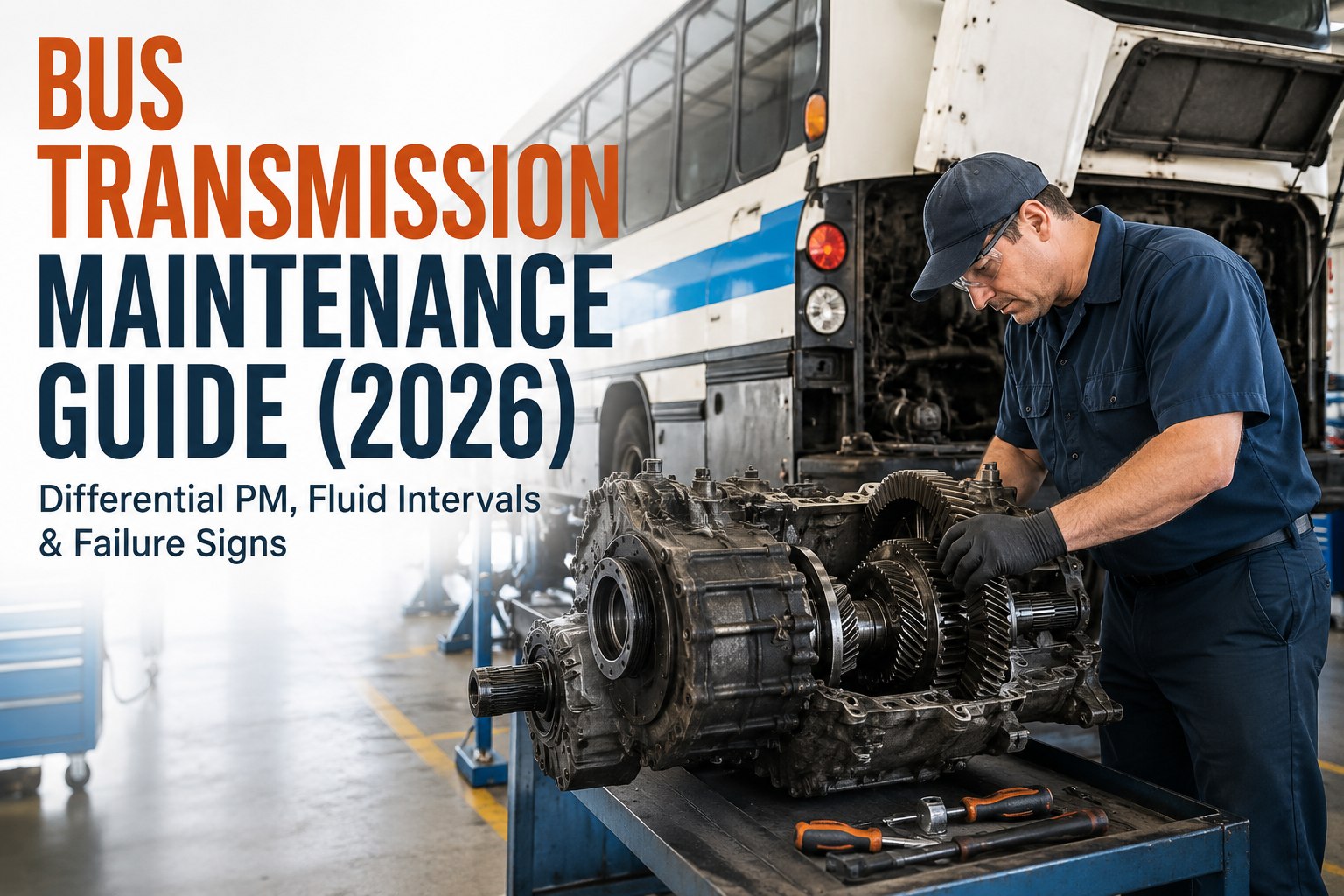
A transmission rebuild on a school bus runs $8,000 to $15,000, plus a week of downtime and a substitute bus you probably do not have. A transmission fluid and filter service runs $400. Almost every rebuild starts with someone skipping the $400 service one time too many. This guide shows you exactly what to service, when, and how to catch failures three months before they leave you paying for the rebuild.
Bus Transmission Maintenance Guide
Fluid intervals, differential PM, warning signs, and the $400 service that prevents $12,000 rebuilds
- $400Preventive service
- $12KRebuild if skipped
- 30XReturn on PM dollar
- Fluid Temp195°FOK
- Shift QualitySOFTWARN
- Converter Slip3.2%OK
- Filter Life8,200 miLOW
The $400 Service That Prevents the $12,000 Rebuild
A bus transmission is the second most expensive component on the vehicle after the engine, and unlike engines, transmissions almost always fail from the same root cause: neglected fluid. Torque converters, clutch packs, valve bodies, and solenoids do not wear out on their own. They wear out because degraded fluid stopped protecting them. The cost math is not close.
- ~$1,600 total over 200K miles
- Fluid stays fit for service
- Zero unplanned rebuilds
- Predictable annual budget
- 5-7 days out of service
- Substitute bus rental $1,200+
- Route disruption + parent calls
- No warranty coverage on neglect
A 50-bus fleet running proper transmission PM saves an average of $80,000-$150,000 per year in avoided rebuilds compared to the same fleet running to failure. That is not marketing math -- that is the real spread between fleets that track fluid change intervals per bus and fleets that do not. Book a demo to see how BusCMMS tracks transmission PM intervals per bus automatically.
The 5 Transmission Services Every Bus Fleet Runs
Transmission maintenance is not one service. It is five layered services, each triggered at a different mileage interval, each preventing a different failure mode. Skip any layer and the next one down starts breaking. The 5 services stack like a ladder from simple daily checks up to full-flush service.
- 01
Fluid Level & Leak Check
Visual inspection under the bus for leaks; fluid level check via dipstick or electronic level. Prevents sudden failure from low fluid.
- 02
Fluid Condition Inspection
Color, smell, and consistency check. Bright red is healthy. Brown or burnt-smelling fluid means clutch pack wear is active. Prevents degraded fluid running longer than it should.
- 03
Filter Replacement
Internal transmission filter swap. A restricted filter starves the pump and hydraulic control system. Prevents solenoid contamination and slow-shift complaints.
- 04
Fluid Change
Drop pan, replace filter, refill with correct fluid (Allison TES 295, Dexron VI, or manufacturer spec). Removes half the old fluid. Prevents clutch pack wear from oxidized fluid.
- 05
Full Flush + Torque Converter Service
Complete fluid exchange via cooler line flush. Removes 95%+ of old fluid including what is trapped in the torque converter. Prevents complete rebuild.
Each service targets a specific failure mode. Skip Level 3, and dirty fluid destroys solenoids. Skip Level 4, and worn fluid burns clutch packs. Skip Level 5, and heat-damaged fluid in the converter kills the whole unit. A CMMS that schedules each level per bus per mileage is the difference between running to spec and running to failure. Book a demo to see 5-level transmission PM scheduling live.
Transmission Fluid Intervals by Type: Allison, ZF, Voith, Manual
Not every bus transmission runs on the same schedule. Allison 2000/2500 series (most school buses) has a different fluid life than Allison 3000 series or ZF EcoLife (transit). Voith DIWA transmissions on transit fleets have their own spec. Ignore these differences and your PM schedule is guessing. Follow them and you extend transmission life by 30-50%.
| Transmission Type | Filter | Fluid Change | Full Flush | Fluid Spec |
|---|---|---|---|---|
| Allison 2000/2500 | 30K mi | 60K mi | 150K mi | TES 295 |
| Allison 3000 series | 30K mi | 75K mi | 200K mi | TES 295 |
| ZF EcoLife (transit) | Per manual | 60K mi | 150K mi | ZF Ecofluid |
| Voith DIWA (transit) | Per manual | 75K mi | 150K mi | Voith spec |
| Manual transmission | N/A | 100K mi | N/A | MTF or 75W-90 |
| Differential | N/A | 100K mi | N/A | 75W-90 gear oil |
Severe-duty schedules (heavy stop-and-go, high ambient temperature, mountain routes) cut every interval above by 25-40%. School bus routes with 60+ stops per day qualify as severe-duty even though the mileage looks light. Transit routes in urban environments qualify by default. Book a demo to see how BusCMMS applies severe-duty adjustments automatically per route type.
6 Warning Signs That Predict a Transmission Failure
Transmissions announce their failures weeks before they happen. The cost of the repair triples or quadruples every month you ignore the warning. Drivers report these six symptoms most often -- and the cost to fix now versus the cost to fix later is not a rounding error.
01 Slipping Under Load
Engine RPM rises but the bus does not accelerate. Clutch pack wear or fluid degradation.
NOW: $400 (fluid + filter)+1 mo: $1,500 (valve body)+3 mo: $12,000 (rebuild)02 Harsh or Delayed Shifts
Bus bangs into gears or hesitates from Park to Drive. Solenoid contamination or line pressure issue.
NOW: $150 (diagnostic + fluid)+1 mo: $800 (solenoid pack)+3 mo: $6,000 (valve body)03 Overheating (Above 220°F)
Transmission temp gauge climbs on grades or long routes. Cooler blockage or heavy load without cooling upgrade.
NOW: $200 (cooler flush)+1 mo: $600 (cooler replacement)+3 mo: $8,000 (heat damage)04 Burnt Smell From Fluid
Distinctive burnt-toast smell on the dipstick. Clutch friction material overheating. Usually late-stage.
NOW: $400 (emergency flush)+1 mo: $3,500 (clutch service)+3 mo: $12,000 (rebuild)05 Whining or Humming Noise
High-pitched whine that changes with speed. Bearing wear or planetary gear issue.
NOW: $300 (diagnostic + fluid)+1 mo: $1,200 (bearing service)+3 mo: $8,000 (gearbox rebuild)06 Pink Milkshake Fluid
Fluid contaminated with coolant, appears milky pink. Failed transmission cooler mixing coolant into ATF.
NOW: $600 (cooler + flush)+2 wk: $3,000 (contamination cleanup)+1 mo: $12,000 (rebuild)
Any one of these on a DVIR should open a work order the same day. The escalation math is unforgiving -- what costs a few hundred dollars this week costs thousands next month. Book a demo to see driver-reported transmission symptoms auto-create work orders in BusCMMS.
Transmission Fluid Analysis: What the Lab Actually Sees
Transmission fluid analysis is the cheapest way to see inside a transmission without opening it up. For $18-25 per sample, a certified lab reports wear metals, viscosity, oxidation, and contamination. It catches problems 30-60 days before they turn into failures. Three markers matter most on a transmission fluid report.
Aluminum (Al)
Watch >20 ppmRising aluminum means clutch pack friction material is wearing beyond spec. Trend line matters more than one reading.
Brass / Copper (Cu)
Watch >30 ppmCopper indicates bushing and thrust washer wear. Combined with iron, points to planetary gear stress.
Water / Glycol
Any presence = FAILCoolant contamination means the transmission cooler is leaking. Same failure that shows up as pink milkshake fluid.
Sample every 60,000 miles or at each fluid change. Send to any commercial oil analysis lab -- Blackstone, Polaris, or Wearcheck all handle transmission ATF alongside engine oil. Load the results into your CMMS so trends stay visible per bus. Book a demo to see transmission fluid analysis trended alongside engine oil.
Do Not Forget the Driveline: Driveshaft + Differential PM
The transmission does not do its job alone. Power flows from the transmission through the driveshaft to the differential and out to the axles. Every point in that chain needs its own PM. Ignore the downstream components and a healthy transmission still leaves you stranded.
Transmission
Fluid, filter, flush per interval matrix above.
Driveshaft
U-joint inspection at every PM. Grease every 5,000-10,000 miles. Balance if vibration reported.
Differential
75W-90 gear oil change every 100K mi. Check for leaks, unusual noise, and heat.
Axle + Wheel Ends
Wheel bearing endplay, seal condition, brake system integrity. Overlaps with chassis PM.
A differential failure costs $2,500-$5,000 to rebuild. A driveshaft U-joint failure at highway speed can total a bus. Both are trivially cheap to prevent and expensive to repair. Sign up free and schedule driveline PM alongside transmission service.
How BusCMMS Automates Transmission Maintenance
The gap between a well-run transmission PM program and a failing one is not knowledge -- it is systems. Every fleet manager knows they should change transmission fluid on schedule. Few can prove which of their 60 buses is actually due this month, which fluid spec applies to each, and which bus reported a "soft shift" complaint last week that never became a work order. That is what a bus-specific CMMS solves.
Per-Bus PM Scheduling
Filter, fluid, and flush intervals tracked per VIN with automatic triggers by mileage or calendar.
DVIR-to-Work-Order
Driver reports "slipping" or "harsh shift" on digital DVIR. Work order created and assigned instantly.
Fluid Analysis Tracking
Every ATF lab report stored per bus. Aluminum, copper, and iron trended over time.
Severe-Duty Adjustments
Route-type profiles automatically shorten intervals for stop-and-go and mountain-route buses.
Warranty Documentation
Complete PM history exported for warranty claims on Allison, ZF, and Voith units.
Cost-per-Mile Reporting
Transmission PM costs rolled into per-bus and fleet-wide cost-per-mile board reports.
BusCMMS reports fleets running transmission PM through its platform reduce transmission-related road calls by 65-80% within 12 months, based on customer-reported outcomes. On a 50-bus fleet averaging 2-3 transmission failures per year at $10,000 each, that is $16,000-$24,000 in annual savings, at minimum. Book a demo to see transmission PM automation on your actual fleet size.
The Bottom Line on Bus Transmission Maintenance
Transmission maintenance is the highest-ROI decision in a bus fleet's PM program. $400 every 60,000 miles beats $12,000 every 200,000 miles by roughly 30 to 1. The only way it fails is if the schedule lives in someone's head, the intervals get skipped, or the driver complaints get buried in a paper stack. All three problems disappear when the program runs in a CMMS built for buses.
How often should bus transmission fluid be changed?
Fluid change intervals depend on transmission type and duty cycle. Allison 2000/2500 series (most school buses) runs 60,000 miles under normal service, 30,000-45,000 under severe duty. Allison 3000 series runs 75,000 miles normal, 50,000 severe. ZF EcoLife and Voith DIWA transmissions on transit buses follow their own manufacturer schedules, typically 60,000-75,000 miles. Severe duty includes urban stop-and-go, heavy stop counts, mountain routes, or high ambient temperatures. School bus routes with 60+ stops per day qualify as severe duty even at low annual mileage.
What is the difference between a fluid change and a full flush?
A fluid change (drop pan, replace filter, refill) removes about 50% of the old transmission fluid. The remaining half is trapped inside the torque converter, cooler lines, and valve body. A full flush uses a machine or cooler-line disconnect to circulate new fluid through the entire system, replacing 95%+ of the old fluid. Most fleets do fluid changes every 60,000-100,000 miles and a full flush every 150,000-200,000 miles. Full flushes cost more ($500-800 vs $150-400) but prevent heat-damaged fluid in the converter from destroying clutch packs.
What are the warning signs of a failing bus transmission?
The six most common driver-reported warning signs are: slipping under load (engine RPM rises but bus does not accelerate), harsh or delayed shifts (banging into gear or hesitating from Park to Drive), overheating above 220 degrees Fahrenheit, burnt smell from the fluid on the dipstick, whining or humming noise that changes with speed, and pink milkshake-colored fluid (coolant contamination from a failed cooler). Any of these on a DVIR should open a work order the same day -- the cost to fix typically triples or quadruples every month you delay.
How much does a bus transmission rebuild cost?
A bus transmission rebuild typically costs $8,000-$15,000 depending on transmission type, extent of damage, and parts availability. Allison 2000-series units are on the lower end; Allison 3000-series and ZF EcoLife transit units are on the higher end. Add 5-7 days of out-of-service time, potential substitute bus rental at $1,000-1,500, and route disruption costs. A single preventive fluid and filter service at $400 every 60,000 miles avoids the vast majority of rebuilds. The cost ratio is roughly 30 to 1 in favor of PM.
How does BusCMMS help manage transmission maintenance?
BusCMMS ships pre-loaded with transmission PM templates for Allison, ZF, Voith, and manual gearboxes. Filter, fluid, and flush intervals are tracked per VIN and triggered automatically by mileage or calendar. Severe-duty route profiles shorten intervals as needed. Driver DVIR complaints like "slipping" or "harsh shift" auto-create work orders assigned to the shop foreman. Fluid analysis lab reports are stored per bus with wear-metal trending. Complete PM history exports for warranty claims. All of this runs on one dashboard designed exclusively for bus fleets.