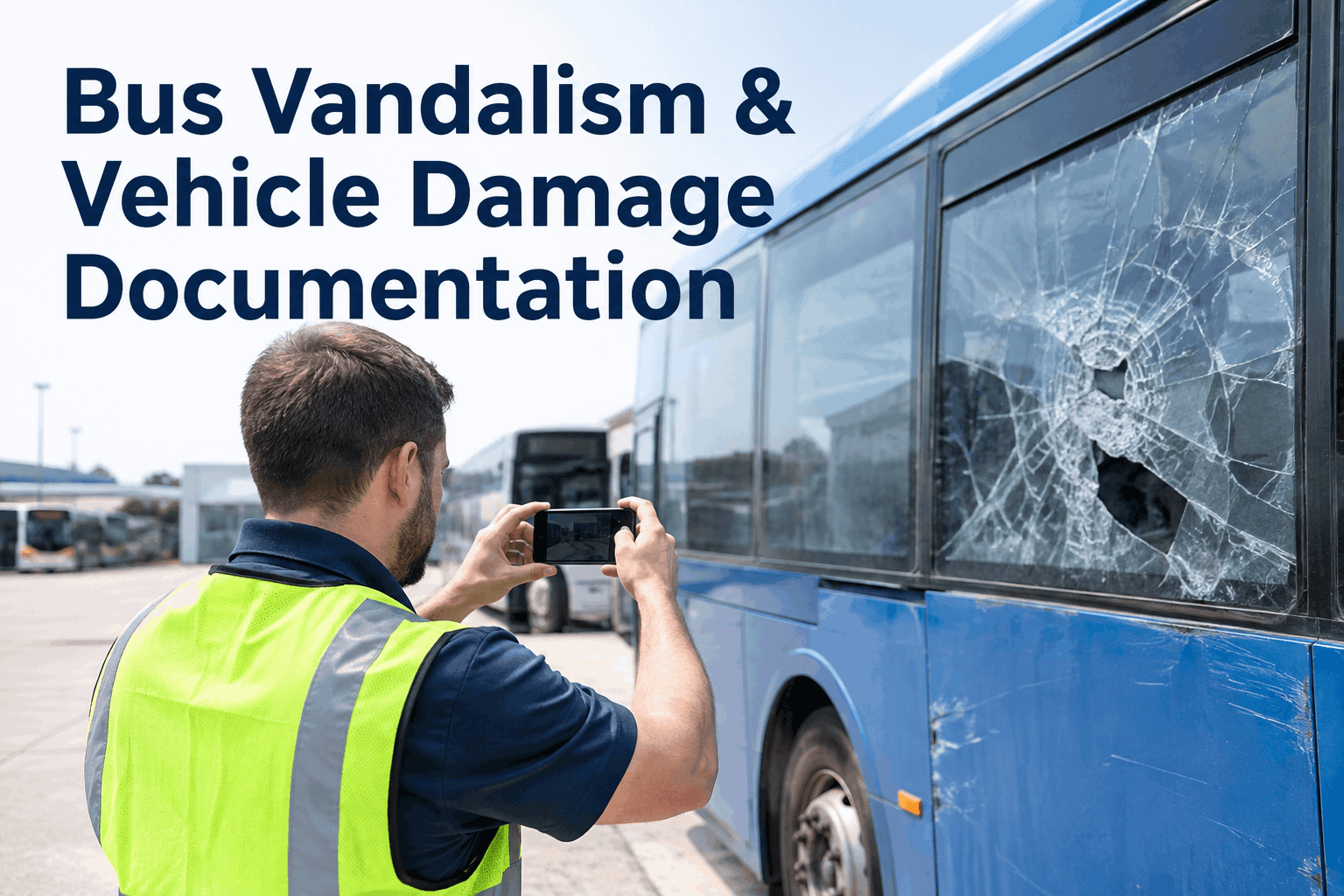
Bus 9 comes in Monday with three slashed seats and graffiti across the back bench. By the time anyone thinks to photograph it, a cleaner has already scrubbed the paint and two more buses have rolled through the bay. Then the insurer asks for proof of what happened and when — and you have a repair bill but no evidence. Bus vandalism and damage documentation is what turns an incident into a claim you can actually win, and you can see damage logged and photo-documented against each bus in a demo.
Bus Vandalism & Damage Claim Documentation: Build the Evidence Before You Need It
A claim is decided by what you captured at the scene, not by how real the damage was. Document it right and the claim closes in days; document it badly and it drags for weeks — or gets denied.
Why Damage Claims Get Denied or Dragged Out
The damage is obvious to you — the slashed vinyl, the etched glass, the missing fire extinguisher. The problem is proving it to an adjuster who wasn't there. Four gaps sink more claims than the damage ever does.
No timestamp
A photo with no verified date can't prove when the damage happened — and "when" is the first thing an adjuster asks.
Repaired before documented
Clean it or fix it first and the evidence is gone. Without the before shot, there is nothing to compare the repair to.
No baseline
With no record of the bus's prior condition, an insurer can argue the damage was already there. A baseline settles it.
Scattered records
Photos on one phone, the repair bill in email, the report on paper — assembling it weeks later is how claims stall.
Without the right photos taken at the right time, a claim can be denied regardless of the damage — speed and completeness, not the size of the dent, decide the outcome.
The Five Things a Defensible Damage Record Needs
Claims teams and adjusters look for the same handful of evidence every time. Each piece you add makes the record harder to dispute — and together they turn an incident into a claim that pays.
Captured at the scene and kept on the bus's record, these assemble themselves into a packet — so you are never starting a claim from a blank page. You can walk through building that record in a demo or sign up free and document your first incident.
From Damage to Documented: The Workflow
The goal is to make documenting an incident as routine as logging any other defect — so the evidence exists before anyone knows there will be a claim. Four steps, all on the bus's record.
Log the damage on inspection
The driver or shop records the vandalism or damage against that bus the moment it is found — before anything is cleaned or moved.
Attach photos and notes
Multiple angles and close-ups, tied to the bus, date and route — plus a police report number if one was filed. The timestamp is automatic.
Open a work order with cost
The repair becomes a tracked work order, capturing parts and labor — the exact repair-cost figure an adjuster needs to settle.
Export the claim packet
Photos, condition notes, repair cost and history pull from one record into a single packet — the format adjusters ask for.
Four steps replace a frantic hunt across phones and email weeks after the fact. You can book a demo and see the packet export.
Your Bus Vandalism & Damage Documentation Checklist
Run your incident process against this list. Each item is something BusCMMS captures or tracks on the bus's record — the rows still open are where a payable claim slips away.
- Photos from multiple angles, with close-upsWide shots for context and tight shots for detail — the standard documentation an adjuster expects.CORE
- Every photo timestampedA verified date and time proves when the damage occurred — the single most disputed fact in a claim.CORE
- Documented before any repair or cleanCapture the damage first so there is a clear before, then an after — the comparison that proves the loss.CORE
- Tied to bus, date, route and report numberIncluding the police report number where one was filed — so the record ties to every external document.LINK
- Repair work order with real costParts and labor captured as the repair happens — the settlement figure, backed by the actual work.COST
- One exportable packetPhotos, notes, cost and history export together in the format adjusters request — no last-minute assembly.CLAIM
- Recurring vandalism spots flaggedReporting shows which routes or yards get hit most — so you can push for cameras, lighting or secure parking.INSIGHT
Hit every row and a damaged bus is an open-and-shut claim, not a fight. You can book a demo and run this checklist against your process.
Why Speed and Proof Decide the Claim
Fleet claims live and die on evidence assembled before anyone knew there would be a claim — and the numbers show how fast that window closes.
As one government-fleet guide put it, claim speed is a documentation problem, not an adjuster problem — the evidence either exists at the scene or it does not.
A Fleet Risk Manager's Take
Key Takeaways on Bus Damage Documentation
Evidence decides claims
Not the size of the damage — the photos, timestamps and records you captured at the scene.
Document before you repair
A before shot and a timestamp are the two things you can never recreate after a cleanup.
Keep it on one record
Photos, cost and reports on the bus's record export as one packet instead of a scattered hunt.
Speed is the win
Complete documentation closes a claim in days and recovers far more of its value.
Bus vandalism and damage claim documentation is not extra paperwork — it is capturing a few things at the right moment so a damaged bus becomes a claim that pays instead of an argument you lose. Document it on the bus's record and the next incident is already handled.