The third coach you added felt easy. The tenth is where it bites: more inspections to chase, more work orders to log, more PM dates to track, more compliance records an auditor could ask for — and the same one or two people doing it all by hand. Charter bus fleet management software is how growing operators add vehicles without adding an admin hire for every few of them. You can see how your maintenance and inspection admin shrinks in a demo before the next contract lands.
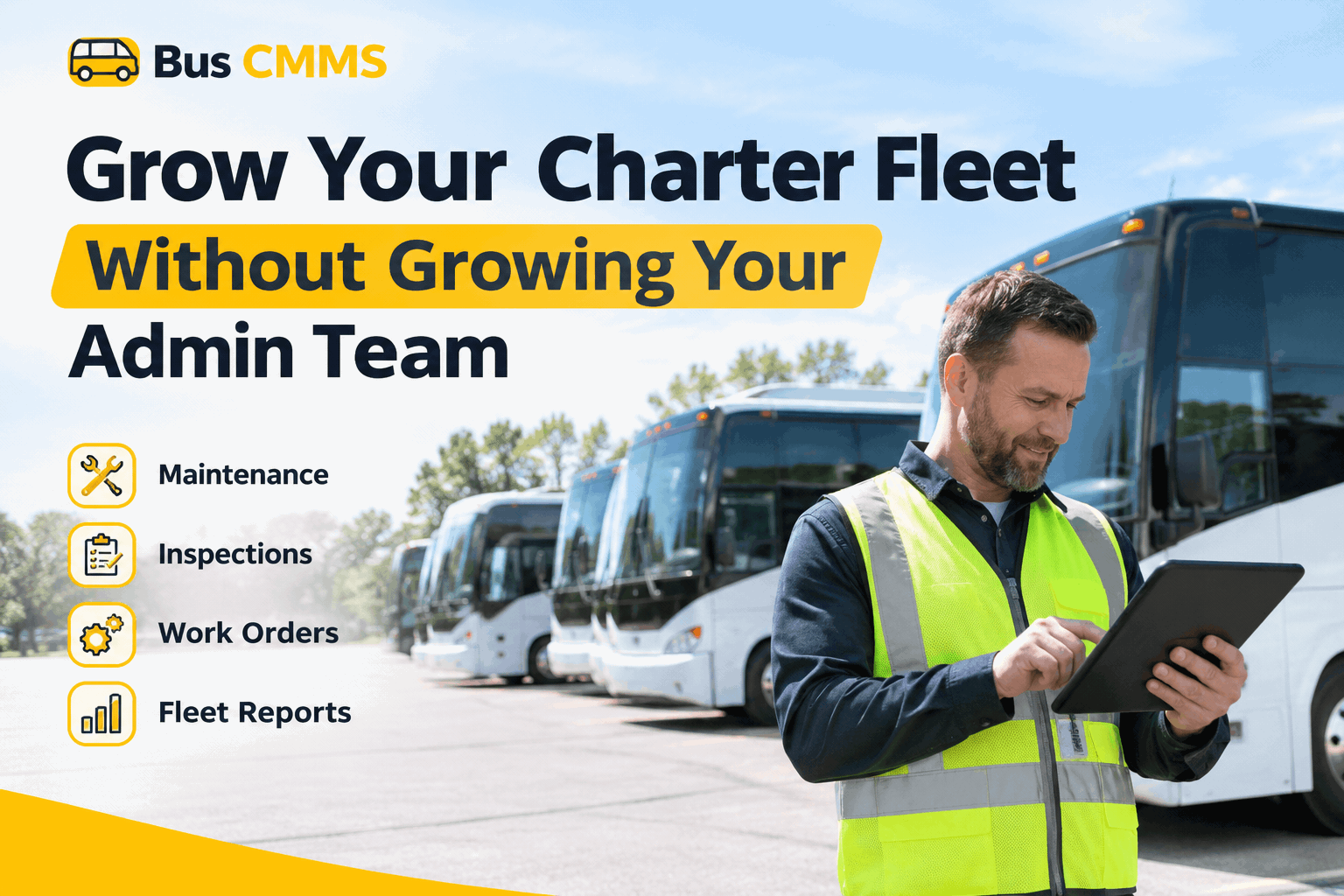
Grow Your Charter Fleet Without Growing the Admin Team
Add coaches and your manual admin climbs right along with them — unless the system carrying it scales instead of your staff. Here is how to keep the paperwork flat while the fleet grows.
The Charter Scaling Trap
Here is the problem every growing charter operator hits: when the admin is manual, it scales one-to-one with the fleet. Twice the coaches means roughly twice the inspection chasing, work-order logging and compliance filing. Industry analyses put manual compliance paperwork at 15 to 25 hours a week for a fleet, with administrative overhead running 5 to 10 percent of operating costs — and that clock only grows as you add vehicles.
The fix is not working faster — it is cutting the manual work so the fleet can grow while the admin stays flat. You can see the before-and-after on your own workload in a demo.
A single missed PM on a coach that strands forty passengers mid-trip does not just cost a repair — it costs the contract, a replacement vehicle, and the next booking. Admin that keeps up is what prevents it.
What One System Replaces
Most growing charter operations are not short on effort — they are short on one place for everything. The admin load is spread across tools that do not talk to each other, and every new coach multiplies the juggling. The effort is real — it is just aimed at keeping five disconnected systems in sync instead of running the business.
- Spreadsheets for mileage and PM dates
- Paper DVIRs in a binder or a glovebox
- A whiteboard for what is in the shop
- Text threads chasing driver defects
- Records pulled together the night before an audit
- PM scheduled and tracked per coach automatically
- Digital DVIRs filed from a phone, every trip
- Work orders auto-created from failed inspections
- Parts and repairs logged against the vehicle
- Audit-ready records exportable in minutes
When it all lives in one record per coach, adding the eleventh bus does not add an evening of juggling — it is just one more vehicle in the same system. You can see the scattered-to-one-system switch in a demo.
Operators who scale smoothly are rarely the ones working the most hours — they are the ones who stopped letting each new coach add a new pile of paperwork to someone's desk.
Your Scale-Ready Charter Checklist
If you are planning to grow the fleet, run your operation against this list first. Each box ticked is admin that will not multiply when the next coaches arrive.
- PM scheduled per coach, not tracked by memoryMileage and calendar triggers that fire on their own as the fleet grows.AUTOMATE
- Digital DVIRs filed from the driver's phoneEvery passenger trip documented instantly — no paper to collect or re-key.COMPLIANCE
- Work orders generated from failed inspectionsA defect becomes a tracked repair automatically, not a note someone might lose.WORKFLOW
- Parts and repair history tied to each vehicleCosts and work logged per coach, so growth does not blur what each bus costs you.RECORDS
- Audit-ready records you can pull on demandFMCSA records assembled in minutes for any coach or date, not days of digging.COMPLIANCE
- One dashboard across the whole fleetStatus of every coach at a glance, so more vehicles does not mean less visibility.VISIBILITY
The more of these you automate before you grow, the more coaches you can run on the same team. You can check your scale-readiness in a demo against this list.
How Charter Bus Fleet Management Software Scales With You
BusCMMS is built for bus and coach fleets, so the admin that normally multiplies with growth is automated from day one. It is part of what it does for coach and passenger operations, and the same system handles five coaches or fifty.
Digital DVIRs and compliance records
Drivers file inspections from a phone every trip, and FMCSA-ready records are a search away — no binders, no night-before scramble.
Automated PM and work orders
Motorcoach PM schedules trigger by mileage or date, and failed inspections create work orders on their own — the admin runs itself.
One dashboard, any fleet size
Every coach's status, costs and upcoming service in one view, so adding vehicles adds visibility instead of taking it away.
That is how a charter operation books more work without the back office becoming the bottleneck. Sign up free and bring your coaches into one system.
A Charter Owner's Take
Key Takeaways on Scaling a Charter Fleet
Growth should not mean a bigger back office. Four things to carry away.
Manual admin scales with the fleet
More coaches means more inspections, PM and records — by hand, that is more hours.
Automation flattens the curve
Digitized compliance work can cut admin time sharply, per industry findings.
One system beats five tools
Spreadsheets, paper and text threads multiply the juggling; one record per coach does not.
Set it up before you grow
Automate the admin first, and the next coaches ride on the same team.
Charter bus fleet management software earns its place the moment your growth starts outrunning your back office. The coaches are the easy part to add — keeping the admin flat as you add them is what lets the business scale, and that comes down to getting the maintenance, inspection and compliance work into one system before the next contract rather than after.