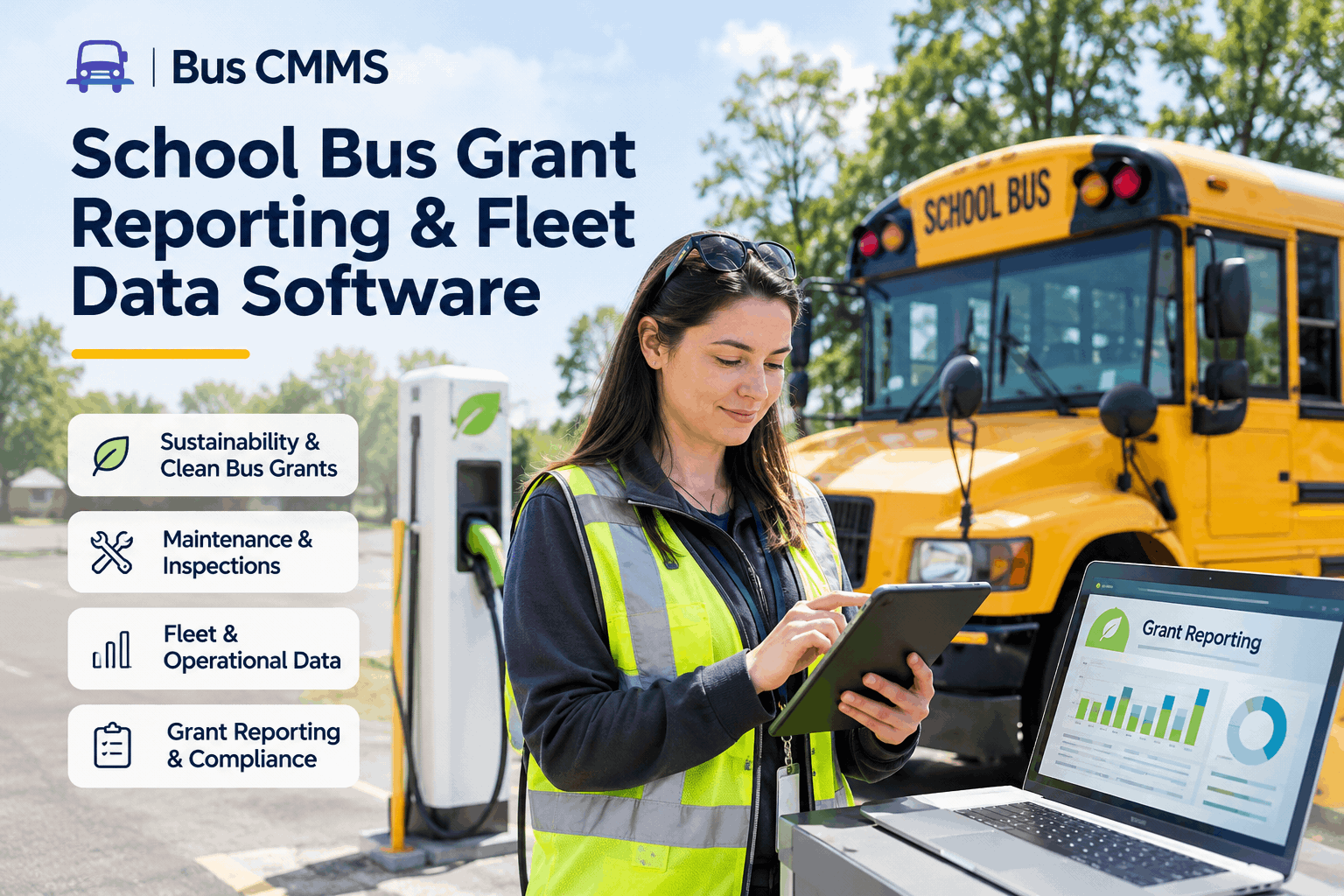
You won the grant. The buses are on order, the board got its photo op, and then the first reporting template lands in your inbox asking for per-bus odometer readings, annual miles, fuel used in gallons and proof the old diesels were actually scrapped. School bus grant reporting is where a lot of fleets discover their data lives in six places and none of them talk. You can see how your fuel, mileage and inspection data can live in one grant-ready system before the next deadline.
School Bus Grant Reporting: Keep Your Fleet Data Audit-Ready All Year
Clean-bus grants pay for the buses, but they bill you in paperwork — per-vehicle odometer, annual miles, fuel, maintenance and disposition records, submitted on a schedule. Here is how to stop assembling it from scratch every reporting period.
Why School Bus Grant Reporting Punishes Paper Fleets
The grant does not end when the buses arrive — that is when the data obligation starts. The EPA's Clean School Bus Program puts $5 billion behind replacing older diesels with cleaner buses, and the agency reports roughly 390,000 school buses carry about 24 million students a day, so the oversight is real and ongoing. If your records are spreadsheets, fuel-card exports and a drawer of paper DVIRs, every reporting period becomes a reconstruction project.
A missed or inconsistent figure is not just annoying — grant records can be audited, and sloppy reporting puts future funding at risk.
What the Grant Reporting Template Actually Asks For
The EPA's Clean School Bus Grants Reporting Template (Form 5900-692) wants specific, per-vehicle data — and almost all of it is information a bus fleet already generates every single day. The problem is never that the data does not exist; it is that nobody captured it in one place. Here is the map from what the template demands to where it already lives.
Swipe sideways to see all columns.
Seen this way, grant reporting is a data-organization problem, not a research project. Line up your template against your records and walk through your reporting template fields in a demo to see which ones you are already capturing.
Your Clean-Bus Grant Reporting Readiness Checklist
Run this against your fleet before the next deadline. Every box you cannot tick today is a scramble waiting to happen at reporting time — and the fix is almost always capturing it in one system from the start.
- Current odometer on every grant-funded and replaced busReadings kept up to date, not guessed at the deadline.PER VEHICLE
- Annual miles and annual fuel in gallons, per busThe two activity figures the template asks for by vehicle.ACTIVITY DATA
- Maintenance and repair history you can pull per busWork orders and PM logged, not reconstructed from memory.RECORDS
- Disposition evidence for every retired dieselScrappage proof that old buses were rendered inoperable.CRITICAL
- A calendar of reporting deadlines, not surprisesEach reporting period mapped so nothing lands late.TIMELINE
- One place to export it all from, in minutesA single source of truth, so numbers match across periods.EXPORT
If most of these are ticked, your reporting is a formality. If they are not, that is the gap to close — you can see your readiness status in a demo and know exactly where you stand.
Grant Data Is a Lifecycle, Not a One-Time Form
Clean-bus grant reporting is not a single submission — it runs across the life of the award, each stage asking for a different slice of the same fleet data. Map it once and every deadline becomes predictable.
Because the same odometer, fuel and maintenance data feeds every stage, capturing it continuously is the whole game — sign up free and start logging it from today so the records are built by the time the first template is due.
How BusCMMS Keeps Your Fleet Grant-Ready
BusCMMS is purpose-built for school bus, transit and charter fleets, so the data clean-bus grants ask for is captured as part of normal operations — not bolted on at deadline. It is the difference between what a bus CMMS actually is and a generic spreadsheet.
Per-bus fuel, miles and odometer
Fuel tracking in gallons, mileage and odometer logged per vehicle — the exact activity figures the template wants, ready to pull.
Maintenance & disposition on record
Every work order, PM and bus retirement time-stamped with notes, so service history and scrappage proof are attached, not hunted for.
Dashboards & audit-ready export
One source of truth means figures match across reporting periods, and you export a clean record instead of stitching sources together.
That turns reporting from a dreaded project into a status you can show leadership any day of the year. To set it up against your award, book a demo and bring your grant's reporting template.
A Transportation Director's Take
Key Takeaways on School Bus Grant Reporting
Clean-bus grants are won on the application but kept on the reporting. Four things to carry away.
The data obligation starts after the award
Winning is the beginning of reporting, not the end of the work.
It is per-vehicle, over the lifecycle
Odometer, miles, fuel and disposition, reported bus by bus, period after period.
You already generate the data
The problem is scatter, not absence — one system fixes it.
Capture continuously, export easily
Log it day to day and reporting is minutes, with numbers that match.
Treat school bus grant reporting as a data-organization habit, not a deadline-week emergency, and it stops threatening your funding and your weekends. The buses were the hard part to win; keeping the records clean is the easy part to get right — if you build it into one system from day one.