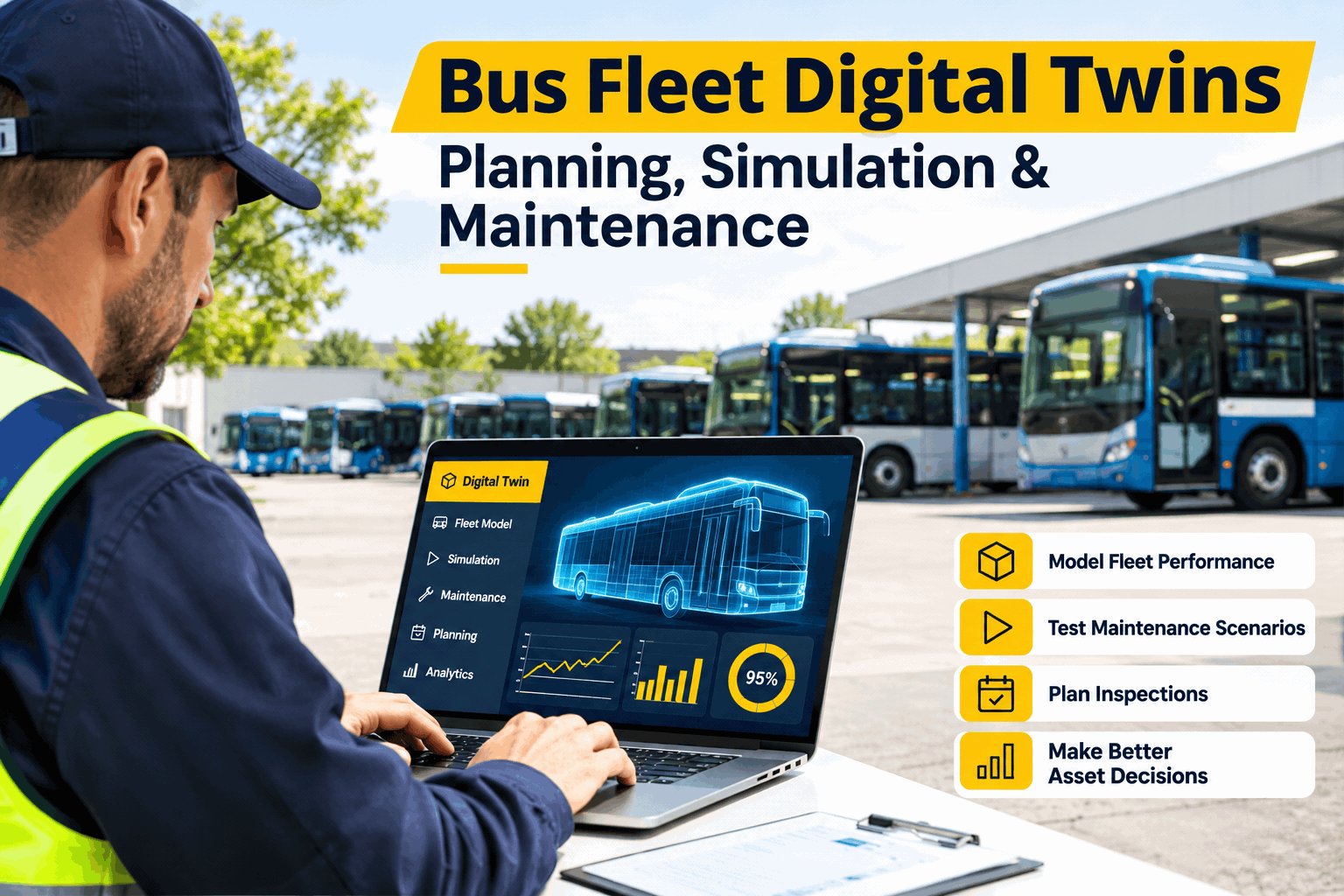
Picture a virtual copy of your fleet you could run scenarios against — push a bus's mileage forward, test a PM change, watch a failure coming — without touching a real vehicle. That's a digital twin, and transit is starting to use it. A digital twin for bus fleets promises simulation and prediction, but it runs on one thing your operation already produces: maintenance data. Here's what it is, what it needs, and how to build the foundation for it in a demo.
Bus Fleet Digital Twins: Planning, Simulation & Maintenance
A digital twin mirrors your real fleet in data, then lets you simulate, predict, and optimize. Here's the loop it runs on — and the maintenance records that make it possible.
What a Digital Twin Does for a Bus Fleet
Strip away the buzzword and a fleet digital twin is about four practical questions you can finally answer with data instead of a gut call.
Predict failures early
Model real and historical data to flag a component trending toward failure, so it's a planned repair in the bay instead of a road call on a route.
Test scenarios safely
Try a new PM interval, a route change, or a fuel-type mix against the model first — and see the effect before you commit real buses to it.
Plan the lifecycle
Forecast when each bus tips from worth-keeping to worth-replacing, turning capital planning into a data-backed schedule instead of a guess.
Optimize the whole fleet
See performance, cost, and availability across every bus at once, and shift maintenance effort to where it moves the fleet, not just one vehicle.
In rail, where the technology is further along, these aren't theoretical: one European corridor's digital twin reported cutting maintenance costs by about 22% and raising asset availability by 18%. The bus version is earlier — and it starts with your data.
A Twin Is Only as Good as Its Data
Here's the part the vendor demos skip: a digital twin can't model what you haven't recorded. The simulation, the prediction, the lifecycle forecast — all of it is built on the maintenance history, usage data, and asset records your fleet produces every day. No data foundation, no twin.
Data in binders & spreadsheets
Paper DVIRs, PM tracked in a spreadsheet, costs scattered across systems. There's nothing structured for a model to learn from — the twin has no past to predict from.
Structured maintenance data
Every inspection, work order, part, and mile logged against one asset ID, with live telematics flowing in. That's the clean history a twin — or simpler predictive tools — can actually use.
The good news: building that foundation delivers value long before you reach a full twin — usage-based PM and failure trends pay off on day one. You can see the data foundation in a demo.
The Path From Spreadsheets to a Digital Twin
You don't jump straight to a twin — you climb to it. Each rung delivers value, and each one is built on the data captured by the one below.
Spreadsheets & paper
Data exists but isn't structured or connected. No history a model could use.
Structured CMMS data
Asset records, work orders, PM, and costs captured against one asset ID. The foundation.
Predictive & usage-based PM
Live telematics plus history drive condition-based maintenance and failure trends.
Full digital twin
A live virtual model that simulates scenarios and optimizes the whole fleet.
Most bus fleets live on rung one and dream of rung four — but rung two is where the real leverage starts, and it's reachable now. You can sign up free and move up to structured data this month.
Data-Readiness Checklist for a Fleet Twin
Whether you're aiming for a full twin or just better prediction, these are what make it possible. The first three are the foundation; the rest sharpen the model.
- Complete asset records per busMake, model, year, components — the model needs to know each vehicle.FOUNDATION
- Full maintenance & work-order historyThe past the model learns from — captured, not in a filing cabinet.FOUNDATION
- Live telematics feeding usage & healthMileage, engine hours, fault codes — the real-time half of the twin.FOUNDATION
- Structured PM & failure dataPatterns a model can read — not free-text notes scattered everywhere.HIGH VALUE
- Lifecycle cost tracked per vehicleCost per mile over time — the input for replacement forecasting.HIGH VALUE
- One master asset IDSo every data source lines up against the same bus — the joinable key.HIGH VALUE
Tick these and you're twin-ready — and already running on data most fleets never capture. You can book a demo and see your readiness mapped.
How BusCMMS Lays the Groundwork
Let's be straight: BusCMMS isn't a full physics-simulation digital twin. It's the structured data layer a twin is built on — and it delivers the predictive and lifecycle value most fleets actually need, today, without the hype.
Structured asset records
A clean digital record of every bus — make, components, firmware, and history — the asset backbone any model or forecast is built on.
Complete maintenance history
Every DVIR, work order, and part captured and queryable — the past a predictive model or a digital twin needs to learn from.
Live telematics integration
Pre-built connectors feed real-time mileage, engine hours, and fault codes in — the live data stream that keeps a model current.
Dashboards: MTBF, MTTR, cost/mile
Real-time reliability and cost metrics — the analytics that turn raw records into the fleet picture a twin would visualize.
Usage-based predictive PM
Mileage- and condition-triggered maintenance catches issues before they strand a bus — the practical predictive value, available now.
Lifecycle & replacement data
Cost-per-mile trends over a bus's life feed the keep-or-replace call — data-backed capital planning without a simulation lab.
New to the category? Our complete guide to what a bus CMMS does covers the basics, and transit agencies can see how BusCMMS supports passenger transit fleet operations. To start building toward a twin, book a demo and map your data.
A Few Numbers Worth Knowing
Context for where digital twins stand, and where a bus fleet starts.
The twin is the destination; clean, structured maintenance data is the road — and it pays for itself long before you arrive.
A Fleet Director's Take
Key Takeaways on Bus Fleet Digital Twins
A digital twin for bus fleets is powerful — and entirely dependent on the data beneath it. Four things to carry forward.
A twin simulates, predicts, optimizes
A live data replica you can run scenarios against before touching a bus.
It runs on your data
No structured maintenance history, no twin — the data is the foundation.
Climb the ladder
Spreadsheets to CMMS data to predictive to twin — each rung pays off.
The foundation pays now
Structured data delivers predictive PM well before a full twin exists.
Treat a digital twin for bus fleets as a destination you build toward, not a product you buy — capture clean, structured maintenance data against one asset ID, add live telematics, and the predictive power arrives in stages you can use at every step. Start with the data, and the twin becomes reachable; skip it, and it stays a slide deck.