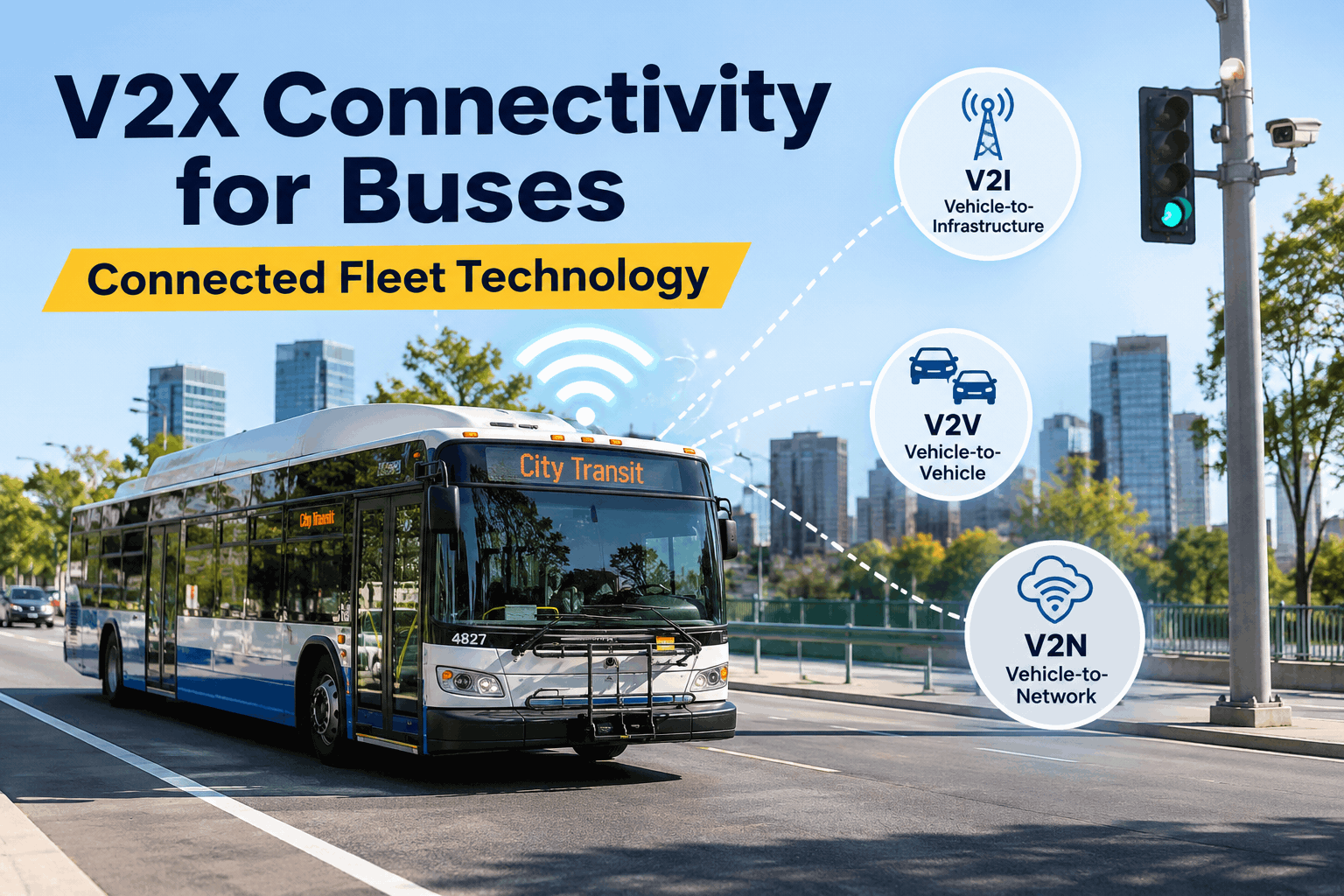
A city bus rolling up to a red light can now tell the signal it's coming — and the light can hold green to keep it on schedule. That's V2X: the bus talking to traffic signals, other vehicles, and pedestrians in real time. V2X connectivity for buses is landing in U.S. transit now, and it brings real on-time gains — plus a new piece of hardware on every bus your shop has to keep alive. Here's what it does, and how to keep your connected fleet running in a demo.
V2X Connectivity for Buses: Connected Fleet Technology
Vehicle-to-everything lets a bus exchange live data with the road around it. Here's what it talks to, the on-time payoff it's already delivering, and the hardware your shop keeps alive.
What V2X Does for a Transit Bus
For a fleet, V2X isn't abstract — it shows up as three concrete capabilities riders and operators feel.
Transit signal priority
The bus asks the signal for green as it approaches, cutting red-light waits and keeping routes on schedule. This is the headline transit use case.
Pedestrian safety
A turning bus triggers a "caution, bus turning" alert at the crosswalk — visual and audible — protecting walkers, cyclists, and low-vision riders.
Priority & preemption
The same backbone gives emergency vehicles preemption and buses priority at intersections, smoothing movement across a whole corridor.
All three ride on one idea: the bus and the roadside exchanging data through an onboard unit talking to roadside units at the intersection. You can see how the on-bus hardware fits your maintenance plan in a demo.
The Payoff Is Already Measurable
This isn't a lab promise. U.S. agencies running V2X signal priority are posting real, auditable results.
Better on-time performance, fewer late arrivals, safer intersections — the kind of numbers a transit board understands. And every one of them depends on the equipment on the bus actually working.
But It Only Works If the Hardware Does
Here's the maintenance truth behind the shiny tech: V2X adds a connected device to every bus, and unlike a flat tire, a failed one gives you no obvious signal. The bus still runs its route — it just stops getting priority, and nobody notices until on-time performance slips.
A silent failure
The onboard unit drops offline. The bus looks fine, runs fine — but it's invisible to the signals. Your TSP gains leak away, unexplained, for weeks.
A caught failure
The unit is a tracked asset with a scheduled functional check. It fails the check, opens a work order, gets fixed — and the priority keeps delivering.
That's the shop's job in a connected fleet: treat the V2X unit like any other critical component — inventoried, inspected, and repaired — so the investment keeps paying off. You can sign up free and add your V2X hardware to the asset list today.
Keeping a V2X Fleet Connected: The Checklist
Run your connected buses against this. The first three keep the system actually working; the rest keep it reliable and documented.
- OBU & antennas on the asset listYou can't maintain what the system doesn't know each bus carries.CRITICAL
- Scheduled functional check it's transmittingA silent-failure device needs a proactive "is it alive?" test.CRITICAL
- V2X hardware added to the bus inspectionAntenna, mount, and connections on the regular DVIR-style check.CRITICAL
- GPS & firmware health monitoredPriority depends on an accurate position and current software.STRONG PLUS
- Technicians trained on the install & diagnosticsKnow who can test and swap a unit — and keep them current.STRONG PLUS
- Install & repair records keptA clean history for the deployment, grants, and your own audits.STRONG PLUS
With each item scheduled and logged, your V2X investment keeps earning instead of quietly degrading. You can book a demo and see the connected-hardware checklist built in.
How BusCMMS Keeps Connected Buses Running
BusCMMS doesn't run the V2X network or manage signal priority — that's the traffic system's job. It does the fleet-side part: keeping the on-bus hardware tracked, checked, and repaired so the connection stays live.
Track the OBU as a bus asset
Every onboard unit and antenna recorded per bus — model, install date, firmware — so the connected hardware is part of the vehicle's history, not an afterthought.
Schedule functional checks as PM
Build a recurring "is the unit transmitting?" check into preventive maintenance, so a silent failure gets caught on a schedule, not by a performance report weeks later.
Add V2X to inspection forms
Put the antenna, mount, and connection on your digital inspection so the connected hardware gets eyes on it every service, same as any safety item.
Failures become work orders
A failed check or flagged unit opens a work order with the full repair trail — so a dead OBU gets fixed and documented, not shrugged off.
Technician training records
Track who's trained to install and diagnose V2X units, so connected-hardware work routes to qualified techs and nothing lapses.
Records for the deployment
Install, check, and repair history in one place — the documentation a grant-funded connected-vehicle project and your own board will ask for.
New to the category? Our complete guide to what a bus CMMS does covers the basics, and transit agencies can see how BusCMMS supports passenger transit fleet operations. Rolling out V2X? book a demo and bring your deployment plan.
A Fleet Manager's Take
Key Takeaways on V2X Connectivity for Buses
V2X connectivity for buses delivers real on-time and safety gains — and quietly depends on hardware your shop keeps alive. Four things to carry forward.
V2X is the bus talking to the road
Signals, vehicles, pedestrians, network — mostly C-V2X now, not DSRC.
The payoff is measured and real
Less red-light wait, faster routes, fewer late arrivals, safer crossings.
Failures are silent
A dead unit still runs the route — it just stops delivering the benefit.
Maintenance protects the investment
Track, check, and repair the OBU, and the gains keep coming.
Treat V2X connectivity for buses as both an operations win and a maintenance responsibility — inventory the hardware, schedule its checks, and fix it fast when it drops — and your connected fleet keeps earning the on-time and safety gains it was funded to deliver. The road is getting smarter; your shop is what keeps your buses part of the conversation.