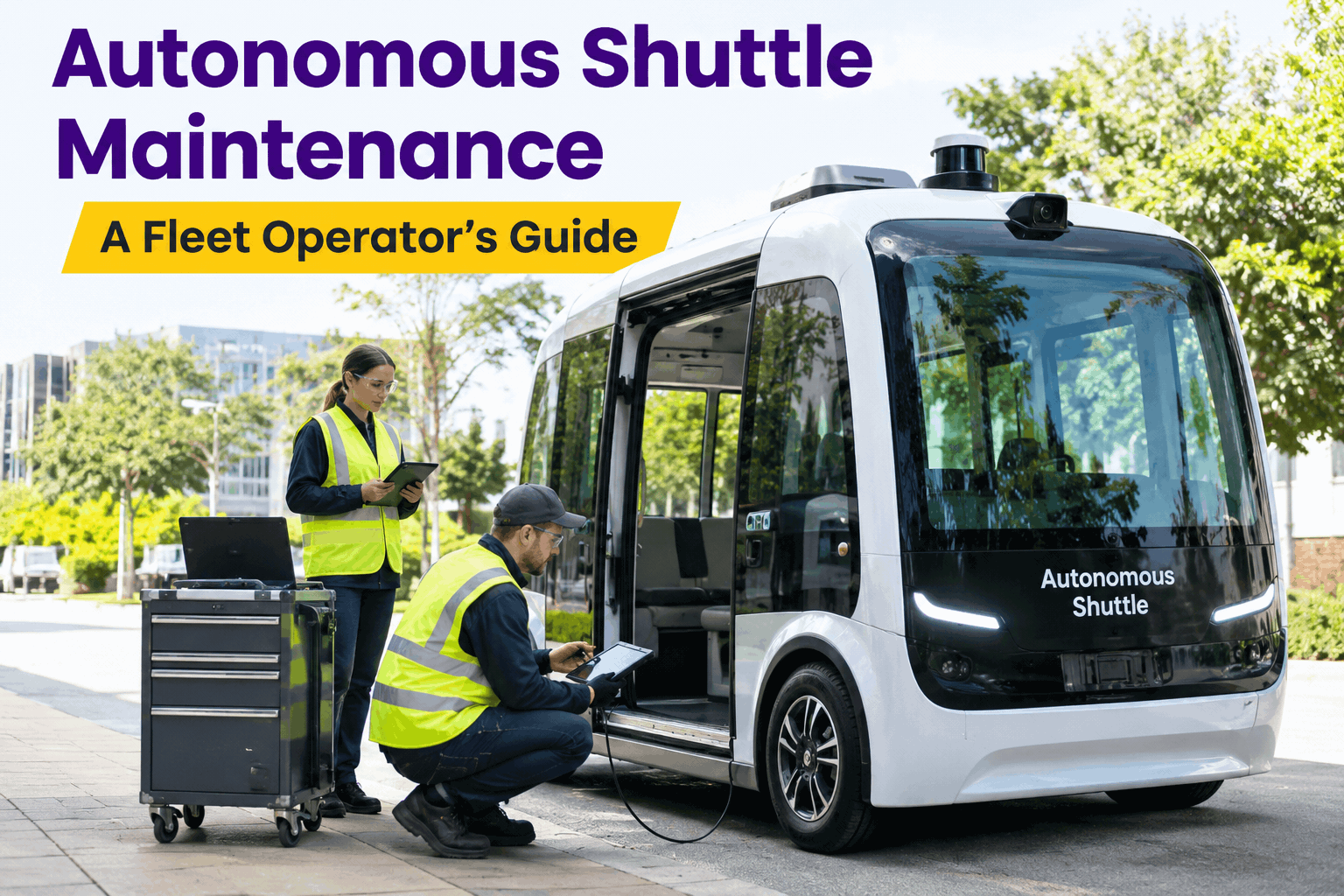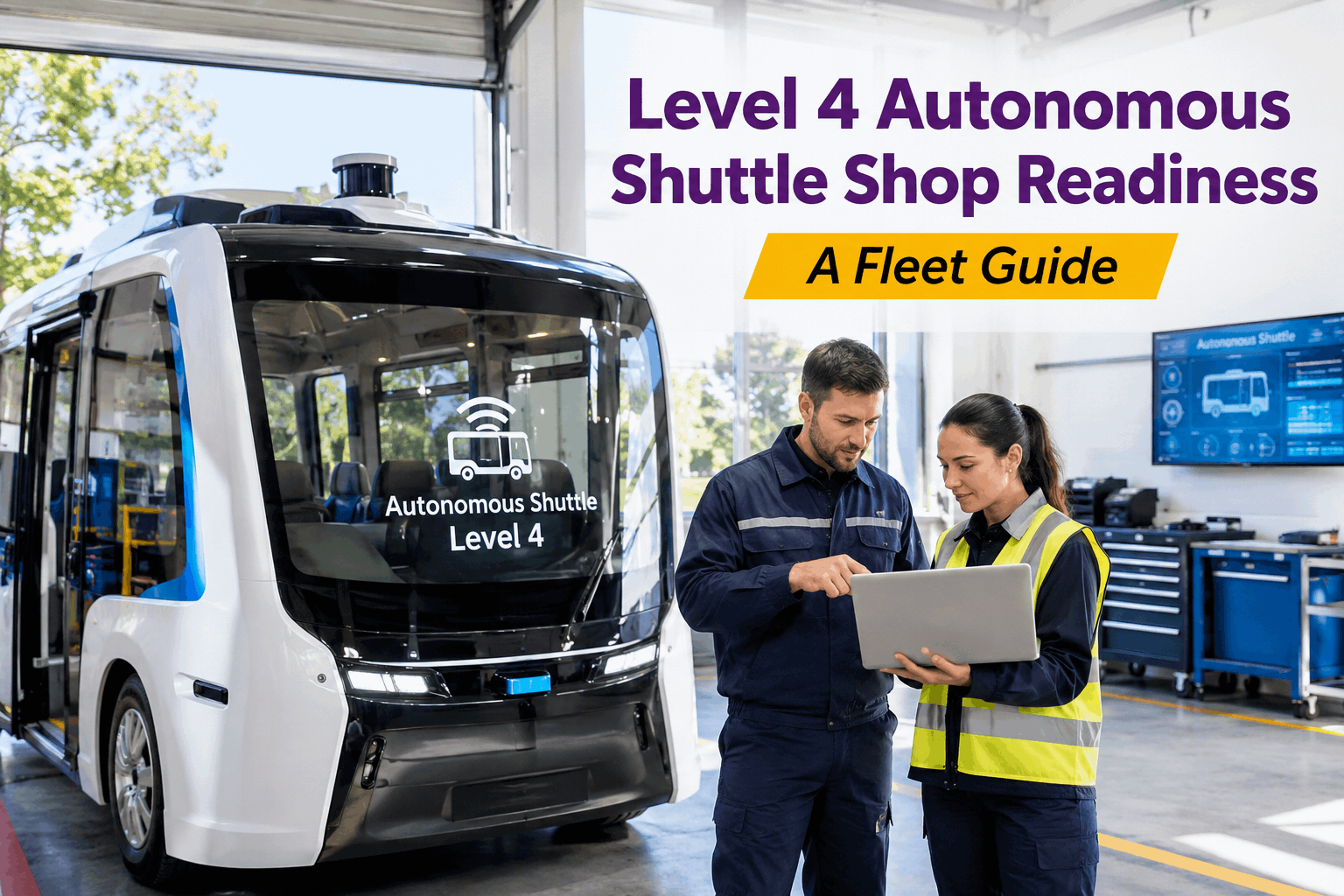
The shuttle arrives with no steering wheel and no driver — and the person who used to catch a problem on the morning walkaround isn't on board anymore. Preparing your shop for Level 4 autonomous shuttles means getting ready to maintain a perception stack, not just a drivetrain, before the first one runs a route. Here's what actually changes, and how to track your shop's readiness in a demo.
Level 4 Autonomous Shuttle Shop Readiness: A Fleet Guide
A driverless shuttle brings a whole new maintenance surface into your bay. Here's what it adds — and the readiness to put in place before it shows up.
Remove the Driver, Lose the Early Warning
This is the shift that reshapes everything else. On a crewed bus, your first condition-monitoring sensor was a person — the driver who felt the pull, heard the noise, and flagged it on the DVIR. An L4 shuttle has no one in that seat.
The driver was sensor one
A daily pre-trip caught the soft brake, the pull, the warning light. Problems announced themselves to a human before they became road calls.
The shop is the early warning now
No one feels the drift. Catching it moves to scheduled sensor checks, calibration, and the data — a maintenance program, not a morning walkaround.
That's why autonomous shuttle maintenance leans on recurring, precision tasks the old pre-trip never covered: alignment and calibration of sensors that drift with every vibration, mount and harness inspection, and redundancy tests that only protect you if they're actually maintained. You can see those recurring checks built into a PM plan in a demo.
What's Actually New to Maintain
Four domains land on your shop that a diesel or even a standard EV bus never brought. Each one needs a plan before the shuttle runs a route.
Perception sensors
LiDAR, radar, and cameras need cleaning and calibration on a schedule. A misaligned sensor sees the world in the wrong place — precision work, not a wipe-down.
Compute & AV software
Domain controllers and the AV stack update over the air. Versions and system-integrity checks become maintenance records you have to keep.
Redundancy & fail-safe
AV designs fail to a safe state only if the backup is healthy. Testing redundant braking, steering, and power is a recurring, logged task.
EV high-voltage base
Most L4 shuttles are electric, so you also carry EV high-voltage work — qualified techs, insulated tools, and HV-safe procedures.
None of this replaces your mechanical PM — it stacks on top of it. The shop that's ready has a plan for each domain and the trained hands to do it. You can see each domain scheduled and assignable in a demo.
Your L4 Shuttle Shop-Readiness Checklist
Run your shop against this before the first shuttle is commissioned. The first three make the work safe and legal; the rest keep the fleet reliable and the safety case provable.
- Technicians trained for the perception stackQualified hands for sensors, compute, and HV — tracked, in date.CRITICAL
- Sensor calibration & cleaning on a scheduleA recurring PM, not an ad-hoc wipe — drift is constant.CRITICAL
- Redundancy & fail-safe tests loggedConfirm the backup works — and keep the record that it does.CRITICAL
- EV high-voltage safety in placeInsulated tools, HV-rated PPE, and a safe bay for the electric base.STRONG PLUS
- A scheduled check to replace the driver pre-tripThe daily walkaround becomes a shop inspection — nothing skipped.STRONG PLUS
- Records audit-ready for the safety caseCalibration, redundancy, and training history, pullable on demand.STRONG PLUS
Any item still open closest to go-live is the one that parks a shuttle or weakens your safety case. You can book a demo and track every item to done against your deployment date.
How BusCMMS Gets the Shop AV-Ready
BusCMMS doesn't calibrate your sensors or run the AV stack — your OEM or AV provider does that. It manages the people-and-process side of readiness, the part that's easy to lose track of and hard to prove without a system.
Technician training & certification
Track who's qualified for sensors, compute, and high-voltage work, with expiry dates — so you always know who can touch an autonomous shuttle.
AV-specific PM scheduling
Build recurring sensor calibration, cleaning, and redundancy tests into the plan alongside your mechanical and EV preventive maintenance.
An inspection to replace the pre-trip
Custom digital inspection forms turn the lost driver walkaround into a scheduled shop check — mounts, sensors, redundancy, logged every time.
Qualified-only work routing
Route perception and HV jobs only to in-date qualified techs, keeping untrained hands off the systems that carry riders.
EV & fuel-type-aware PM
The electric base of most shuttles gets its own PM logic, so battery and HV work runs on the right schedule, not a diesel one.
Audit-ready readiness records
Training, calibration, and redundancy history in one place — the documentation an AV safety case and a leadership review both ask for.
New to the category? Our complete guide to what a bus CMMS does covers the basics, and transit agencies can see how BusCMMS supports passenger transit fleet operations. When you're planning a deployment, sign up free and build your readiness plan.
Where L4 Shuttles Stand Today
A few numbers to keep the planning grounded — this is real, but still early.
Most deployments still run inside a tight ODD, often with a safety operator aboard as the technology matures — which makes now the right time to build the shop-side readiness, before true driverless scales up.
A Shop Foreman's Take
Key Takeaways on L4 Shuttle Readiness
Level 4 autonomous shuttles don't just add a vehicle — they add a maintenance surface and remove your first sensor. Four things to carry into planning.
No driver, no early warning
The pre-trip that caught problems moves into your maintenance program.
Sensors are precision PM
Calibration drifts with every mile — schedule it, don't wait for it.
Redundancy only works if maintained
Fail-safes protect riders only when the backup is tested and logged.
Train the hands before the vehicle lands
Qualified techs for the perception stack are the longest lead item.
Treat shop readiness for Level 4 autonomous shuttles as a project with a deadline — trained techs, scheduled sensor and redundancy work, an inspection that replaces the lost pre-trip, and records that prove it — and your first driverless vehicle runs safely from day one instead of exposing a gap. The shuttle is the easy part; a ready shop is what makes it one.