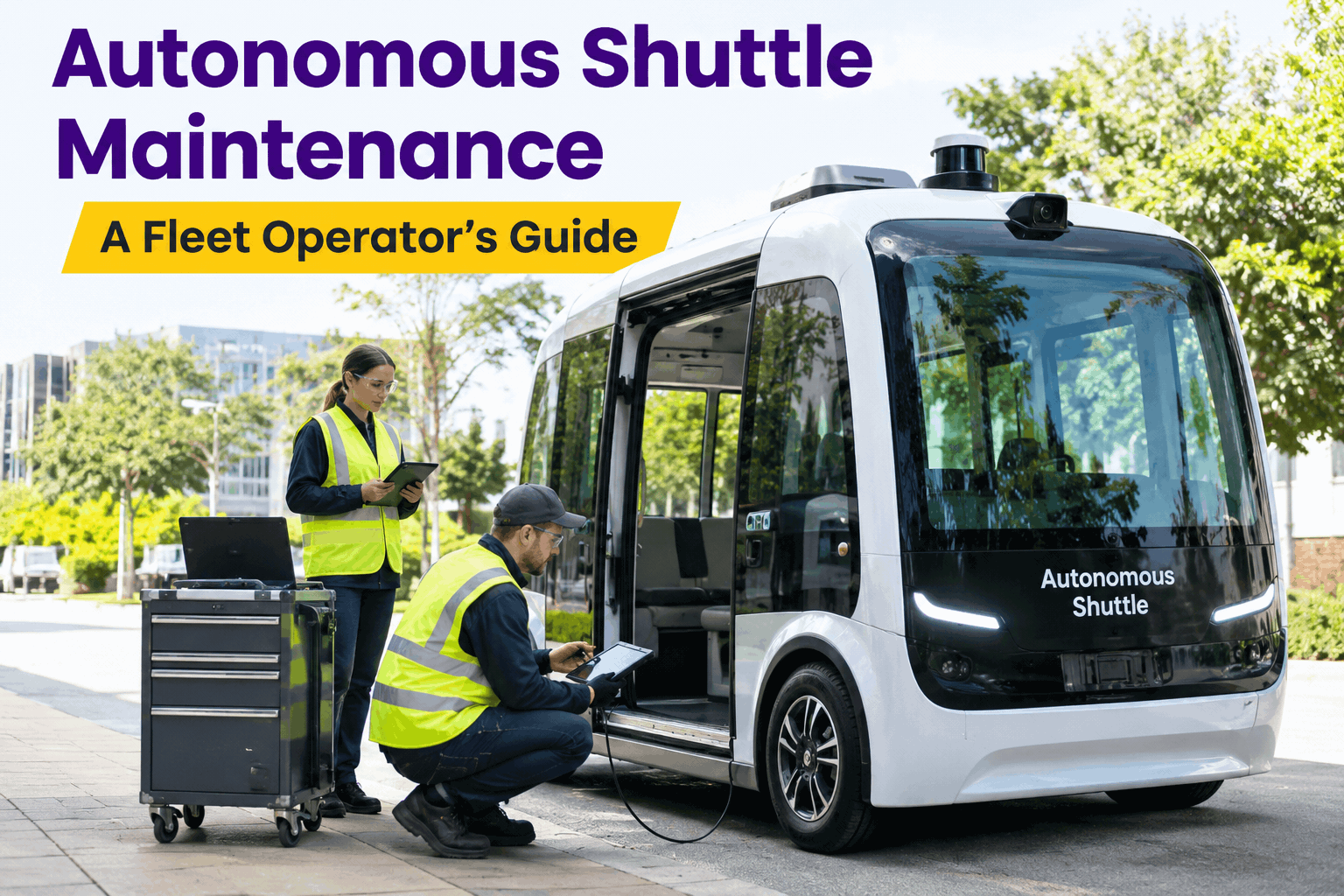
An autonomous shuttle pilot lives or dies on a number your board will ask for: uptime. And uptime is a maintenance problem — signal drops, battery limits, and sensor faults are what pull a driverless shuttle off its route. Autonomous shuttle maintenance during a pilot is less about turning wrenches and more about tracking what fails, fixing it fast, and proving the program works. Here's how to run it, and how to see it managed in a demo.
Autonomous Shuttle Maintenance: A Fleet Operator's Guide
A pilot is graded on metrics you have to capture — uptime, disengagements, battery health. Here's the maintenance side of running one, and the records that decide whether it scales.
A Pilot Is Judged on Numbers You Have to Track
When the pilot ends, leadership asks one question: did it work, and should we scale? The answer is a set of metrics — and every one of them comes out of your maintenance operation.
Service uptime
Hours actually operated divided by hours scheduled. It's the headline number — and it drops every time a shuttle sits for a fault or a charge.
Disengagements
Every time the shuttle drops out of autonomy — from signal loss, a sensor issue, or the environment — is a data point that shapes the scale decision.
Battery & charging
Most shuttles are electric with midday charging windows. Battery management directly limits service hours — and it's a leading cause of interruptions.
Trips & O&M cost
Trips completed against planned, and the operations-and-maintenance cost behind them, turn the pilot into a real per-mile case for or against scaling.
If these live in a spreadsheet nobody updates, the pilot ends with anecdotes instead of evidence. You can see these metrics tracked as you operate in a demo.
Where Driverless Shuttles Actually Go Down
U.S. pilot evaluations keep surfacing the same culprits. Knowing them tells you what to inspect, schedule, and chase.
Signal loss
GPS or connectivity drops knock the shuttle out of autonomy. Antenna and positioning health become real maintenance items.
Battery limits
Charge depletion and midday charging cut into service hours. Battery and charging management is a daily uptime lever.
Sensor faults
Calibration drift or a dirty LiDAR degrades perception. Scheduled cleaning and calibration keep the shuttle seeing straight.
Environment
Weather, construction, and complex traffic trigger stops. Not a repair — but logged, it explains the numbers to leadership.
Only some of these are wrench work — but all of them belong in your maintenance record, because together they are the story of whether the pilot is ready to grow.
Who Fixes What: Operator, OEM, and Your Shop
A pilot is a three-way relationship, and the biggest early mistake is fuzzy ownership. Here's the usual split — and where your maintenance system ties it together.
| Work | Usually owned by | Your record of it |
|---|---|---|
| AV stack & sensor calibration | AV operator / OEM | Log the event, version, downtime |
| Software & OTA updates | AV operator / OEM | Record when and which version |
| Battery, brakes, chassis, HVAC | Your shop (electric-bus work) | Work orders & PM schedule |
| Daily readiness & cleanliness | Your staff / operator | A scheduled inspection form |
| Uptime, cost, incident reporting | You (the agency) | The system of record for all of it |
Whoever turns the wrench, you own the record — and a clean, shared history is what keeps a pilot from dissolving into finger-pointing. You can sign up free and set up that shared record before the first incident.
Running Maintenance Through Your Pilot: The Checklist
Set these up on day one of the pilot. The first three generate your evidence; the rest keep the shuttles reliable and the costs honest.
- Uptime tracked: hours run vs. scheduledThe headline metric — capture it automatically, not by hand.CRITICAL
- Every disengagement & fault logged with causeSignal, sensor, battery, environment — categorized, not lumped.CRITICAL
- Sensor & battery faults become work ordersA fault is a tracked repair with a trail, not a verbal hand-off.CRITICAL
- Charging & battery schedule managedMidday charging planned so it doesn't quietly eat service hours.STRONG PLUS
- O&M cost captured per shuttleCost per mile or hour — the number the scale decision rests on.STRONG PLUS
- Records built to justify scalingUptime, cost, and reliability history, exportable for the board.STRONG PLUS
With all six running, the end-of-pilot report writes itself from real data. You can book a demo and see the pilot dashboard built in.
How BusCMMS Runs an Autonomous Pilot
BusCMMS doesn't drive the shuttle or service the AV stack — the operator and OEM do that. It's the maintenance system of record that turns a pilot's messy reality into the clean numbers a scale decision needs.
Work order management
Every fault, disengagement, or repair becomes a trackable work order with cause, downtime, and resolution — the backbone of the pilot record.
Uptime & reliability tracking
Availability and miles (or hours) between failures, calculated from your records — the headline numbers your pilot is judged on, always current.
Custom AV inspection forms
Digital daily-readiness and sensor-check forms sized to a driverless shuttle, so the walkaround the vehicle can't do itself still gets done and logged.
O&M cost per vehicle
Parts, labor, and downtime rolled into a cost per mile or hour — the figure that turns a pilot from a story into a business case.
Qualified-tech routing
Route sensor and high-voltage work only to trained techs, and keep the AV-operator and shop responsibilities clear in one shared system.
Scale-decision records
One exportable history of uptime, cost, and reliability — exactly what a board, a grant report, or a go/no-go review asks to see.
New to the category? Our complete guide to what a bus CMMS does covers the basics, and transit agencies can see how BusCMMS supports passenger transit fleet operations. Launching a pilot? book a demo and bring your evaluation framework.
What U.S. Pilots Show
Lessons from real deployments — useful when you set up your own.
The agencies that get a second phase funded are the ones that can prove what happened — which makes the maintenance record the most important deliverable a pilot produces.
A Pilot Operations Manager's Take
Key Takeaways on Autonomous Shuttle Maintenance
In a pilot, autonomous shuttle maintenance is really about data — what fails, how fast it's fixed, and whether you can prove it. Four things to carry in.
Uptime is a maintenance output
The headline metric is downstream of how you track and fix failures.
Know the usual culprits
Signal loss, battery, and sensor faults — inspect and log them by cause.
Own the record, whoever fixes it
Operator, OEM, or your shop — one shared history prevents finger-pointing.
The record is the deliverable
Clean uptime and cost data is what gets phase two funded.
Treat autonomous shuttle maintenance as the evidence engine of your pilot — track uptime, log every fault by cause, route repairs through work orders, and capture the cost — and you finish with a business case, not a shrug. The vehicle proves the technology; your maintenance record proves the program.