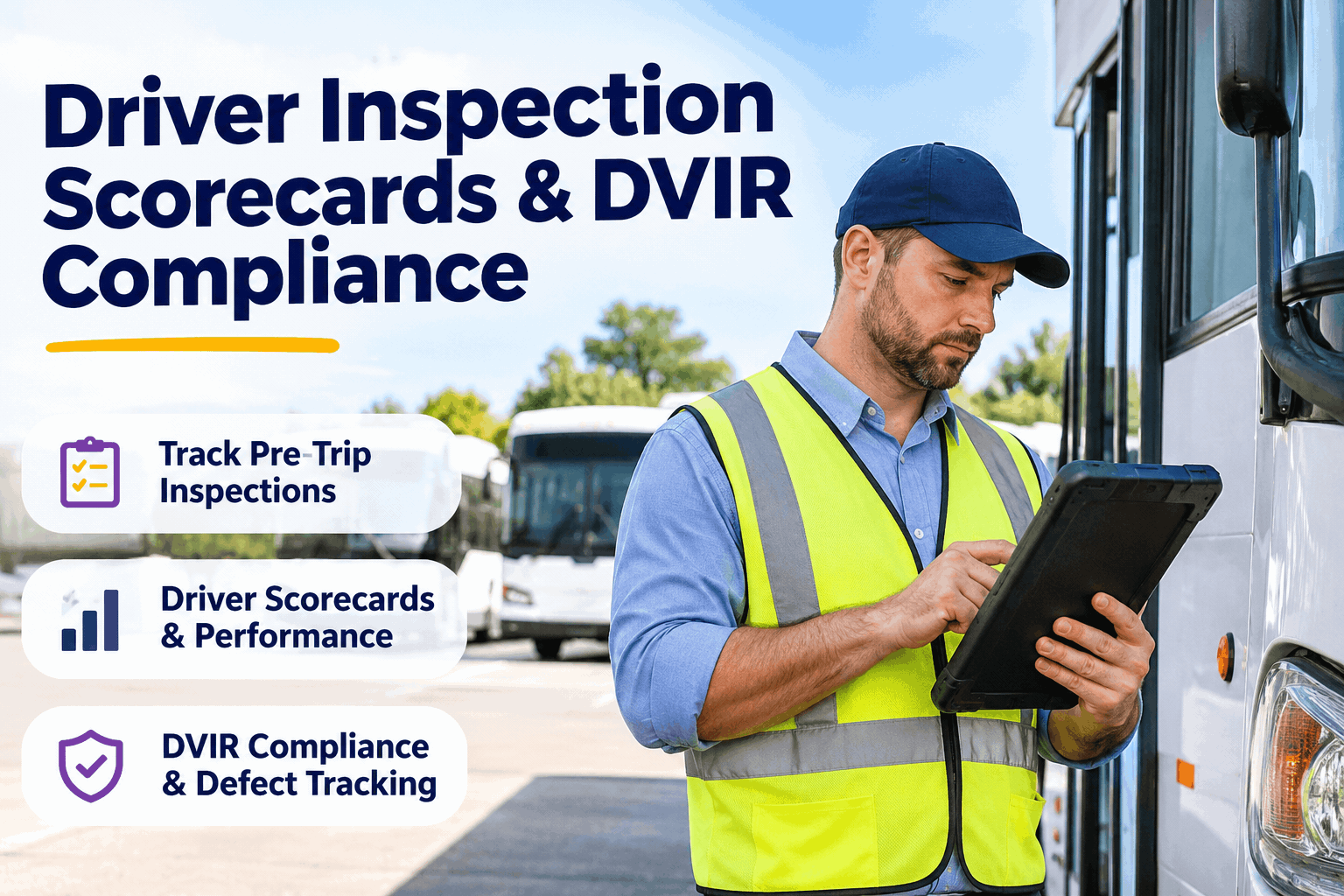
Your DVIR dashboard is all green — every bus checked off, every driver signed in before the morning run. Then Bus 114 fails a state inspection for a crossing gate that was "inspected" at 6:02 a.m. in forty seconds flat. A driver pre-trip inspection compliance scorecard is how you catch that gap before the state does — and you can see your drivers scored on live DVIR data in a demo.
Driver Pre-Trip Inspection Compliance Scorecards: Turn DVIR Data Into a Ranked Scorecard
A completion rate tells you a form was opened. A scorecard tells you whether the inspection was real — who is thorough, who is rubber-stamping, and which bus is one audit away from a finding.
Two drivers below the line, same "100% completion." The scorecard is where the difference shows up.
Why 100% Completion Isn't the Same as Compliance
A completion rate answers one question: did the driver open the DVIR and sign it? It says nothing about whether they walked the bus, checked the stop arm, or tested the lift. That is the hole a pre-trip inspection compliance scorecard is built to close — and on an aging bus fleet, where a missed defect can strand a route full of students, it is a hole worth closing before it costs you.
- 52s on the walkaround
- 0 defects found this month
- 0 photos attached
- 7m 40s on the walkaround
- 4 defects caught and logged
- 11 photos attached
On a completion report, these two look identical. Under FMCSA's pre-trip rule (49 CFR 392.7), only one of them is actually meeting the duty — and only a scorecard tells them apart before a roadside inspection does.
The Four Signals a Real Scorecard Measures
A credible score is not one number pulled from thin air — it is four DVIR signals combined. Each one catches a different way a pre-trip goes wrong: the skip, the rush, the never-finds-anything habit, and the undocumented call. On their own, any single metric can be gamed; together they turn a pile of inspection reports into a single, defensible grade you can stand behind in a board meeting or an audit.
Completion rate
The floor, not the finish line. Were pre- and post-trip DVIRs filed for every bus, every shift? It catches skipped inspections but nothing about quality.
Inspection time
Timestamps don't lie. A 40-second walkaround of a 40-foot bus with a wheelchair lift and an eight-light system is physically impossible to do right.
Defect-find rate
A driver who never finds a defect on an aging bus isn't lucky — they're not looking. This signal flags the "everything's fine" inspector.
Photo evidence
A photo on a flagged stop arm or cracked mirror proves the item was actually seen — and gives you defensible documentation for any audit.
Weight them to your risk and you have one grade per driver you can coach on. You can walk through how the four signals combine in a demo or sign up free and build the score on your own DVIR data.
Build Your Pre-Trip Compliance Scorecard: The Checklist
Run your DVIR program against this list. Each item is something a digital DVIR captures automatically and a scorecard rolls into a grade — the rows still open are exactly where your audit risk lives. The point isn't to police drivers; it's to make a thorough inspection the easy, visible default and a skipped one impossible to hide.
- Bus-specific DVIR items, pre-loadedStop arms, crossing gates, eight-light warning, student mirrors, wheelchair lifts — scored, not a generic truck form.CORE
- Timestamp on every inspectionStart and finish captured so impossibly fast walkarounds surface on the scorecard automatically.CORE
- Defect-find rate per driverZero defects on an eight-year-old bus is a red flag, not a gold star — track it by driver.CORE
- Photo evidence on flagged itemsA picture proves the defect was seen and builds audit-ready documentation with no extra paperwork.BOOST
- Failed items auto-create work ordersA flagged defect becomes a repair task instantly — closing the loop from inspection to fix is part of the score.BOOST
- Records retained and pullableDVIRs kept the required retention window and exportable in seconds for an FMCSA or state DOT review.AUDIT
Hit every row and "are my pre-trips real?" stops being a worry and becomes a number you watch. You can book a demo and run this checklist against your own fleet.
Manual Tracking vs. a Digital DVIR Scorecard
Most districts still reconstruct this from paper or a spreadsheet after something goes wrong — usually the week an auditor asks for it. The difference isn't effort; it's whether the data was ever captured in a form you can score. Here is the same compliance picture, two ways, and you can see the digital version running on your routes in a demo.
Swipe sideways to see all columns.
BusCMMS reports districts save an average of about $2,800 per bus a year and hold 95%+ fleet availability — a lot of which starts with catching defects at the pre-trip instead of on the route.
A Transportation Director's Take
Key Takeaways on Pre-Trip Compliance Scorecards
Completion is the floor, not the finish. A signed DVIR proves a form opened, not that a bus was walked.
Four signals make the grade. Completion, inspection time, defect-find rate and photo evidence together expose rubber-stamping.
Bus-specific items matter. Stop arms, crossing gates and lifts have to be in the DVIR for the score to mean anything.
A score coaches, not just catches. One ranked number turns a vague worry into a specific conversation with a specific driver.
A pre-trip inspection compliance scorecard doesn't add work — it reads the DVIR data you already collect and tells you the truth a completion rate hides. Start measuring it and the next state inspection stops being a gamble.