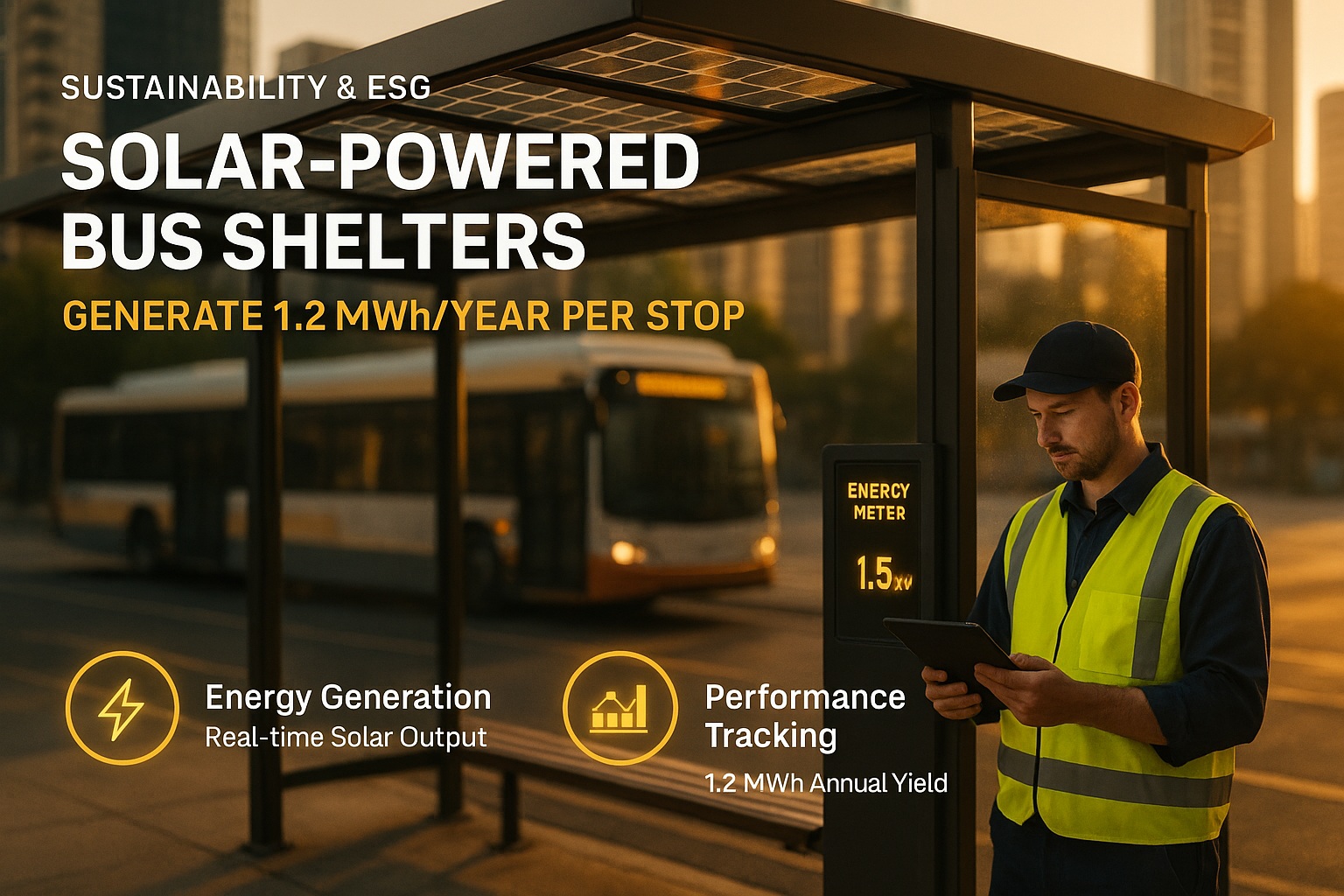
How much does a solar bus shelter actually cost? Prices range from $800 for a basic solar lighting kit to $45,000 for a premium smart shelter with digital advertising displays. This guide breaks down every cost component, compares solar vs. grid-connected options, and shows you which federal grants can cover 80% of your project. Whether you're retrofitting one bus stop or deploying 500 solar shelters network-wide, here's what you need to budget in 2025.
How Much Does a Solar Bus Shelter Cost in 2025?
Solar bus shelter costs depend on three factors: whether you're adding solar to an existing shelter or buying a complete new structure, what features you need (lighting only vs. digital displays), and your location's solar conditions. Here's the detailed breakdown:
Complete Cost Breakdown by Configuration
Add solar lighting to an existing bus shelter or standard bus stop pole. Lowest cost option for agencies with usable existing infrastructure.
What's Included:
• 20-50W solar panel with pole/roof mount
• 12V AGM or LiFePO4 battery (3-day autonomy)
• MPPT charge controller with Bluetooth
• LED light fixture (1,000-2,200 lumens)
• Motion sensor (optional)
Installation: 30-60 minutes, no permits required
New aluminum shelter structure with integrated solar panels and LED lighting. Standard choice for new installations where grid connection isn't available.
What's Included:
• Aluminum shelter structure (8-12 ft length)
• 200-400W integrated solar panel array
• 5 kWh battery bank with enclosure
• LED lighting system (dusk-to-dawn)
• Bench seating
Installation: 4-8 hours, foundation required
Full-featured shelter with digital displays, USB charging, and connectivity. Premium option for high-traffic stops with advertising revenue potential.
What's Included:
• Premium shelter structure (stainless or aluminum)
• 800W-1.2kW bi-facial solar panels
• 10 kWh LiFePO4 battery system
• E-paper or LCD digital display
• USB charging ports + WiFi hotspot
• Real-time arrival information integration
• Security camera (optional)
Installation: 1-2 days, permits may be required
Need help calculating costs for your specific fleet?
Get personalized pricing for your transit network. Our team can help you identify the right solar shelter configuration and available grant funding for your specific locations.
Getting Started Book a DemoSolar vs. Grid-Connected Bus Shelters: Which Costs Less?
The real question isn't "how much does solar cost?" but "how does solar compare to running power lines?" For most transit agencies, solar is significantly cheaper—especially for stops more than 100 feet from existing power infrastructure.
Solar vs. Grid-Connected: True Cost Comparison
Quick Decision Guide: Solar vs. Grid
Distance to nearest power line?
Under 50 feet: Grid may be cost-competitive
50-100 feet: Solar usually wins
Over 100 feet: Solar is significantly cheaper
How many stops need lighting?
1-10 stops: Evaluate case-by-case
10-50 stops: Solar streamlines procurement
50+ stops: Solar eliminates utility coordination
What FTA Grants Cover Solar Bus Shelters?
Federal grants can cover up to 80% of solar bus shelter costs. The primary funding source is the FTA's Buses and Bus Facilities Program, but several other programs also apply. Here's what transit agencies need to know:
The primary federal funding source for bus shelter construction. Covers "bus-related facilities including technological changes or innovations." Solar infrastructure qualifies as eligible technology.
Eligible: Complete solar shelters, solar lighting retrofits, smart shelter technology
Apply: Through state DOT or as direct recipient via Grants.gov
While primarily for zero-emission buses, this program can fund supporting infrastructure including solar-powered charging stations integrated into bus shelters.
Eligible: Solar shelters with EV charging capability, supporting renewable infrastructure
Note: Requires zero-emission vehicle component
Most states pass through federal funds plus add state matching funds for transit infrastructure. Many states prioritize sustainable infrastructure projects.
Eligible: All solar shelter configurations
Example: Nevada received $4.8M specifically for solar bus stop lighting at 250 stops
Private transit operators and public-private partnerships can claim a 30% federal tax credit on solar equipment costs through 2032.
Eligible: Solar panels, batteries, charge controllers, installation labor
Note: Government agencies must use direct pay provision
Real Example: How Grants Reduce Costs
Want help identifying grant opportunities for your agency?
Access our grant tracking tools and get expert guidance on FTA Section 5339 applications. We'll help you maximize federal funding for your solar bus shelter project.
Getting Started Book a DemoHow Long Do Solar Bus Shelter Components Last?
Understanding component lifespans is essential for calculating true long-term costs. Solar bus shelters have fewer moving parts than you might expect, and most components outlast the shelter structure itself.
Component Lifespan & Replacement Costs
25-Year Maintenance Cost Projection
With AGM Batteries
5 battery replacements × $300 = $1,500
1 controller replacement = $150
Annual cleaning (25 × $100) = $2,500
Total: $4,150 over 25 years
With LiFePO4 Batteries
2 battery replacements × $1,000 = $2,000
1 controller replacement = $150
Annual cleaning (25 × $100) = $2,500
Total: $4,650 over 25 years
LiFePO4 has similar lifetime cost but fewer service visits (2 vs 5 battery swaps)
Do Solar Bus Shelters Work in Cloudy or Cold Climates?
Yes—and cities like Seattle, Portland, and Minneapolis prove it daily. Modern solar bus stop systems are engineered for worst-case conditions, not average conditions. Here's how they perform across different U.S. climates:
Seattle, WA
3.8 peak sun hours/day
✓ Works Year-Round
Requires 25-30% larger panel than Southwest installations. 5-day battery backup standard. Hundreds of solar bus shelters operating successfully.
Minneapolis, MN
4.5 peak sun hours/day
✓ Works Year-Round
Cold temperatures actually improve panel efficiency. Snow-shedding panel angle (40°+) prevents accumulation. Cold-rated LiFePO4 batteries required.
Phoenix, AZ
6.5 peak sun hours/day
✓ Works Year-Round
Excellent solar conditions. Smaller panels sufficient. Battery temperature management important in extreme summer heat (45°C+ enclosures).
Chicago, IL
4.2 peak sun hours/day
✓ Works Year-Round
Standard sizing works for most of year. Winter requires larger battery bank for extended cloudy periods. Snow clearing may be needed 2-3 times per winter.
Panel Sizing by Climate Zone
For standard bus shelter lighting (8W LED, dusk-to-dawn operation):
Planning a deployment in a challenging climate?
Get location-specific system design recommendations. Our solar experts will help you size panels and batteries correctly for your climate zone.
Getting Started Book a DemoHow to Track and Maintain Solar Bus Shelters with CMMS
Managing dozens or hundreds of solar bus stops across a transit network requires centralized tracking. CMMS (Computerized Maintenance Management System) platforms integrate with solar shelter systems to automate monitoring, schedule maintenance, and generate reports for grant compliance.
Remote Performance Monitoring
Track energy generation, battery state-of-charge, and system faults across your entire shelter network from a single dashboard. Cellular-connected controllers send data automatically—no site visits needed for routine checks.
Automated Work Orders
System generates maintenance work orders automatically when performance drops below thresholds. Battery voltage low? Panel output declining? CMMS creates the ticket and assigns the technician before problems cause outages.
Preventive Maintenance Scheduling
Schedule quarterly cleaning, annual inspections, and battery replacements based on actual usage data—not arbitrary calendars. CMMS tracks component age and condition, optimizing replacement timing.
Grant Compliance Reporting
Generate documentation for FTA and state grant requirements automatically. Track energy generation, carbon offset metrics, and maintenance history with one-click reports for funding renewals and audits.
CMMS ROI for Solar Shelter Networks
Step-by-Step: How to Buy Solar Bus Shelters
Whether you're a transit agency, municipality, or private operator, here's the procurement process for solar bus shelter projects:
Assess Your Stops
Identify which stops need lighting upgrades. Prioritize by ridership, safety concerns, and distance from existing power. Note shading obstacles and available mounting surfaces.
Choose Configuration
Retrofit kits for existing shelters ($800-$1,500)? New complete shelters ($15,000-$45,000)? Match the solution to each stop's needs and budget.
Apply for Grants
Contact your state DOT about FTA Section 5339 funding. Prepare project scope, cost estimates, and timeline. Grant applications typically take 3-6 months for approval.
Issue RFP or Direct Purchase
For large projects, issue an RFP specifying your requirements. For smaller projects, many agencies use cooperative purchasing contracts (e.g., Sourcewell, HGAC) for faster procurement.
Install and Commission
Solar lighting kits install in under an hour. Complete shelters require foundation work (4-8 hours). Commission systems and verify connectivity to your CMMS for ongoing monitoring.
Ready to Get Started?
Solar bus shelters deliver real cost savings—especially when FTA grants cover 80% of project costs. Whether you're retrofitting 10 stops with $800 lighting kits or deploying 100 smart shelters, the economics work. Use CMMS to track performance, automate maintenance, and document grant compliance from day one.
Frequently Asked Questions
How much does a solar bus shelter cost in 2025?
Solar bus shelter costs range from $800 for basic lighting retrofit kits to $45,000 for premium smart shelters with digital advertising displays. Basic solar lighting kits cost $800-$1,500. Complete solar shelter structures run $15,000-$25,000. Mid-range smart shelters with digital signage cost $25,000-$35,000. Premium shelters with advertising and WiFi cost $35,000-$45,000.
Is solar cheaper than grid-connected bus shelter lighting?
Yes, in most cases. Grid connection requires trenching ($50-$150 per foot), electrical permits ($200-$500), utility connection fees ($500-$2,000), and ongoing electricity bills ($15-$30/month). For bus stops more than 100 feet from power lines, solar saves $5,000-$15,000 in installation costs alone. Over 10 years, solar typically costs 70-80% less than grid-connected options.
What federal grants cover solar bus shelters?
The FTA Buses and Bus Facilities Program (Section 5339) covers bus shelter construction including solar infrastructure at 80% federal share. The Low-No Emission Vehicle Program offers 85% funding for shelters with EV charging integration. State DOT programs, utility rebates, and the federal Investment Tax Credit (30%) can reduce costs further.
How long do solar bus shelter batteries last?
Battery lifespan depends on type. Lead-acid AGM batteries last 3-5 years and cost $200-$400 to replace. Lithium iron phosphate (LiFePO4) batteries last 10-15 years and cost $800-$1,500. Most manufacturers recommend LiFePO4 for lower lifetime cost despite higher upfront investment—you'll replace batteries 2 times vs. 5 times over 25 years.
Do solar bus shelters work in Seattle or other cloudy cities?
Yes. Modern solar bus stop systems include 3-5 days of battery backup for extended cloudy periods. Systems are sized using 30 years of local weather data to ensure year-round operation. Seattle, Portland, Minneapolis, and other cloudy/cold cities operate hundreds of solar bus shelters successfully. Cloudy climates require 25-30% larger panels than sunny locations.
Can I add solar to an existing bus shelter?
Yes. Solar retrofit kits ($800-$2,500) mount to existing shelter structures or standard 2x2 bus stop sign poles. Kits include solar panel, battery, charge controller, and LED light fixture with all mounting hardware. Installation takes 30-60 minutes and typically requires no electrical permits since systems use low-voltage DC power.
What maintenance do solar bus shelters require?
Minimal maintenance: quarterly panel cleaning ($25-$50 per visit), annual electrical inspection ($75-$150), and battery replacement every 3-15 years depending on battery type. Total annual maintenance averages $150-$300 per shelter. CMMS platforms can automate scheduling and track component lifecycles to optimize maintenance timing.
How long does solar bus shelter installation take?
Solar lighting kit installation on existing shelters takes 30-60 minutes with basic hand tools. Complete new solar shelter installation requires 4-8 hours including foundation work. Compare this to grid-connected shelters which require 2-4 weeks for electrical permits, trenching, and utility coordination. Solar's fast installation reduces labor costs significantly.