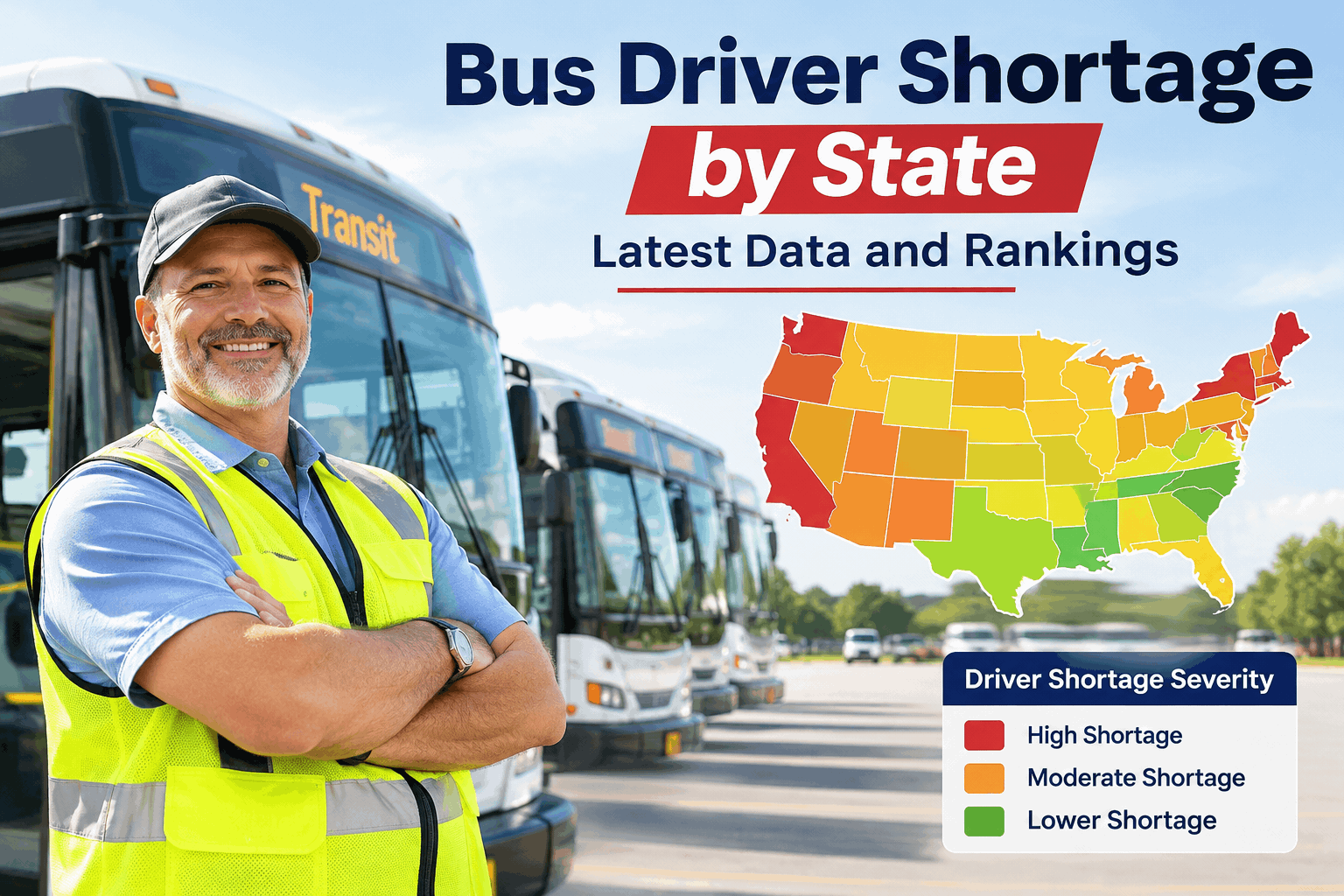
Monday morning, three routes have no driver, and a dispatcher is begging office staff to take a wheel. You are not imagining that some states have it worse than others. The bus driver shortage by state varies widely, but the national picture is stark: tens of thousands fewer drivers than before the pandemic. You can book a quick demo to see how bus uptime stretches every driver you have.
Bus Driver Shortage by State: How Severe, and Why
The shortage is national but uneven. Reporting singles out states like Maine, Missouri, and Vermont as especially hard hit, while a few markets have stabilized. Underneath the map sits one hard number: the country is still running well short of its pre-pandemic driver workforce.
The national driver gap, by the numbers
Reported as especially severe
Every state has seen at least one major shortage; a few, like parts of Illinois, report the market has since stabilized.
Figures from the Economic Policy Institute and the 2025 AP-NORC and HopSkipDrive State of School Transportation study. A uniform 50-state severity ranking is not consistently published; treat state callouts as reported standouts, not a full ladder.
The Driver Workforce Still Hasn't Recovered
This is not a bad hiring season. The driver workforce shrank sharply around the pandemic and has only barely started to climb back. Even with recent gains, the country is still well below where it stood in 2019, which is why the pressure feels permanent rather than temporary.
School bus driver workforce vs 2019 baseline (indexed, illustrative)
Shape reflects EPI reporting: roughly a 15 percent drop by 2023 and a partial recovery leaving about 9.5 percent fewer drivers than 2019 as of August 2025. Indexed for illustration.
What Makes the Shortage Worse in Some States
The same national forces hit every state, but local conditions decide how hard. These are the levers that separate a stabilized market from one cutting routes.
Swipe sideways to see all columns.
Most of these are hiring and policy levers outside a maintenance shop's control. But there is one response fully in a fleet's hands, and it gets more valuable the fewer drivers you have. You can start on it free.
When Drivers Are Scarce, Every Bus Has to Run
Here is the connection most workforce coverage misses. A driver shortage makes every available bus and driver more precious, so a bus pulled off the road by a preventable breakdown is not just a repair, it is a route you cannot cover with a driver you do not have. Reliability becomes a staffing strategy.
A bus breaks down on a route
With spares thin, a down bus means scrambling or canceling a run.
Its driver is now idle too
A scarce, trained driver sits waiting instead of covering students.
Another route gets cut
The shortage that forced route cuts just got one worse, avoidably.
Reliability protects coverage
Preventive maintenance keeps buses up so every driver you have stays productive.
You cannot hire your way out of the shortage overnight, but you can make sure a mechanical failure never compounds it. Keeping buses road-ready is the one lever a fleet fully controls, and a platform demo shows how it maximizes uptime.
Your Shortage-Resilience Checklist
You cannot fix the labor market, but you can harden your operation against it. CRITICAL items protect routes now; PLAN items ease the squeeze over time.
- CRITICALMaximize bus availability. Keep every bus road-ready so a breakdown never idles a scarce driver.A down bus wastes the one driver who was ready to work.
- CRITICALProtect your spare ratio. Guard enough working spares to cover a breakdown without canceling a run.Thin spares plus a down bus equals a cut route.
- CRITICALClose defects fast. Turn a flagged inspection into a repair quickly so buses return to service sooner.Every day a bus waits is a day a driver cannot run it.
- PLANRight-size routes to your real workforce. Plan coverage around the drivers you have, not the ones you wish you had.Honest route planning beats last-minute cancellations.
- PLANSupport driver retention with better conditions. Reliable equipment and a manageable workload help keep the drivers you have.A driver stuck with a problem bus is a driver thinking of leaving.
- PLANTrack availability as a core metric. Watch fleet uptime and mean time to repair as closely as your driver count.Uptime is the half of the coverage equation you fully control.
Loaded into BusCMMS, availability becomes a number you manage, with PM and defect tracking that keep buses working for the drivers you have. You can see it in a demo.
Stretch a Thin Workforce With Reliable Buses
BusCMMS does not recruit drivers or set their pay, the real fixes for a labor shortage. What it does is make sure the fleet never makes the shortage worse. By keeping buses on preventive schedules and turning defects into fast repairs, it protects availability, so the limited drivers you have are never sidelined by a bus that could have been kept running.
Maximize availability
Preventive maintenance keeps buses road-ready so no driver sits idle.
Quick defect-to-repair
Flagged problems become work orders fast, returning buses to service sooner.
Protect the spare ratio
Healthier buses mean real spares are there when a breakdown hits.
Availability you can manage
Track uptime and repair speed as the coverage levers you control.
"We are short drivers like everyone, so the last thing we can afford is a bus down for something we could have caught. Once we tightened our PM and started closing defects fast, our available buses went up, and that bought back the routes a breakdown used to cost us."
Transportation director, rural school district fleet (52 buses)
What to Remember About the Driver Shortage
- 1It is national but uneven. States like Maine, Missouri, and Vermont are hit hardest, while a few markets have stabilized.
- 2The gap is structural. Still roughly 9.5 percent below 2019, the workforce has only barely begun to recover.
- 3Pay and conditions drive it. Low pay, competing wages, rural geography, and the split shift decide local severity.
- 4Reliability is your lever. Keeping buses up so every scarce driver stays productive is the part a fleet fully controls.
The driver shortage is a labor problem you cannot solve from the shop, but you can refuse to make it worse. Where you operate sets how hard it hits; how you maintain your buses decides whether a breakdown turns a staffing squeeze into a cut route. Protect availability, and every driver you have goes further. You can see how in a demo.
Bus Driver Shortage FAQs
Which states have the worst bus driver shortages?
Recent reporting singles out Maine, Missouri, and Vermont as especially hard hit, with districts cutting routes to cope. Every state has seen at least one major shortage, though a few local markets report the situation has stabilized.
How bad is the bus driver shortage nationally?
As of August 2025 there were about 21,200 fewer school bus drivers than in 2019, a 9.5 percent decline per the Economic Policy Institute. In a 2025 AP-NORC survey, 81 percent of administrators called it a problem in their district.
Why is there a school bus driver shortage?
Among shortage-hit districts, most cite driver pay and difficulty recruiting. Competing warehouse and delivery wages, rural geography, the split-shift schedule, and an aging workforce hit hardest in 2020 all add to it.
What can a fleet do if it cannot hire more drivers?
Protect the drivers you have by maximizing bus availability. A breakdown that idles a scarce driver or cuts a route makes the shortage worse, so preventive maintenance and fast defect repair are a real coverage strategy.
How does maintenance software help with a driver shortage?
It keeps buses road-ready and turns defects into fast repairs, so your limited drivers are never sidelined by a down bus. Protecting fleet availability is the half of the coverage equation a fleet fully controls.