arizona-bus-fleet-dot-inspection-pass-rate-buscmms

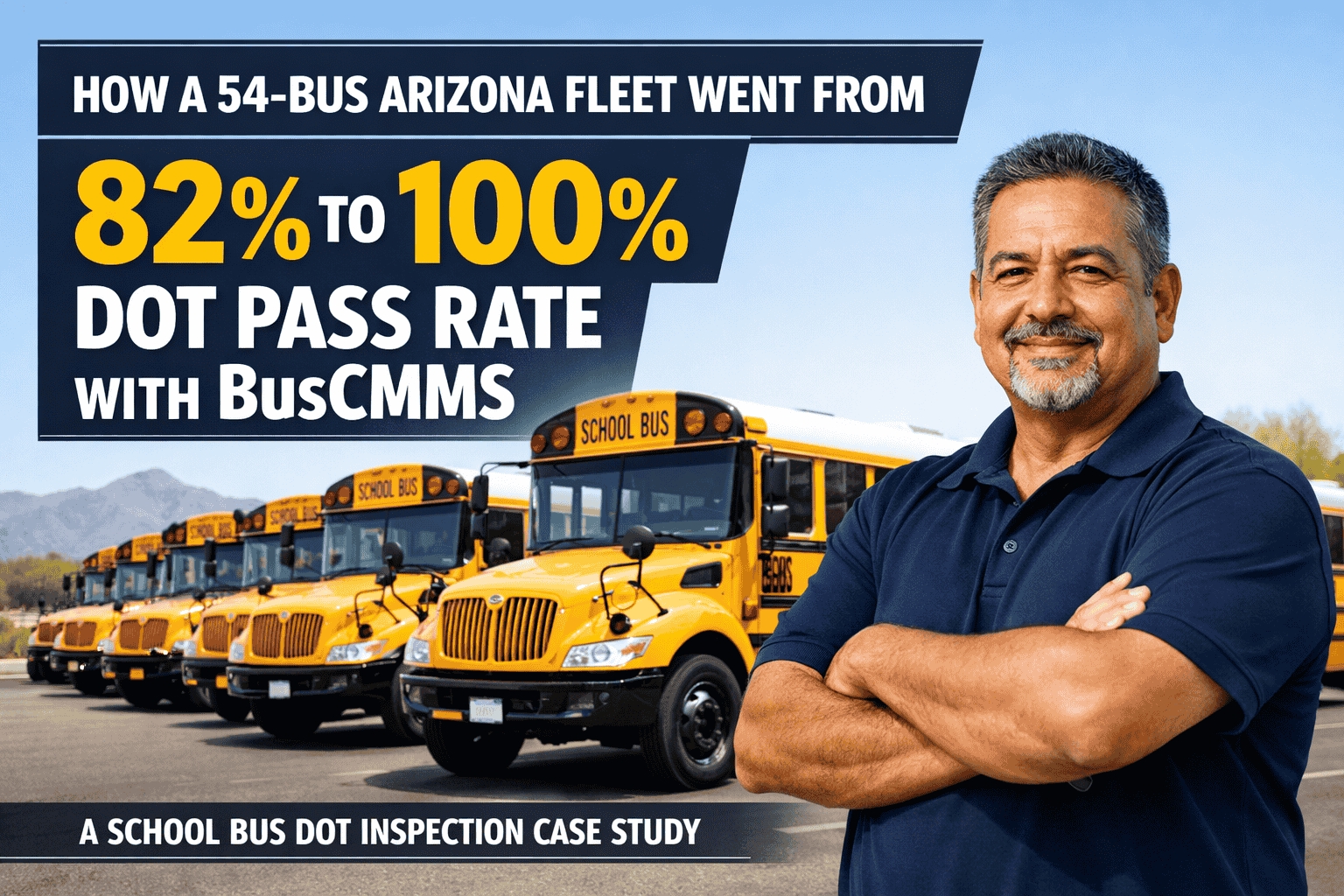
How a 54-Bus Arizona Fleet Went From 82% to 100% DOT Pass Rate With BusCMMS


James Rodriguez had a problem. As Safety Coordinator for a 54-bus school district fleet in Arizona, he was watching nearly 1 in 5 buses fail DOT inspections — costing the district thousands in emergency repairs, substitute transportation and compliance headaches. Six months later, every single bus passed. Here is exactly what changed.

Case Study

How a 54-Bus Arizona Fleet Went From 82% to 100% DOT Pass Rate With BusCMMS

A preventive maintenance & digital inspection case study

100% Pass Rate
54 Buses
6 Months
82%
100%
DOT Pass Rate
6–8
0–1
Breakdowns / Month
~60%
100%
DVIR Completion

Client Profile

OrganizationPublic School District — Arizona
Fleet Size54 school buses (mixed ages, diesel)
Key ContactJames Rodriguez, Safety Coordinator
Students Served3,000+ daily riders
Maintenance Staff4 technicians, 1 shop supervisor
Previous SystemPaper DVIRs, Excel, filing cabinets

The Challenge

The fleet was operating at an 82% DOT inspection pass rate — roughly 10 buses out of 54 failing every cycle. Each failure triggered cascading costs far beyond the repair itself.

$4,200+
Average cost per out-of-service event (repair + downtime + substitute transport)
~$42K
Estimated annual cost of 10 failed inspections per cycle
Weeks
Delay between a driver reporting a defect and the shop completing repair
"We were always playing catch-up. A driver would note a brake issue on a paper form, and by the time it reached the shop, that bus had been running routes for a week. We didn't have a system — we had a filing cabinet."
— James Rodriguez, Safety Coordinator

Root Cause Analysis

A review of inspection history revealed three systemic breakdowns — patterns common across school districts nationwide.

01

Missed Preventive Maintenance Intervals

Without mileage-triggered reminders, PM-A services were skipped on high-mileage buses. Components that should have been caught at 5,000 miles weren't found until the annual inspection — when they'd already become violations.
02

Broken DVIR Follow-Through Chain

Drivers completed paper DVIRs, but the defect → repair → sign-off chain was broken. Forms sat in trays for days. The documentation chain auditors check had gaps everywhere.
03

No Pre-Inspection Self-Audits

Buses entered DOT inspections without being pre-checked against the same criteria inspectors use. A $50 light bulb that could've been replaced in the morning became a $4,200 out-of-service event.

The Solution

The fleet didn't hire more mechanics or buy new buses. They replaced a broken manual process with BusCMMS — deployed across all 54 buses with three core modules.

Digital DVIRs

Mobile inspections with instant defect routing. Defects auto-create work orders and route to the shop immediately.

Mileage-Based PM

PM-A, PM-B, and PM-C intervals auto-triggered by actual odometer readings. Work orders generate before service is due.

Compliance Tracking

Annual inspections, 90-day emergency exit checks, DVIR retention — all auto-scheduled with alerts. Audit-ready records one click away.

Implementation Timeline

Week 1–2

Digital DVIRs + Instant Defect Routing

Paper forms replaced with mobile inspections. Defects auto-create work orders and route to the shop in real time.
Week 3–4

Mileage-Based PM Scheduling

PM-A (5K mi), PM-B (15K mi), and PM-C (30K mi) intervals configured for every bus. Triggered by actual mileage.
Week 5–8

Pre-Inspection Self-Audits

Built-in pre-inspection checklist catches defects before inspectors do. Pass rate jumped from 82% to 94% in this phase alone.
Month 3–6

Full Compliance Automation

All inspection intervals auto-scheduled with alerts. Every document one click away at audit time. Pass rate reached 100%.
Your Fleet Can Follow the Same Playbook
We'll configure the exact setup for your fleet: digital DVIRs, PM scheduling, pre-inspection checklists, and compliance tracking — ready in days.

The Results

Measured across 6 months from deployment to second full DOT inspection cycle.

MetricBeforeAfter 6 Months
DOT Pass Rate82%100%
Emergency Breakdowns / Mo6–80–1
DVIR Completion Rate~60% (paper)100% (digital)
Defect-to-Repair Time3–10 daysSame day
PM Compliance Rate~55%100%
Audit ReadinessWeeks of prepAlways ready

Testimonial

"We went from 82% DOT inspection pass rate to 100% in 6 months after switching to digital inspections. BusCMMS flags defects before they become violations."
James Rodriguez
Safety Coordinator, 54-Bus Fleet, Arizona

Key Takeaways

01
Fleets maintaining 80%+ preventive maintenance ratios see 85% fewer breakdowns and consistently pass DOT inspections first time.
02
Preventing 10 failures per cycle saves over $42,000 annually — well above the cost of a digital CMMS platform.
03
Digital DVIRs with instant defect routing closed the defect-to-repair gap from days to hours — the single highest-impact change.
04
Pre-inspection self-audits using the same DOT checklist caught 90% of would-be failures internally before the inspector arrived.
Get the Same Results — Book Your Demo
We'll configure BusCMMS for your fleet and show you the exact workflow that took this fleet from 82% to 100%. No obligation. Results in 90 days.

Frequently Asked Questions

How quickly can we see DOT pass rate improvements?
Most fleets see measurable improvement within 60–90 days. The Arizona fleet jumped from 82% to 94% in the first 8 weeks and reached 100% by month 6. The first gains come from digital DVIRs and pre-inspection self-audits.
What size fleet does BusCMMS work for?
Any size — from 10-bus rural districts to 500+ bus urban operations. Smaller fleets often see faster ROI because one prevented out-of-service event has a bigger impact on tight budgets. Sign up free and try it with your fleet.
What were the most common inspection failures?
Brake defects (#1 nationally at 24% of violations), lighting failures, tire issues, and incomplete documentation. The documentation gap — missing DVIRs, broken repair chains — accounted for nearly half of failures and was eliminated entirely by digital tracking.
How much does a failed DOT inspection cost?
$4,200+ per event including repair, substitute transport, admin time, and route disruption. FMCSA fines can reach $23,048 per out-of-service order violation. For a fleet failing 10 per cycle, that's $42,000+ in avoidable annual costs.
Do drivers need training for digital DVIRs?
Minimal — most complete their first digital DVIR in under 5 minutes. The guided mobile interface is faster than paper forms. Book a demo and see the driver experience live.


Share This Story, Choose Your Platform!