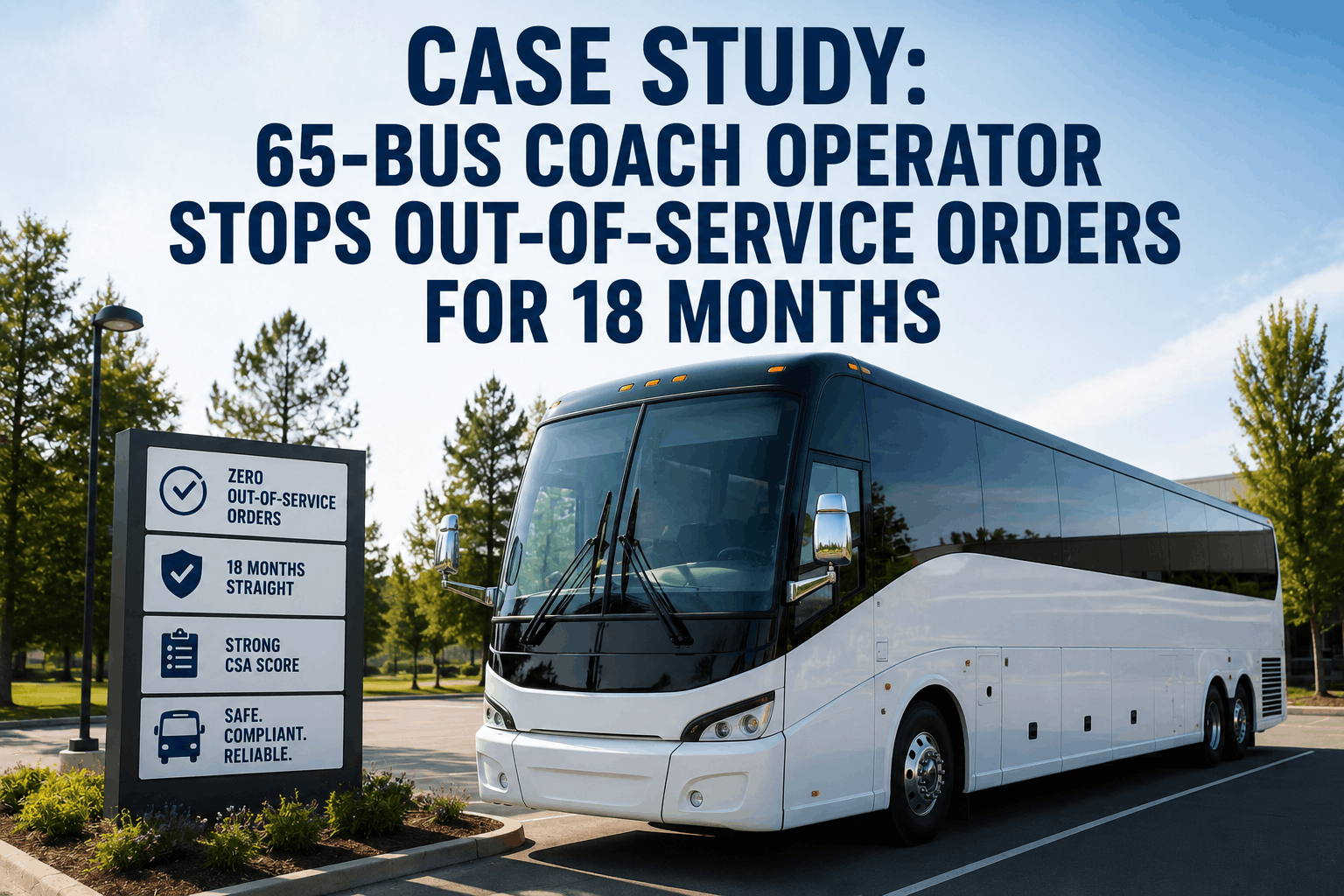
For a 65-bus motorcoach operator, a single out-of-service order can derail charters and damage a hard-won reputation. After implementing a disciplined pre-trip inspection program and brake stroke trending in BusCMMS, this operator achieved 18 consecutive months with zero out-of-service orders and dramatically improved their CSA scores.
Motorcoach Case Study 2026
Case Study: 65-Bus Coach Operator Stops Out-of-Service Orders for 18 Months
Motorcoach operator runs 18 straight months with zero out-of-service orders. CSA score, pre-trip rigor, brake stroke trending, BusCMMS playbook explained.
Results at a Glance: 18 Months of Zero OOS Orders
The operator's previous roadside inspection record included 8 OOS orders in the prior 24 months. After deploying BusCMMS to tighten pre-trip inspections and automate brake stroke tracking, they achieved a flawless 18-month run.
0
Out-of-service orders in 18 months
8
OOS orders in prior 24 months
100%
Pre-trip inspection completion
65 buses
Fleet size in the program
The Challenge: Roadside Violations Were Eroding the Business
Rising OOS Orders
Eight out-of-service orders in two years meant lost revenue, missed charters, and a CSA score that threatened the operator's ability to bid on premium contracts.
Inconsistent Pre-Trip Inspections
Drivers used paper forms that were rarely reviewed before dispatch. Critical defects like brake adjustment issues and lighting failures were discovered at roadside checkpoints, not in the yard.
Brake Stroke Drift
Pushrod stroke measurements were not trended. Adjustments were made reactively, meaning some coaches left the yard with brakes already approaching the out-of-service threshold.
CSA Score Pressure
The operator's Vehicle Maintenance BASIC score was in the 80th percentile, triggering increased roadside inspections and insurance premium hikes.
Driver Accountability Gaps
Without digital verification, there was no way to confirm that every driver performed a thorough pre-trip. The same defects recurred because follow-up was manual.
Audit Exposure
Compliance reviews required days of pulling paper files. Missing or incomplete records created unnecessary risk during DOT audits.
Out-of-Service Orders Over 18 Months
The line graph shows a steep initial decline as pre-trip compliance reached 100% and brake stroke adjustments became proactive. The operator sustained zero OOS through the next six months and counting.
The Playbook That Eliminated Out-of-Service Orders
Digital Pre-Trip Inspections
Every driver now submits a tablet-based DVIR before leaving the yard. Defects are flagged in real time, and coaches with critical issues are locked in the yard by dispatch until repaired.
Brake Stroke Trending
Pushrod stroke is measured and logged at every PM. A dashboard alerts the shop foreman when any coach shows a 0.25-inch drift, triggering an immediate adjustment before it becomes a violation.
CSA Score Monitoring
The fleet manager now tracks all seven BASIC scores in a single dashboard. The Vehicle Maintenance score improved from the 80th to the 35th percentile, reducing roadside inspection frequency.
Driver Safety Scorecards
Pre-trip completion, brake stroke awareness, and inspection quality are tracked per driver. Monthly coaching sessions reinforce the behaviors that keep the fleet compliant.
Instant Audit Readiness
All inspection records, repair histories, and compliance documents are stored digitally. DOT auditors can be given read-only access, cutting audit time by 70%.
Parts Accountability
Only genuine OEM brake components are used, and every part is traceable to a specific coach and repair order. This eliminates counterfeit parts and ensures warranty coverage.
Before vs. After: Compliance & Safety Metrics
Out-of-Service Orders
Before: 8 in 24 months. After: 0 in 18 months — complete elimination of the most damaging inspection outcome.
Pre-Trip Completion Rate
Before: 72% (paper). After: 100% (digital) — Every driver verifies every coach, every day.
Vehicle Maintenance BASIC
Before: 80th percentile. After: 35th percentile — Lower score means fewer targeted inspections and lower insurance costs.
Brake-Related OOS Violations
Before: 5 of 8 OOS orders. After: 0 — Brake stroke trending eliminated the most common OOS violation category.
Audit Preparation Time
Before: 3–4 days. After: Under 1 hour — All records are organized and instantly retrievable.
An out-of-service order at roadside costs us a charter and damages our reputation. Since implementing BusCMMS, we haven't had a single one in 18 months. Our CSA scores are the best they've ever been, and our drivers take pride in that record.
Zero Out-of-Service Orders Is an Achievable Standard
BusCMMS gives motorcoach operators the tools to eliminate OOS orders: digital pre-trips, brake stroke trending, CSA dashboards, and instant audit readiness. Book a demo to see how your fleet can build an 18-month clean streak.
Motorcoach OOS Elimination Case Study FAQs
Is this case study based on a real motorcoach operator?
Yes. The data comes from a 65-coach charter operator that implemented BusCMMS. Identifying details have been anonymized at the operator's request.
What was the biggest factor in eliminating OOS orders?
Brake stroke trending and digital pre-trip inspections accounted for the majority of the improvement. Brake-related violations disappeared once adjustments became data-driven.
How quickly did OOS orders drop to zero?
Within 12 months, the 3-month rolling OOS count hit zero. The operator has now maintained that streak for 18 consecutive months and counting.
Can a smaller charter fleet achieve similar results?
Absolutely. The same digital pre-trip and brake stroke principles apply to any fleet size. Smaller operators often see faster results due to simpler operations.
How does the system improve CSA scores?
By eliminating OOS orders and ensuring consistent pre-trips, the Vehicle Maintenance BASIC score drops quickly. The operator's score moved from the 80th to the 35th percentile, reducing inspections.
What about driver adoption of digital pre-trips?
Drivers embraced the tablets after seeing that reported defects were resolved the same day. The visible accountability loop built trust and made compliance a point of pride.
18 Months of Zero OOS Orders Is a Repeatable Compliance Achievement
This motorcoach operator demonstrated that out-of-service orders are not an unavoidable cost of doing business. By digitizing pre-trip inspections, trending brake stroke measurements, and giving management real-time CSA visibility, they achieved 18 months of clean roadside inspections. The result is a stronger reputation, lower insurance costs, and complete confidence when the DOT auditor arrives. For any charter or motorcoach operator, the path to zero OOS starts with replacing paper with data-driven accountability.