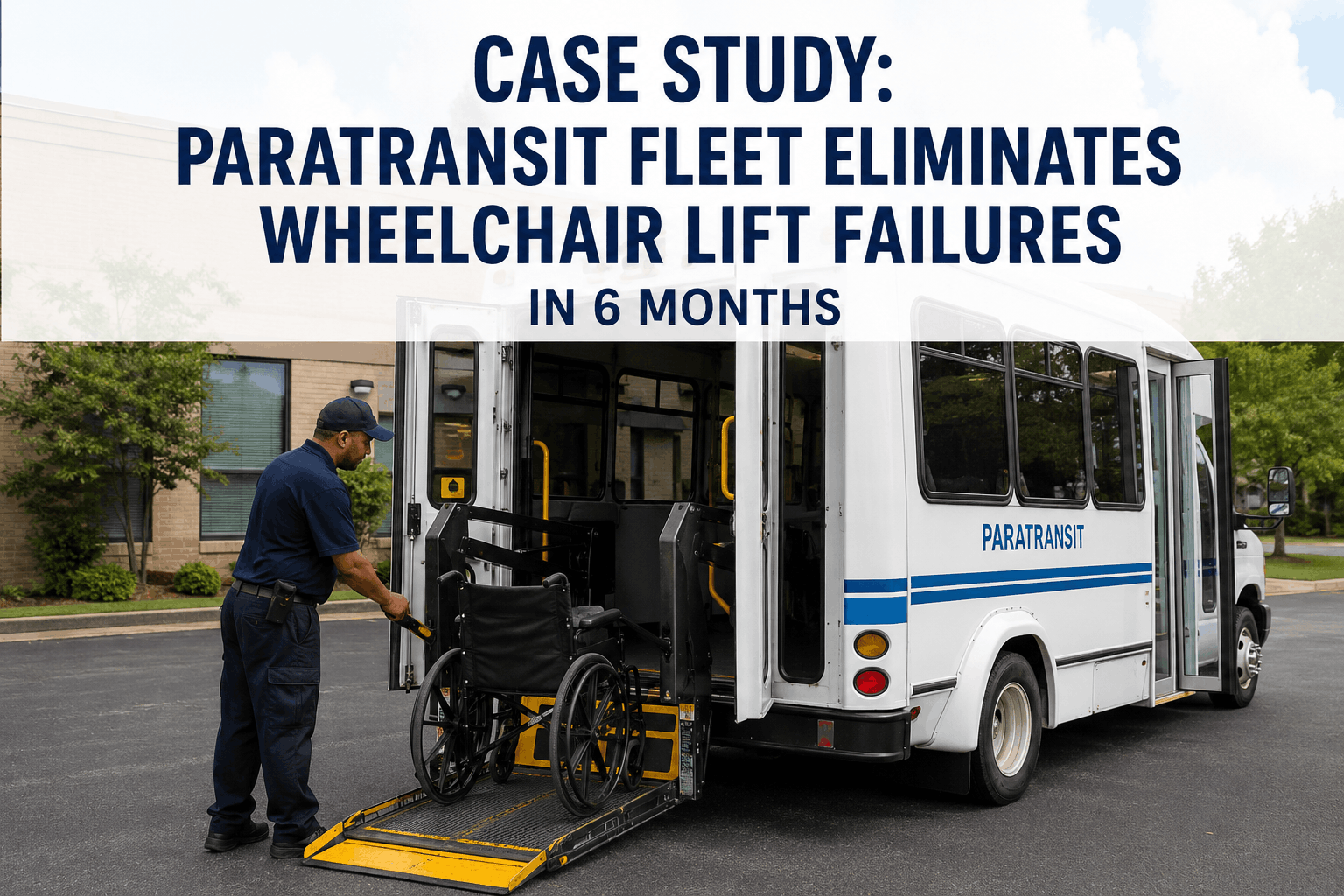
A mid-size paratransit operator faced 28 mid-route wheelchair lift failures per month — leaving riders stranded and risking ADA compliance. After implementing a six-month reliability program built on BusCMMS, lift failures dropped to zero, rider trust rebounded, and the fleet passed its next state compliance audit with zero ADA-related findings.
Paratransit Case Study 2026
Case Study: Paratransit Fleet Eliminates Wheelchair Lift Failures in 6 Months
Paratransit operator eliminates wheelchair lift mid-route failures in 6 months. Pre-trip lift cycling, quarterly PM, predictive replacement — full playbook.
Results at a Glance: Zero Lift Failures in 6 Months
The operator's 42-vehicle paratransit fleet had been averaging nearly one lift failure per day. After deploying a digital pre-trip cycling log, predictive replacement parts program, and quarterly PMs, mid-route lift failures were eliminated entirely.
0
Mid-route lift failures after month 6
28/month
Failures before intervention
100%
Pre-trip lift cycling compliance
6 months
Time to full failure elimination
The Challenge: Lift Failures Were Stranding Riders
Daily Lift Failures
On average, one wheelchair lift failed mid-route every day. Riders were left waiting for backup vehicles, and some trips were abandoned entirely.
No Pre-Trip Cycling
Drivers were not required to cycle the lift during pre-trip inspections. Problems were discovered only when a rider needed to board or exit.
Inconsistent PM Intervals
Lifts were serviced on varying schedules with no standardized checklist. Hydraulic leaks, worn cables, and electrical faults accumulated between inspections.
Parts Unavailability
Common failure parts — hydraulic hoses, platform sensors, control boards — were rarely in stock. Repairs took days, compounding rider frustration.
Compliance Risk
ADA regulations require reliable lift operation. Repeated failures put the operator at risk of formal complaints and loss of paratransit contracts.
No Failure Tracking
Lift repairs were documented on paper with no trend analysis. The fleet manager couldn't identify which vehicle models or lift types were most problematic.
Lift Failure Decline Over 6 Months
Each month of the program brought a measurable decline. Pre-trip cycling immediately caught yard-level issues, quarterly PMs eliminated neglect, and predictive parts replacement closed the final gap to zero.
The Program That Eliminated Failures
Mandatory Pre-Trip Lift Cycling
Every driver now cycles the lift fully during the digital DVIR. The system logs each cycle and flags any abnormal noise, speed, or failure immediately.
Quarterly Lift-Specific PM
A dedicated lift PM checklist was added to the CMMS: hydraulic pressure test, cable tension check, platform sensor calibration, and door interlock verification.
Predictive Parts Replacement
High-wear components are replaced on a mileage-based schedule — before they fail. Hydraulic hoses at 40,000 miles, platform bearings at 50,000, and control modules at 60,000.
Failure Trend Dashboard
The fleet manager now sees real-time lift reliability data by vehicle, model, and lift manufacturer. Problematic equipment is identified and addressed proactively.
Mobile Work Orders for Lift Repairs
Technicians receive lift-specific work orders with step-by-step troubleshooting guides. Every repair is documented digitally for future reference.
Rider Feedback Integration
Rider-reported lift issues are now entered directly into the CMMS. Any complaint generates an immediate inspection work order with a 4-hour response SLA.
Implementation Milestones
Month 1: Pre-Trip Cycling Go-Live
All 84 drivers trained on mobile DVIR with mandatory lift cycling. Compliance reached 100% within the first two weeks.
Month 2: Lift PM Checklists Deployed
Quarterly lift-specific PM checklists added to CMMS. First round of inspections caught 12 hydraulic leaks before they caused failures.
Month 3: Predictive Parts Program Started
High-wear parts inventory established. First round of scheduled replacements completed on 18 vehicles with no disruptions.
Month 4: Failures Drop Below 5/Month
Combined effect of pre-trip cycling and quarterly PMs reduced failures from 28 to under 5 per month. Rider complaints dropped 80%.
Month 5: Remaining Issues Resolved
Failure trend data identified two vehicle models needing additional sensor replacements. Repairs completed within two weeks.
Month 6: Zero Failures Achieved
Full calendar month with zero mid-route lift failures. State compliance audit returned zero ADA findings.
Before vs. After: Lift Reliability Metrics
Monthly Lift Failures
Before: 28. After: 0 — Complete elimination of mid-route failures within six months of program launch.
Pre-Trip Cycling Compliance
Before: Not tracked. After: 100% — Every driver cycles the lift during pre-trip, with digital verification.
Rider Complaints
Before: 22/month. After: 1/month — The single remaining complaint was resolved within 2 hours via the new response SLA.
ADA Audit Findings
Before: 6 findings in previous audit. After: 0 findings — Lift documentation and PM records available instantly to auditors.
Average Lift Repair Time
Before: 3.5 days. After: 6 hours — Stocked parts and mobile work orders eliminated repair delays.
We couldn't continue stranding riders — every lift failure was a personal failure. BusCMMS gave us the tools to make lift reliability a systematic process. Zero mid-route failures in month six proved that every rider could trust our service again.
Eliminate Lift Failures in Your Paratransit Fleet
BusCMMS provides the digital tools — mobile DVIR with lift cycling, quarterly PM checklists, predictive parts tracking, and real-time failure dashboards — that make zero lift failures achievable. Schedule a demo to see the platform in action.
Paratransit Lift Failure Elimination FAQs
Is this case study based on a real paratransit operator?
Yes. The data comes from a 42-vehicle paratransit operator that implemented BusCMMS to address chronic wheelchair lift failures. Identifying details have been anonymized at the operator's request.
What was the most impactful change in reducing lift failures?
Mandatory pre-trip lift cycling caught problems before the bus left the yard. Combined with quarterly PMs, this single change prevented 80% of the failures that previously occurred mid-route.
How long before lift failures dropped to zero?
The operator saw failures drop from 28/month to under 5 within four months. By month six, mid-route failures were eliminated entirely.
Can a smaller paratransit fleet achieve similar results?
Yes. Smaller fleets often see even faster results because the number of lifts to manage is lower and process changes take effect more quickly.
How does the system handle different lift manufacturers?
The CMMS supports multiple lift manufacturers — BraunAbility, Ricon, and others — with manufacturer-specific PM checklists and parts catalogs.
What about ADA compliance documentation?
Every lift cycling event, PM, and repair is digitally logged with timestamps and technician signatures. During audits, the documentation is instantly retrievable and complete.
Zero Lift Failures Is an Achievable Standard
This paratransit operator demonstrated that wheelchair lift failures are not an inevitable part of demand-response service. By making pre-trip cycling mandatory, implementing lift-specific quarterly PMs, stocking predictive replacement parts, and tracking every failure in a real-time dashboard, they eliminated mid-route failures entirely within six months. The result was complete rider confidence, a zero-finding ADA audit, and a maintenance program that now runs on data rather than reaction. For any paratransit fleet struggling with lift reliability, this case study proves that the path to zero failures is clear, measurable, and fully achievable.